Migration as a household investment and why finance arrives too late
 by Alvina Zafar and Bijoy Bhowmick
 Jun 2, 2026
 5 min
5 min


Migration is one of the largest investments that Tangail households make. Yet, financial services often arrive after remittances begin. Families spend years assembling savings and loans before departure, bearing great risks. Earlier financial support can transform migration into a secure pathway to resilience.
Households in Bangladesh with family members working abroad celebrate remittances as a lifeline with profound economic and social significance. They spend months or even years assembling the resources needed to send earners overseas and must wait for the first remittance to arrive. In communities that send migrants, such as Tangail, families gradually scrape together savings and loans to finance recruitment costs, travel, and documentation.
One BURO member described how she liquidated a savings account she had built for more than 17 years to finance her son’s migration to Saudi Arabia. She chose savings rather than a loan because loan repayment begins immediately, while income from migration can take time to stabilize.

Among BURO clients in Tangail, the decision to send someone abroad is often discussed as part of a broader household strategy. Migration offers the potential for higher income, but it also involves substantial uncertainty. The financial decision comes with an emotional cost. During fieldwork, we met many women whose husbands or sons could only return home once every two or even three years. Families are forced to navigate long periods of separation alongside the financial risks migration entails.
Families must assemble significant funds before departure to cover recruitment fees, travel costs, and documentation. The World Bank’s Migration and Development Brief estimates that remittance inflows to Bangladesh totaled around USD 23 billion in 2024. Yet behind these national figures lie thousands of household decisions about whether migration is financially possible and how the risks will be managed.
These decisions are rarely individual. In households, family members weigh risks and potential returns together. Savings frequently play a central role in these discussions, as households gradually accumulate funds that can support migration expenses or reduce reliance on borrowing.
Field observations among BURO members in Tangail suggest that households rarely rely on a single financial source to fund migration. Instead, families assemble resources through a layered approach. Savings accumulated over many years often form the foundation. Long-term deposits allow households to gradually build capitals that can be mobilized when migration opportunities arise. These savings reduce the amount households need to borrow and provide a degree of financial flexibility during uncertain periods.
Households then layer loans on top to cover the remaining costs. For example, one BURO member described taking a loan of BDT 200,000 (USD 1,630) to support her son’s migration abroad, which is an example of how borrowing often complements existing savings rather than replacing them. Migration costs are higher than household income, so families often commit resources well before departure, without certainty about when migration income will begin.
How remittances reshape financial behavior
The flow of remittances is rarely smooth or predictable. Migrants often need time to secure stable employment, and transfers may arrive irregularly based on working conditions and payment arrangements. During this early phase, households continue to rely on savings to manage uncertainty.
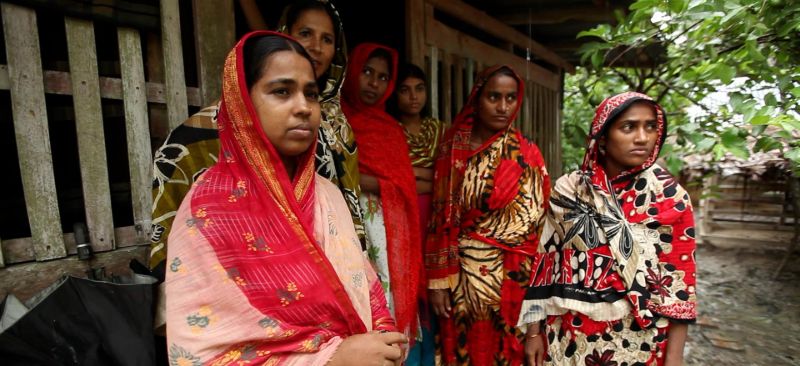
Remittances also appear to shift financial behavior within some communities. In several BURO centers in Tangail, staff observed that households that receive regular remittances often rely less on loans and instead accumulate savings from these transfers. In one center, 13 of 16 households had family members working overseas, and women were saving remittance income through Deposit Pension Scheme (DPS) accounts.
Field observations also showed how remittance income translated into tangible household investments over time. In these BURO centers, families used savings from remittances to purchase land, improve housing, invest in livestock, and finance vehicles, such as autorickshaws, which supported local income generation.
In one household, regular remittances of around BDT 80,000–100,000 (USD 650-815) per month enabled repayment of a housing loan worth BDT 400,000 (USD 3,261) while the family continued to save through contractual savings accounts for children’s future education and security. Because many men work abroad, women often become the household’s financial managers. They receive remittances, decide how much to save, and allocate funds for education, assets, or emergencies.
In some households, migration also becomes cyclical. Family members who migrate earlier help finance the departure of other family members to create repeat migration pathways within the same household. Cleaner guidance on investment options are required.
The timing gap in migration finance
Migration decisions expose households to multiple risks long before any income begins to flow. Families must rely on recruitment intermediaries whose costs and reliability are often uncertain, commit to savings or loans without guarantees about employment conditions, and prepare for the possibility that wages may be delayed or lower than expected after arrival. In some cases, migrants discover that jobs differ from what was promised or that living expenses abroad reduce the amount they can send home. During this period, households need to repay migration-related loans even though remittance income has not yet begun.
At this stage, wrong decisions can have significant consequences. A Business Standard report shows that workers who travel under the apparently “free visa” arrangements lost an estimated BDT 30,000 crore (USD 25 million) in 2022 alone due to inflated recruitment costs and fraudulent intermediary practices. Migration monitoring by Andy Hall has also documented cases in which Bangladeshi workers paid large recruitment fees, only to arrive overseas and find that promised jobs did not exist or wages were withheld for months. As a result, families at home struggle to repay migration-related loans without remittance income.
This creates a timing gap. Financial systems tend to engage once remittances begin to arrive, which focuses on transfers and mobilizing savings. These services are valuable, but households need support when they prepare for migration and manage the risks that make migration possible in the first place.
This gap points to an opportunity to rethink how those services support migration.
Financial risks are the highest before departure. So, households can benefit from tools that combine savings, financing, and information. Structured savings products could help families gradually accumulate migration funds, while migration-linked loans could bridge financing gaps through repayment structures aligned with migration timelines. For example, a combination of savings accumulation with short grace periods or phased repayment schedules can reduce financial strain on households before remittance income begins.
Once remittances begin, financial services can shift to help households manage these flows effectively. Flexible savings tools and advisory services can help families convert remittance income into long-term financial resilience and productive investments.
Current efforts to support migrant households

Moreover, BURO has initiated the “Remittance Management for Socioeconomic Stability of Migrant Families” initiative under the Safal program, supported by the UNCDF and the Swiss Embassy. This initiative is being implemented in selected branches in Tangail and Munshiganj. It strengthens how migrant households plan, manage, and use remittance income effectively and represents an important step toward more lifecycle-oriented engagement with migrant families.
While these efforts represent important progress, they also highlight the opportunity to expand structured financial support across the migration journey.
Designing for the realities households face
Households will continue to pursue migration with or without formal financial support. For many families, it represents a rare pathway to higher income and improved opportunities. The challenge is therefore not whether migration occurs, but how to reduce the risks surrounding it. Better financial preparation can help households avoid excessive debt, reduce exposure to fraudulent intermediaries, and manage the uncertainty that often accompanies the early stages of migration.
Migration is more than a story of labor or remittance. It is also a financial journey. Financial systems that engage before households take risks can help them prepare better and convert remittances into a secure pathway toward resilience and opportunity.

Written by

Alvina Zafar
Senior Manager
Bijoy Bhowmick
Lead, Digital Financial Services, BURO Bangladesh
Leave comments