Climate-resilient affordable housing finance: From affordable at origination to affordable over time
 by Priyam Mrig and Yogendra Kumar Bharti
 Sep 7, 2026
 6 min
6 min


This blog examines how climate change reshapes affordable housing finance in India. It spells out why affordability must extend beyond EMIs and examines climate-resilient construction, flexible financing, local risk assessment, and post-disaster support to protect borrowers, homes, and lenders’ portfolios.
Today’s changing climate alters what affordability means for borrowers, homes, and housing finance portfolios. Affordability can no longer be assessed solely by whether a borrower can afford the equated monthly installment (EMI) during origination. It must also account for the household’s ability to continue to occupy, maintain, repair, and repay the home over the life of the loan.
India’s affordable housing challenge is often assessed by the scale of housing demand addressed through homes sanctioned, constructed, or financed. While these metrics remain important, they do not fully capture whether a home will remain safe, livable, and affordable over the loan period. A home that appears affordable at origination may become increasingly expensive if the household faces higher cooling and water costs, climate-related health expenses, or repeated repairs after floods, cyclones, or extreme heat. Affordability should therefore cover the life of the home and the loan.
The urgency of this issue is evident. More than 80% of India’s population lives in districts at risk of climate-induced disasters. Rising temperatures, changing rainfall patterns, groundwater depletion, intense cyclones, and sea-level rise can affect homes and livelihoods. This creates a dual risk for affordable housing borrowers. A climate event can damage the financed property and disrupt the household’s income. This interaction between asset damage and livelihood interruption is vital for lenders that serve households with limited financial buffers.
The risks are particularly significant for economically weaker sections (EWS), lower-income groups (LIGs), and households with informal or variable incomes. Government housing programs provide important financial support, but they may not always fully cover construction costs. This can potentially leave beneficiaries with a residual financing requirement. Pradhan Mantri Awaas Yojana-Urban (PMAY-U), Pradhan Mantri Awaas Yojana-Gramin (PMAY-G), and various state-level housing schemes provide subsidies and other forms of assistance. These schemes create a potential role for complementary lending, including top-up and stage-based construction finance. However, secondary evidence suggests that access to such formal credit remains relatively limited for many beneficiaries. For instance, as noted in the Standing Committee on Housing and Urban Affairs’ analysis of PMAY-U, the average cost of an EWS house was estimated at approximately INR 0.65 million (USD 6,850) as of 2022. The center, the states, the urban local bodies (ULBs), and the beneficiary were expected to share the cost. While the central contribution is fixed on a per-unit basis, the contributions from the states and ULBs help keep the overall cost affordable for the beneficiary. The Committee observed that variations in the extent of state-level contributions could, in some cases, result in beneficiaries being required to make higher contributions. The average beneficiary contribution was estimated at around 60%, highlighting the potential need for additional financing. In this context, financial institutions can help bridge the residual financing gap through appropriately structured top-up and stage-based construction finance, particularly for households with limited access to conventional housing finance.
The International Finance Corporation (IFC) and Aavas Financiers’ market research on green affordable housing finance also found that 62% of loans for new housing from affordable housing finance companies fund This profile of small, self-built, incrementally expanded housing has important implications for climate resilience. Such homes often fall outside the reach of green-building certification and developer-led green mortgages, yet they are among the most exposed to extreme heat, flooding, and structural vulnerability. Resilience cannot arrive in this segment as a ready-made product. Households must build it feature by feature through stronger roofs, raised plinths, and better drainage during construction or improvement. Climate-responsive finance must therefore reach the household that adds a room, replaces an unsafe roof, or builds gradually on an owned plot.
The research suggests that the intersection of climate and affordable housing finance should extend beyond green mortgages for developer-built projects. Much of the demand involves self-construction, renovation, reconstruction, vertical expansion, and completion of houses stalled by funding gaps.
The relevant interventions need not always involve complex technology. Depending on local conditions, they may include cool roofs, improved shading and ventilation, rainwater harvesting, water-efficient fixtures, raised plinths, stronger drainage, flood-safe electrical systems, and improved roof anchoring. However, affordability remains a challenge. A National Housing Bank (NHB)- study estimated that green features increase residential construction costs by approximately 3.6%. Although these measures may lower utility and repair costs over time, the additional upfront expense can strain lower-income households.
The IFC and Aavas Financiers’ primary research in Jaipur and Indore reinforces this finding. Households in the affordable segment showed broad willingness to adopt green features, but around 60% cited higher upfront costs as the main barrier. Lower-income respondents would, on average, need the next tier of green features at roughly 30% lower cost before they would opt in. Awareness of green home loan products stood at just 7%, and most respondents said they would take one only if it offered interest-rate concessions or fee waivers.
Addressing these risks requires ain how affordability is defined from affordability based on loan amount to affordability based on design. A house is not truly affordable merely because its EMI fits the borrower’s present income. It must also remain affordable to occupy, maintain, and repair. Construction rarely relied on one source of finance. Households relied on a mix of savings, chit funds, gold, personal loans, informal borrowing, and housing finance. A climate event that reduces income or creates an unexpected repair, water, electricity, or healthcare expense can disturb this already delicate balance.
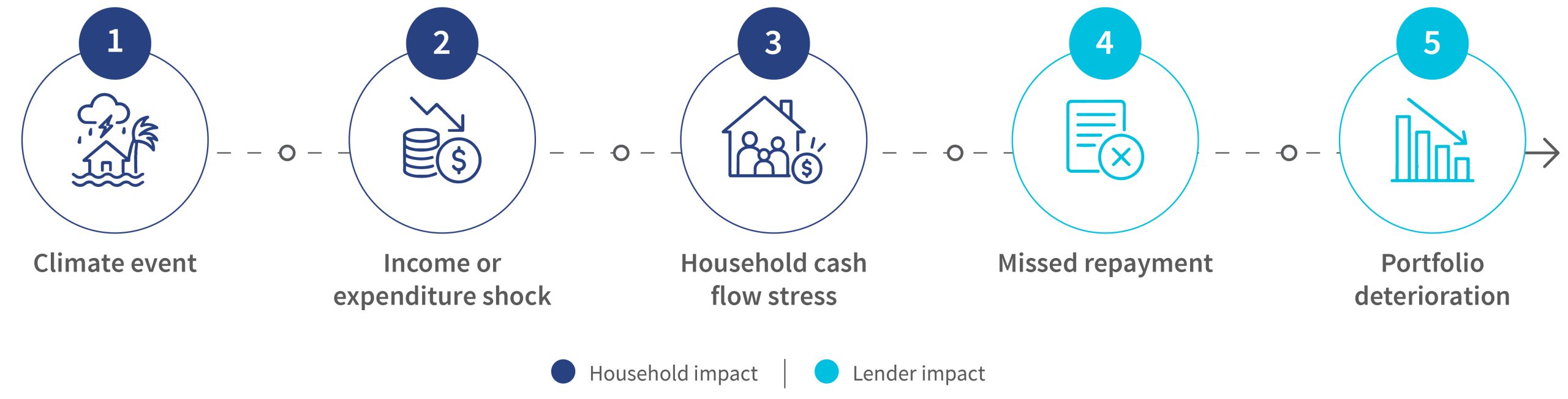
For lenders, the risk extends beyond household cash flow. A flood can damage the mortgaged property, disrupt a small business, and destroy household assets all at once. A heatwave can reduce working hours for outdoor workers while increasing cooling and healthcare expenses. The resulting chain is clear:
This distinction is relevant in a market where smaller loans are not necessarily simpler loans. India’s housing loan market stood at approximately USD 410 billion in portfolio outstanding as of FY25. It grew at around 13% annually from FY20 to FY25, with nonbanking financial companies (NBFCs) and housing finance companies (HFCs) holding roughly one-fifth of the market.
In this scenario, the affordable segment has a distinct risk profile. CRISIL estimates show that gross non-performing assets (NPAs) for affordable housing loans stand at approximately 2.6% in FY25, roughly twice the 1.2% recorded for overall housing loans. This occurred even as asset quality across retail lending improved.
This gap does not establish climate change as a cause of delinquency. It does, however, indicate that affordable-segment borrowers already operate with thinner margins for error. These borrowers are predominantly self-employed or informally salaried households that manage phased construction, mixed financing, and limited financial buffers. Climate-related shocks could intensify these underlying pressures.
The response must begin with an understanding of the local market. Affordable housing markets already differ across districts in terms of income patterns, construction practices, land documentation, housing aspirations, and repayment capacity. Climate risk introduces another layer of variation. A heat-prone district may require a different housing and finance package from a flood-exposed coastal area or a water-stressed inland market. A single national green home loan is unlikely to address these differences.
Product, underwriting, and servicing models must therefore evolve together. Construction-linked loans can include stage-based disbursement, modest top-up flexibility, and simple technical guidance. Property appraisal can consider flood history, drainage, heat exposure, water availability, and structural vulnerability alongside title, valuation, and loan-to-value ratios. The same site visits used to verify loan utilization can check whether essential resilience features are in place. Lenders can also establish predefined post-disaster protocols, including early customer communication, repair finance, and temporary repayment flexibility.
Public policy provides an entry point for this transition. Pradhan Mantri Awas Yojana-Urban (PMAY-U) 2.0 advises states and union territories to raise awareness of innovative construction technologies and materials that enhance thermal comfort, energy efficiency, disaster resilience, and cost-effectiveness. This initiative creates an opportunity to integrate simple climate-resilience checks into beneficiary-led construction, housing finance, and construction-stage monitoring.
Affordable housing finance must ultimately protect three things: the borrower’s repayment capacity, the home’s physical resilience, and the long-term quality of the lender’s portfolio. India still has an opportunity to embed climate considerations into millions of homes that are yet to be built or improved. Building climate resilience into affordable housing finance now will prove more affordable and equitable than financing homes without adequate resilience and paying for a retrofit later, after households and lenders have already absorbed the cost.

Written by

Priyam Mrig
Assistant Manager
Yogendra Kumar Bharti
Senior Manager
Leave comments