Why digital farmer services so often fail
 by Debarshi Chakraborty
 Oct 21, 2026
 6 min


Farmer-facing AI often fails because it assumes capable smartphones, affordable data, and reliable connectivity. This blog draws on evidence from India and Sub-Saharan Africa to argue that agricultural AI must match farmers’ devices, budgets, and networks, including offline and voice-based delivery.
This is the first of a two-part series on rethinking AI delivery for agriculture, based on our experience building digital farmer services (DFS).
What happens when an AI tool designed to help a farmer cannot reach them when they need it most? The answer reveals a problem that goes far beyond the technology itself. Many artificial intelligence (AI) platforms built for farmers still begin with a simple picture: a farmer with a decent smartphone, a stable connection, and cheap data.
For smallholder farmers, these three conditions rarely reflect reality. The gap between these conditions and farmers’ realities matters more than AI quality. It helps explain why many farmer-facing tools work in a pilot but fail once they reach real users.
A farmer in a village three hours from the nearest town points their phone camera at a wilting maize leaf. They need an answer before the disease spreads further. The app opens, but the upload stops. Their two-year-old phone cannot handle the camera and upload simultaneously. The nearest tower is congested, so the connection times out.
They buy a data top-up that they can barely afford. However, the problem continues. They cannot get a usable connection before the evening. The next morning, they walk to town for advice from an agri-dealer instead. They are not an exception. Their experience is common among smallholder farmers across India, Sub-Saharan Africa, and South Asia. They represent the user that server-led AI designs often overlook.
Design for the phones farmers use
A modern AI app expects more from a smartphone than many farmers can provide. It requires processing power and available memory to run smoothly. Most farmers do not have that luxury. In India, the sub-USD 200 entry tier still dominates smartphone sales by volume. Low-cost devices typically have just 2 GB to 4 GB of random access memory (RAM), which is the phone’s short-term working memory. It affects how many apps can run smoothly at once.
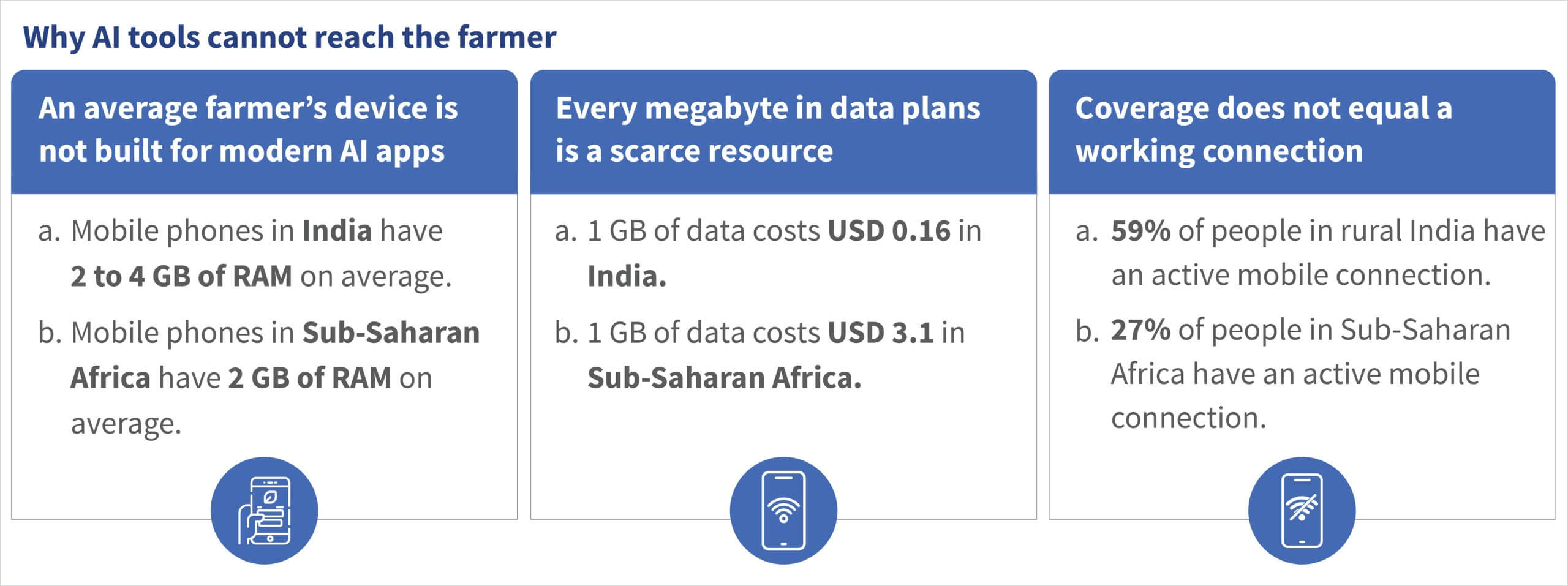
In Sub-Saharan Africa, the baseline is lower still. The GSM Association and African mobile operators have jointly proposed 2 GB of RAM as the minimum specification for an affordable 4G smartphone. The proposed specification sets a target below the current baseline.
A 2 GB phone already runs a messaging app, a camera, and background sync, which leaves little room to hold a large upload in memory while a slow network catches up.
Platforms designed and tested on newer devices can exclude the very farmers they seek to serve. The problem goes beyond what AI can do. The phone must also keep up long enough to deliver it.
Data costs shape whether farmers use the service
Data plans in South Asia look generous until you see what has to be shared with the allowance. For instance, Reliance Jio’s INR 349 (USD 3.66) plan, a standard package on India’s largest network, gives a subscriber 2 GB of data per day for 28 days. That 2 GB covers uploads and downloads, every app on the phone, and all other data use. A farmer must share the allowance across all digital needs, including crop-related questions.
A geotagged, full-resolution photo from a modern camera uses roughly 3 MB to 6 MB per shot once GPS coordinates and device metadata are attached. A crop diagnosis requires the farmer to upload the photo and download the result. A single question can use a noticeable share of the farmer’s daily allowance.
The numbers look very different across markets. Among the five cheapest mobile data markets in the world, two are in South Asia and the Pacific: Fiji and Cambodia. They have roughly USD 0.09 and USD 0.12 per GB, respectively, as per a study. India also has low mobile data costs, at USD 0.16 per GB.
Sub-Saharan Africa is a different market. The same tracking study puts the regional average at USD 3.31 per GB, roughly 20 times the Indian rate. Zimbabwe alone reaches USD 43.75 per GB.
So, the same advisory photo that costs a fraction of a rupee in India can cost real money in Harare, Zimbabwe. For a farmer working with a tight budget, that difference matters before AI even gets a chance to answer.
Coverage does not guarantee a usable connection
Coverage maps can make connectivity seem widely available. Yet, field data shows a different story. In India, 4G signal reaches 89% of villages. By early 2025, 5G had reached roughly 78% of villages as well. Yet rural tele density, or the number of active mobile connections per 100 people, is only 59%, compared with 125% in urban areas. In plain terms, a village can have a strong signal on paper, while roughly four in 10 residents still have no working mobile connection to use it with.
Even when a farmer has 4G, the connection may not perform well. Independent field tests of public 4G networks in rural agricultural settings rarely recorded speeds above 20 Mbps, and latency almost never fell below 100 milliseconds. Latency measures the delay between sending a request and getting a reply. Higher latency means longer upload times and a greater risk of failure.
Sub-Saharan Africa shows the same gap on a larger scale. Roughly 85% of the population lives within reach of 3G or 4G broadband, but 63% remain offline inside that same coverage area.
A weak or congested connection also worsens the cost problem. Mobile networks do not resume a broken upload at the point where it stopped. They restart it from the beginning. On a lossy connection, one retry can become five, and five can become 50 before a transfer succeeds. Each failed attempt uses more of the same data allowance. A photo that should cost a single debit against the day’s allowance. Network failures can make it use two or three times as much. The farmer pays for the network’s failure to deliver a reliable service.
A platform that already confirms this
Maharashtra’s own farmer advisory platform makes this point unintentionally. MahaVISTAAR-AI launched in May 2025 as a smartphone app. It delivers weather updates, market prices, and pest advisories to registered farmers across the state. Within a year, the state government added a voice-telephony layer to the same platform. Farmers could reach it by phone without downloading an app, a smartphone, or an internet connection. This addition is more than a new feature. It shows that the original app-based design could not reach every farmer it was built to serve. The voice layer brings the service closer to the farmers described by the data above.
What this means for AI in agriculture
Device memory, data cost, and connection reliability are not separate problems. They compound each other and define the baseline condition of the market that these platforms seek to serve. These conditions are not an edge case that better infrastructure will eventually solve. A weak connection can delay an answer and increase the data cost of getting it. For farmers with a tight data budget, that cost can determine whether they use a tool or give up on it. AI in agriculture must account for how and where farmers can access the intelligence.
A model that depends on a round trip to a well-provisioned server moves the constraint from the AI’s capability to the farmer’s access. Declaring a problem solved does not make that constraint disappear.
For the farmer with the wilting maize leaf, access matters as much as AI capability. They need an answer on the phone they have, with the connection and data they can afford.
MahaVISTAAR-AI has already found a partial answer through the phone network. The next blog in this series explores the next step. It examines what changes when the AI model itself runs on the device. This model can match the hardware farmers actually own and use, which has little or no network access.
Blog part 2: “The intelligence belongs on the device”
Written by

Debarshi Chakraborty
Senior Principal Architect
Leave comments