Fish cross the border. Financing does not.
 by Lois Eva Adongo
- Oct 27, 2026
- 5 min
 by
 Oct 27, 2026
 5 min


This blog explores the financial barriers facing cross-border fisheries traders in Africa and highlights opportunities to improve access to working capital, trade finance, insurance, and portable credit records to support regional fish trade.
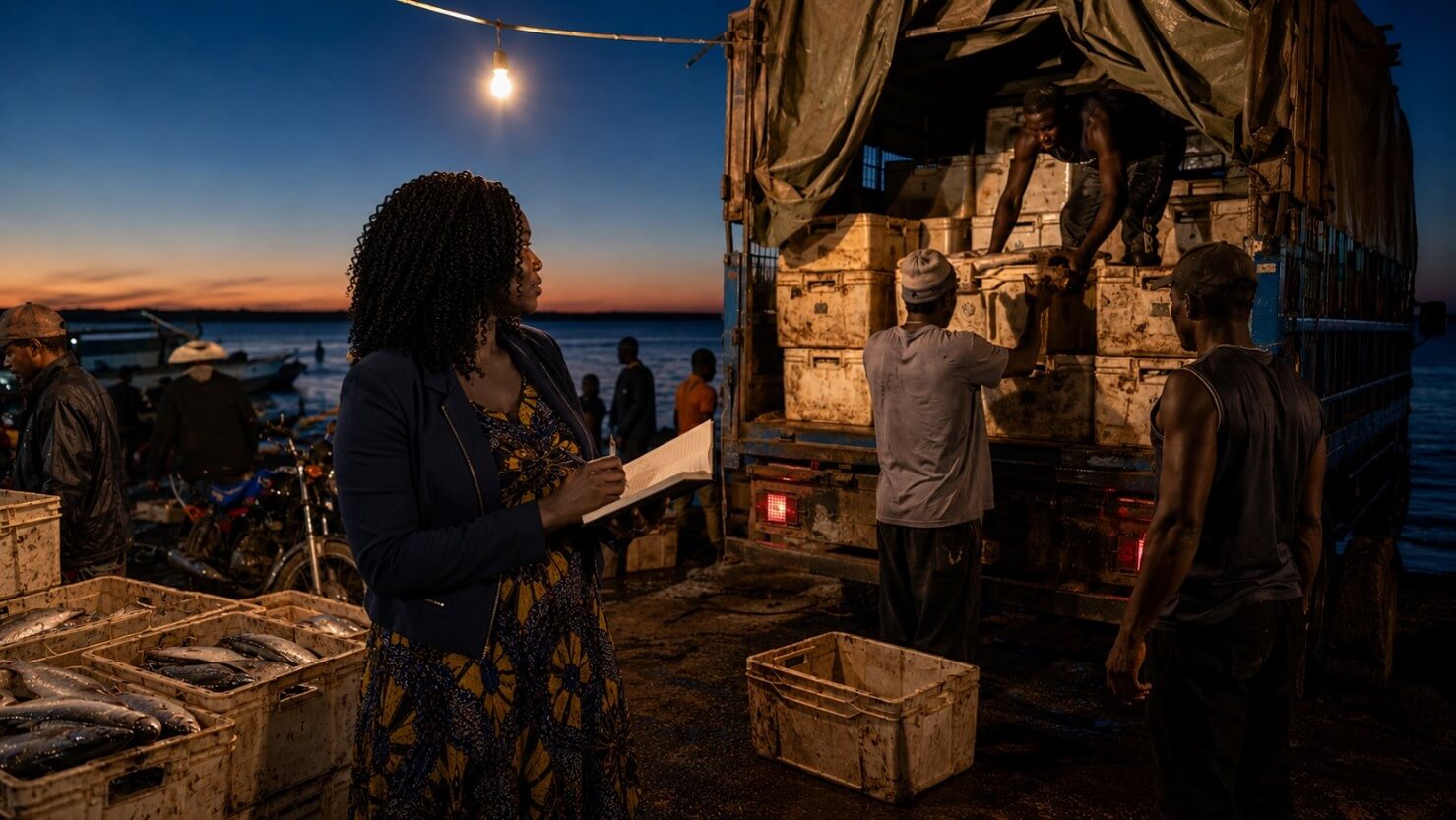
Adhis leaves Kalokol before 4 a.m. to buy sun-dried tilapia from fishers around Lake Turkana. She has pre-financed some of their catch. No single fisher has enough to fill her truck, so she builds the consignment one crate at a time before starting the long journey to regional markets.
By sunrise over the Chalbi Desert, Adhis has secured the last tarpaulin and loaded the truck. The difficult part is only beginning. The fish will travel south and west through a corridor linking Kenya with Uganda, Rwanda, and the eastern Democratic Republic of the Congo (DRC). Markets such as Goma and Bukavu offer higher prices than those in Kenya.
The 1,400 km journey crosses four countries and four currencies: Kenyan shillings, Ugandan shillings, Rwandan francs, and Congolese francs. It also passes through several border posts, each with its own documentary requirements, unofficial fees, and processing delays. Those delays can hold a refrigerated, and more often unrefrigerated, truck for hours in equatorial heat.
Working capital may come from personal contacts or informal lenders. Adhis must often settle border-related costs and unexpected expenses immediately.
Yet the commercial history behind these transactions remains fragmented. Supplier and buyer relationships, mobile-money transactions, consignment records, border crossings, and repayments are kept in separate records rather than forming a credit profile that a lender can assess across markets.
The trade exists, yet formal finance has not matched this cross-border model at scale.
The fish is already crossing
Africa’s cross-border fish trade predates the African Continental Free Trade Area (AfCFTA). Fish already moves through established regional corridors as traders connect producing areas with markets with stronger demand.
Women traders move omena from Lake Victoria into Uganda and Rwanda. Traders deliver Nile tilapia from Kenya to buyers deep in the DRC. Marine fish travel from Tanzania’s coast north to Nairobi and south to Mozambique. Informal supply chains carry fish along the Zambia-DRC copper belt corridor to mining communities in Lubumbashi and Kolwezi. In West Africa, Nigeria and Cameroon share one of the region’s highest-volume informal fish corridors, which rotating savings groups finance.
The Women and Youth Economic Empowerment in Fisheries through Inclusive Market Access (WYEEFIMA) program operates within this reality. TradeMark Africa and the AfCFTA Secretariat implement the program in partnership with the Mastercard Foundation. MSC (MicroSave Consulting) supports access to finance across Kenya, Tanzania, Uganda, Nigeria, the DRC, and Zambia.
Five financing gaps stand out.
- Working capital that can move across markets
A trader operating across Kenya, Uganda, Rwanda, and the DRC may incur costs and receive payments in several currencies during one trading cycle. Exchange-rate movements, conversion costs, and payment timing can all affect margins.
Corporate and commercial banks already offer multi-currency facilities, yet smaller fisheries traders often struggle to access them. Many manage liquidity through cash, mobile money, personal networks, or informal borrowing.
Financial institutions can adapt working-capital products to businesses whose transactions span several markets. Transaction histories, repeat trading relationships, purchase records, and predictable routes can help lenders assess these businesses as cross-border traders rather than purely domestic borrowers.
- Trade finance is suited to smaller transactions
A fish consignment sold to a known buyer across a border creates familiar trade-finance needs. The seller needs liquidity before payment arrives, and both parties face the risk of delay or non-payment.
Letters of credit, guarantees, invoice finance, and similar instruments already address these needs in larger transactions. The gap lies in making suitable structures and ticket sizes accessible to smaller fisheries enterprises.
Without such products, traders may finance purchases and transit costs themselves or through expensive informal credit. They carry much of the liquidity and payment risk personally. Confirmed buyers, repeat orders, invoices, consignment documents, and transaction histories can help formal lenders assess these transactions.
- Insurance that reflects how fish move
Cross-border fish trade combines transport and product risk. Accidents, theft, breakdowns, border delays, and poor handling can reduce a consignment’s value before it reaches the buyer.
Cargo and goods-in-transit insurance already exists, yet many smaller fisheries businesses struggle to access coverage that fits their operations.
Tailored fisheries insurance is possible. GA Insurance launched Samaki Bima in August 2025, providing coverage designed around the risks fish farms face.
This example suggests potential for similarly tailored products that cover cargo and transit risks for fisheries businesses moving perishable goods across borders.
- A credit profile that can travel with the trader
A trader such as Adhis may already produce valuable information about her business, including mobile-money transactions, repeat buyers, supplier relationships, consignment records, and repayment behavior.
These records sit across different systems and jurisdictions, making it difficult for a lender to form a consistent view of the business.
Domestic transaction data also misses cross-border risks, which include currency movements, buyer default, border delays, spoilage, theft, and changes in documentation requirements.
Bringing transaction histories, buyer relationships, route performance, and repayment records together could make the opportunity and its risks easier to assess. MSC’s work on meaningful financial inclusion for women similarly highlights the value of information that women already generate through their businesses, rather than relying only on conventional collateral.
The challenge is to make these records consistent, consent-based, and usable across institutions and markets.
- Finance for preservation and logistics
Cross-border fisheries trade depends on transport, storage, handling, and refrigeration, as required by the product.
Leasing and asset finance can help businesses acquire trucks, cold rooms, insulated storage, and handling equipment without paying the full cost up front. Enterprises with limited formal credit histories may still struggle to access this finance.
The financing structure must also reflect how the business earns money. Seasonal volumes, border delays, variable asset use, and irregular payment cycles can make standard monthly repayments a poor fit, even when the asset is commercially useful.
Lenders must determine whether the asset supports a viable trade flow and generates sufficient cash for repayment.
Making cross-border businesses visible to finance
Under the WYEEFIMA program, MSC works with both fisheries enterprises and financial providers.
For fisheries enterprises, this means strengthening the records lenders can assess, including transaction histories, consignment documents, buyer relationships, and cash flow records. For banks, microfinance institutions, savings and credit cooperatives (SACCOs), FinTechs, and insurers, it means understanding the fisheries value-chain economics and adapting products and risk assessment to these businesses.
Better information does not remove risk. It helps lenders identify and price exposure to foreign-exchange movements, buyer default, transport disruption, product loss, and regulatory uncertainty. It can also prevent viable businesses from being excluded simply because domestic lending templates do not account for cross-border operations.
Financial infrastructure is beginning to emerge
Several building blocks are already in place.
Afreximbank’s African Collaborative Transit Guarantee Scheme is designed to reduce the cost and friction of moving goods through several African customs territories. The Pan-African Payment and Settlement System (PAPSS) is building infrastructure for cross-border payments in African currencies.
The next challenge is to extend this infrastructure to smaller fisheries enterprises and make it commercially viable.
Financial institutions must recognize cross-border cash flows. Insurers and guarantors must cover transit and payment risks, while payment systems must reduce the cost and complexity of moving money between markets. Better records can help traders demonstrate the commercial history behind these transactions.
Adhis will continue moving fish, whether the financial system catches up or not. Supporting her requires more than a loan. Payments, insurance, guarantees, portable records, and financing must move with the trade. The fish has already crossed the border; the opportunity is to ensure that the financial system can cross with it.
Written by

Lois Eva Adongo
Senior Manager
Leave comments