From marketplace to strategic procurement platform: Global lessons for GeM’s next chapter
 by Kushagra Harshavardhan, Himanshu Singh and Vikram Sharma
- Nov 11, 2026
- 6 min
 by
 Nov 11, 2026
 6 min


The next chapter of India’s Government e Marketplace (GeM) is to evolve from a digital marketplace into strategic procurement infrastructure. In this blog, we look at global lessons that highlight the need for stronger interoperability, lifecycle integration, supplier inclusion, data-driven governance, risk management, and procurement capabilities to deliver greater public value
What will it take for the Government e-Marketplace (GeM) to evolve from a digital marketplace into a strategic public procurement platform? Which global public procurement best practices can guide GeM’s next phase of reform in India?
The first blog in this series showed how GeM digitized public procurement in India and made it more accessible and financially viable, particularly for small sellers. It also identified key challenges. The second blog examined how smart payment solutions, integrated financial processes, and ecosystem support could address gaps in GeM’s existing architecture. Yet closing these gaps addresses only part of the challenge. Together, the findings point to the procurement reforms India should pursue over the next decade. GeM has focused primarily on digitizing core transactions, while much of the surrounding financial and operational infrastructure remains outside the platform or only partly connected. Other countries have followed a similar path. Their systems have moved from transaction digitization to lifecycle integration, using artificial intelligence (AI), advanced analytics, and interoperable platforms to make procurement smarter and more data driven.
Countries have taken different paths to procurement reform, so their experiences offer lessons rather than templates for GeM’s long-term institutional, technological, and governance reforms. Drawing on the Organisation for Economic Co-operation and Development’s (OECD’s) framework for public procurement and the World Bank’s Public Expenditure and Financial Accountability (PEFA) framework, we compare GeM with selected leading procurement systems across key capabilities. PEFA Indicator PI-24 covers procurement monitoring, methods, public access to procurement information, and complaints management, complementing the OECD’s broader strategic procurement principles. South Korea’s Korea ON-line E-Procurement System (KONEPS) and Singapore’s Government Electronic Business (GeBIZ) offer aspirational examples of integrated procurement. Chile’s ChileCompra and Ukraine’s ProZorro demonstrate additional practices in transparency, open contracting, and data-driven procurement.
How GeM compares with leading procurement systems globally
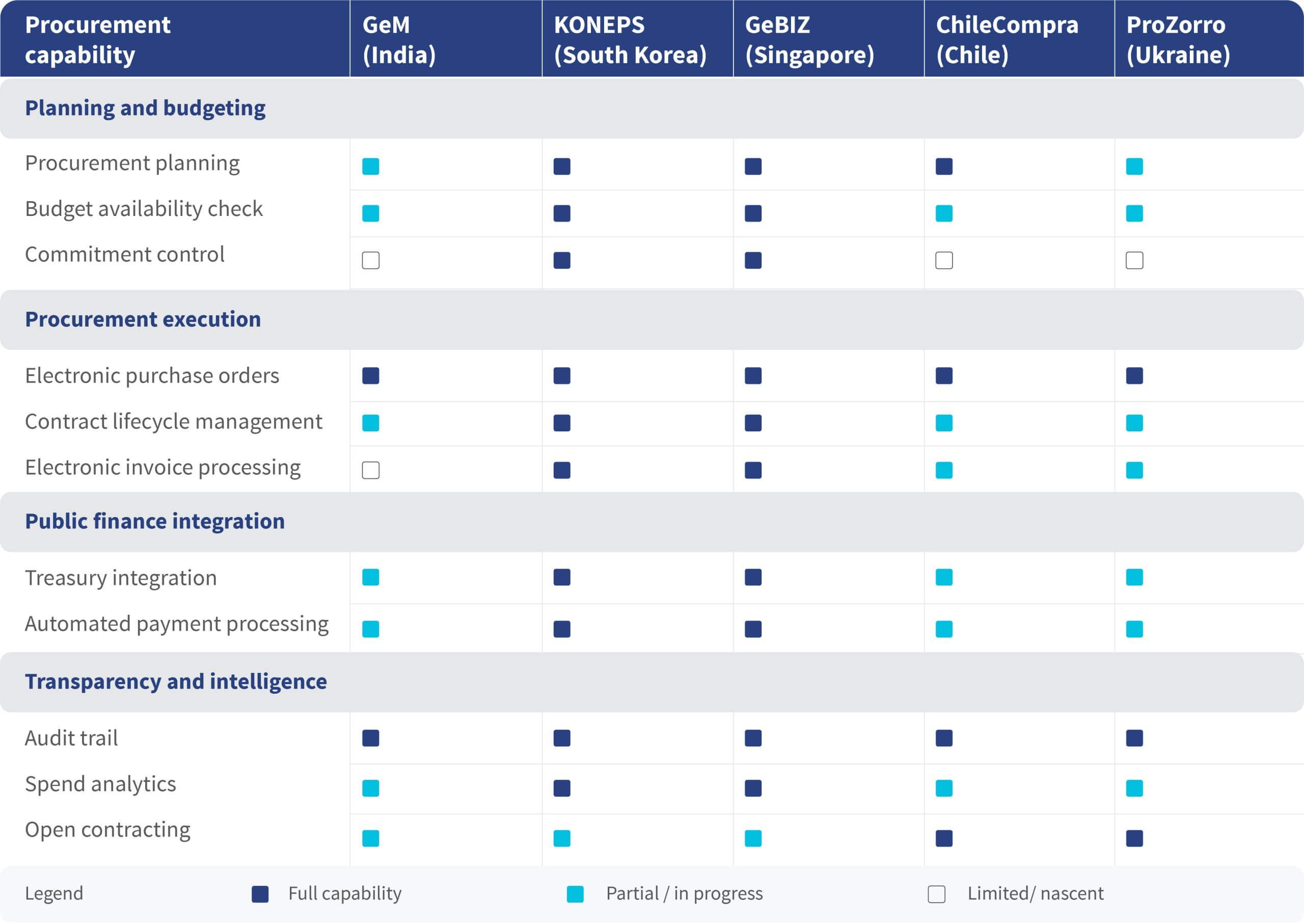
MSC based this indicative comparison on the OECD Recommendation on Public Procurement, the World Bank PEFA framework, and public information on the five systems. The ratings indicate capability integration. Full, half, and open circles indicate integrated, partial or in-progress, and limited or nascent capability, respectively. GeM’s budget checks and treasury integration vary by buyer. Public sector undertaking (PSU) buyers use the GeM pool account (GPA) to hold order funds in escrow and release them to sellers on time. Central ministries and government departments still rely largely on manual budget checks. The Public Financial Management System (PFMS) and state integrated financial management system (IFMS) platforms provide partial treasury integration, with coverage varying by buyer type and state.
The comparison shows that GeM serves diverse buyer entities and has built a strong digital procurement foundation. Yet its capabilities can go further, particularly through deeper interoperability across systems that support the full procurement lifecycle. Two strategic priorities emerge:
1. Move from digitized procurement to build a smarter and integrated procurement ecosystem
Global experience suggests three areas for reform that can strengthen transparency across the procurement lifecycle, level the playing field for diverse suppliers, and connect procurement with the wider service-delivery ecosystem.
Strengthen end-to-end procurement visibility: GeM has increased transparency by digitizing the tendering and award processes. Yet visibility declines after contract award, particularly for execution, amendments, supplier performance, delivery milestones, and completion. The UK and Chile show how publishing information throughout the procurement lifecycle can improve transparency and accountability. GeM could extend transparency beyond the award stage by publishing data on contract execution, supplier performance, and completion using globally accepted open contracting data standards (OCDS).
Level the playing field for diverse supplier segments: GeM has expanded access for underserved suppliers, including micro-enterprises, startups, women-led businesses, and local artisans. It has also reduced information asymmetries that traditionally favored established sellers. The next challenge is to help businesses of different sizes and locations compete on more equal terms by reducing administrative friction. Small sellers still face documentation and compliance burdens that can deter participation. Current metrics emphasize onboarding and transaction volume, with less attention to competitive intensity and supplier diversity. GeM could create a single source of truth through deeper integration with the Goods and Services Tax Network (GSTN) for GST registration, the Ministry of Corporate Affairs (MCA) for company information, Udyam for micro, small, and medium enterprise (MSME) status, and other government databases. This integration could reduce repetitive documentation, compliance requirements, and participation costs for smaller sellers.®1
Integrate procurement with the wider ecosystem throughout the lifecycle: GeM has digitized core processes, including online bidding and reverse auctions, and offers financial services such as digital payments, invoice financing, and working capital credit. Yet most capabilities still focus on the transaction itself. GeM underuses procurement data for strategic sourcing, demand forecasting, and market intelligence, while interoperability with state procurement platforms, treasury, project management, and logistics systems remains limited. The next step is to connect procurement with budgeting, treasury, contract management, automated payments, logistics, and analytics. South Korea’s KONEPS shows the value of lifecycle integration. GeM could develop a unified national procurement architecture that connects public finance, logistics, project management, and state procurement systems. It could also use AI and advanced analytics for demand forecasting, category management, supplier intelligence, and value-for-money assessment.
2. Strengthen the right foundations to evolve from efficient procurement to strategic procurement
Global comparisons can benchmark GeM, but India cannot import another country’s procurement ecosystem wholesale. India can adopt technology, but the institutions, capabilities, governance, and accountability that support it must develop over time. Three foundations should guide GeM’s next phase.
Build procurement capability beyond platform adoption: GeM has encouraged platform use through awareness, training, and hands-on support for buyers and sellers. Yet it places less emphasis on advanced skills such as strategic sourcing, market analysis, category and contract management, and supplier relationship management. Singapore’s GeBIZ pairs digital reform with professional procurement cadres, competency standards, certification systems, and independent review. A National Public Procurement Academy and competency framework could help professionalize procurement as a specialized government function.
Strengthen proactive risk management: GeM has reduced discretion and improved process integrity through digital audit trails, standardized workflows, approvals, and recordkeeping. The next step is to proactively detect risks, including unusual bidding patterns, conflicts of interest, and compliance issues. South Korea’s KONEPS uses a bid-rigging indicator analysis system (BRIAS) to identify patterns such as different vendors submitting bids from the same IP address or using suspiciously similar prices. It then generates a risk score for potentially collusive behavior. Ukraine’s ProZorro uses open data to enable independent civil society analysis, effectively crowdsourcing risk detection. GeM could introduce advanced monitoring tools, red-flag analytics, supplier risk profiles, and dashboards to identify potential issues before they affect outcomes.
Stronger risk tools would also help GeM assess how procurement processes and decisions affect outcomes. Today, GeM measures accountability mainly through transaction volume, orders, and adoption. It offers limited visibility into procurement quality, contract performance, and buyer effectiveness. The UK takes a different approach: contracting authorities must assess supplier performance against defined key performance indicators (KPIs) and publish results for applicable contracts. These measures cover timely delivery, quality, and service performance. Procurement scorecards for buyers, departments, and suppliers, supported by an independent Procurement Review and Performance Unit, could enable systematic outcome assessment, reveal recurring problems, and guide corrective action.
What is the way forward?
How can GeM make public procurement a strategic policy instrument that delivers broader public value? GeM has already changed how India accesses and conducts procurement by creating a common digital platform at unprecedented scale. Yet digitization is only the first step. Small sellers need predictable processes and lower participation costs. Global experience also points to stronger integration, data, capabilities, and institutions. Together, these lessons define three stages of GeM’s evolution: expanding access, strengthening participation, and making procurement more strategic and effective.
GeM should now evolve toward the principles of digital public infrastructure: scale, interoperability, and data-driven governance. Its next phase can build on the platform’s reach and digital foundations to create a more accessible, predictable, integrated, and strategic procurement system. The opportunity is to connect existing gains with the policy, institutional, technological, and behavioral changes needed to deliver greater public value. This is how GeM can evolve from a digital marketplace into a strategic procurement infrastructure over the next decade.
Written by




Leave comments