From Cash to Click-IPPB’s Role in India’s Financial Inclusion Story
 by Aditi Singh and Abhikalp Purohit
- Nov 25, 2026
- 6 min
 by
 Nov 25, 2026
 6 min


This blog shows how IPPB uses India Post’s rural reach and assisted digital banking to help customers adopt digital payments, build financial confidence, and regularly use formal financial services.
Sunita Devi, 42, runs a small vegetable stall in rural Uttar Pradesh. For years, her business operated in a high-friction cash cycle: daily sales were collected in physical notes, and supplier payments were settled in hand-to-hand transactions. The nearest commercial bank branch was 9 kilometres away, a journey that cost her a day’s market revenue and round-trip bus fare just to make a deposit. In 2022, her local Gramin Dak Sevak (GDS) a village postal worker she had known for a decade opened an India Post Payments Bank (IPPB) account for her at her doorstep. Through routine interactions, the GDS helps her to understand the steps involved in assisted banking, become familiar with digital transactions, and build confidence in using formal financial services.
Sunita’s shift from daily cash dependency to digital account management reflects a fundamental structural transition across rural India. Consider a small grocery-store owner in rural India who needs to manage digital payments, and access banking services without travelling to a distant branch. A nearby GDS, trained to provide assisted banking services, brings these solutions directly to the threshold. This doorstep model illustrates how IPPB extends formal banking far beyond conventional brick-and-mortar branches. The GDS role extends beyond India, the Universal Postal Union’s 2025 global report, based on data from 153 designated postal operators, found that 58% identified themselves as providers of digital financial services, highlighting the potential of postal networks to support financial and digital inclusion.
India’s extensive postal network has emerged as an important channel for extending formal financial services to underserved communities, with IPPB leveraging the reach of post offices and GDS to bring banking services closer to customers. Yet, as global policy insights demonstrate, access and active use are not the same thing. The World Bank’s Global Findex 2025 reveals that while close to 90% of Indian adults now hold an account, approximately 16% of Indian account owners maintain inactive accounts1 – significantly higher than the 4% inactive rate observed in comparable low- and middle-income economies. Financial inclusion depends not only on opening an account, but on creating the recurring utility and trust required for active, sustained usage.
IPPB offers a powerful lens through which to examine this transition. By combining India’s extensive postal infrastructure with assisted digital services, IPPB helps bridge the gap between traditional cash-based transactions and the digital financial ecosystem, enabling customers to access banking services, undertake digital transactions and gradually build familiarity with formal financial services.
- Distribution over real estate: The postal advantage
IPPB leverages India Post’s extensive physical network rather than relying solely on conventional bank branches. As of 31 March 2025, India Post operated 164,999 post offices, of which 149,385 were in rural areas (around 90.54%), providing a substantial platform for extending financial services to underserved communities. Supported by 185293 micro-ATMs deployed across the network by September 2025, the postman effectively becomes a mobile bank branch.
IPPB’s reach: Creating the foundation for Cash-to-Click
IPPB’s expanding customer base and growing deposit balances demonstrate the scale at which its postal-led banking model operates. These indicators provide context for the bank’s potential to connect customers with formal financial services, a shift from cash to digital transactions has grown nationally.
- Customer base: Reached 132.5 million customers by 31st March 2026, achieving this scale in under eight years of operations (since launching in September 2018). By comparison, newer conventional universal banks licensed around the same decade such as IDFC FIRST Bank (40 million customers) and Bandhan Bank (32 million customers) serve roughly a quarter of IPPB’s user base after more than ten years of commercial banking. Notably, 77% of these customers reside in rural areas.
- Deposits: Grew from INR 193.5 billion (USD 2.02 billion)2 as of 31st March 2025 to INR 291 billion (USD 3.04 billion) as of 31st March 2026, a 50% year-on-year increase. Average deposit per customer rose from about INR 1,658 (USD 17) to about INR 2,196 (USD 23), a 32% year-on-year increase. This sharper rise suggests that rural customers are holding larger operational balances and that engagement with IPPB’s doorstep banking services is genuinely deepening. Cumulative digital financial transactions also reached INR 21,610 billion (USD 226 billion).
 Source: IPPB annual reports
2. Building the bridge: Trust, assistance and regular bankingAs of 31 March 2026, IPPB reported that 65 million beneficiaries had received approximately INR 1.55 trillion (USD 16.21 billion) through Direct Benefit Transfers (DBT). Such benefit payments connect customers with formal banking channels at important points in their financial lives. Whether this contact becomes regular account use depends on assistance at the last mile. According to IPPB’s FY 2024–25 annual report, 96% of accounts were opened at the customer’s doorstep using micro-ATMs, regular account activity and sustained digital adoption depend on customers’ needs, access, awareness and confidence in using the services available to them.
Trust in assisted banking is also built through representation and language, so that customers are served in their own language by a familiar face. Operating across 557,000 villages and towns, IPPB delivers services in 13 regional languages (Hindi, English, Punjabi, Tamil, Telugu, Malayalam, Kannada, Urdu, Gujarati, Odia, Bengali, Assamese, and Marathi).
Assisted banking can provide an accessible way to interact with a formal bank, while digital payment channels offer additional options for customers as their needs and confidence evolve.
- Assisted cash access through AePS
IPPB enables Aadhaar Enabled Payment System (AePS) transactions through its assisted banking network. This allows Aadhaar-authenticated banking transactions at a doorstep or other assisted service point, reducing the need to travel to a conventional bank branch for cash withdrawals.
 Figure: How a doorstep cash withdrawal works
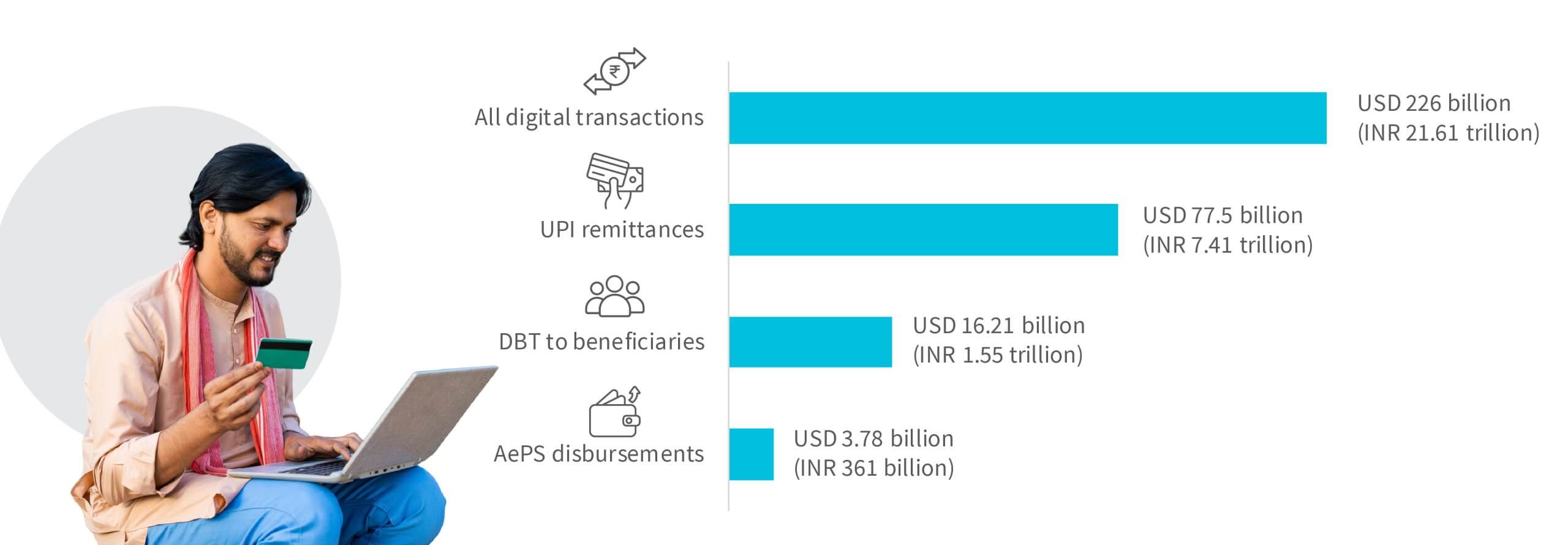
3. From assisted cash access to digital paymentsAs of 31 March 2026, In FY 2025–26, IPPB reported 120.6 million AePS transactions, with a disbursement value of INR 361.4 billion (USD 3.78 billion). The multi-year trend shows that assisted cash access is still expanding, but far more slowly than digital payments. According to IPPB’s annual report, the value of AePS disbursements rose from INR 274.4 billion in FY 2022–23 to INR 311.6 billion in FY 2023–24 (+14%), INR 338.6 billion in FY 2024–25 (+9%) and then INR 361.4 billion in FY 2025–26 (+7%), whereas the value of IPPB’s digital financial transactions grew 88% in FY 2024–25 alone. Assisted cash access therefore acts as an entry point, with digital channels taking a growing share of customer activity.UPI has become the backbone of digital payments in India: at the national level, it processed 241.6 billion transactions worth INR 314 trillion in FY 2025–26. IPPB takes part in this shift by providing UPI and other digital payment services, enabling customers to make eligible payments without relying exclusively on cash. As of 31 March 2026, the bank reported cumulative digital financial transactions worth INR 21.61 trillion (USD 226 billion), including INR 7.41 trillion (USD 77.5 billion) in UPI remittances, which means UPI accounts for roughly a third (34%) of the value of IPPB’s digital transactions.
 Source: PIB, 1st September 2026
Figure: Cumulative value through IPPB by channel, as of 31st March 2026
- Beyond transactions: Broadening access to financial services
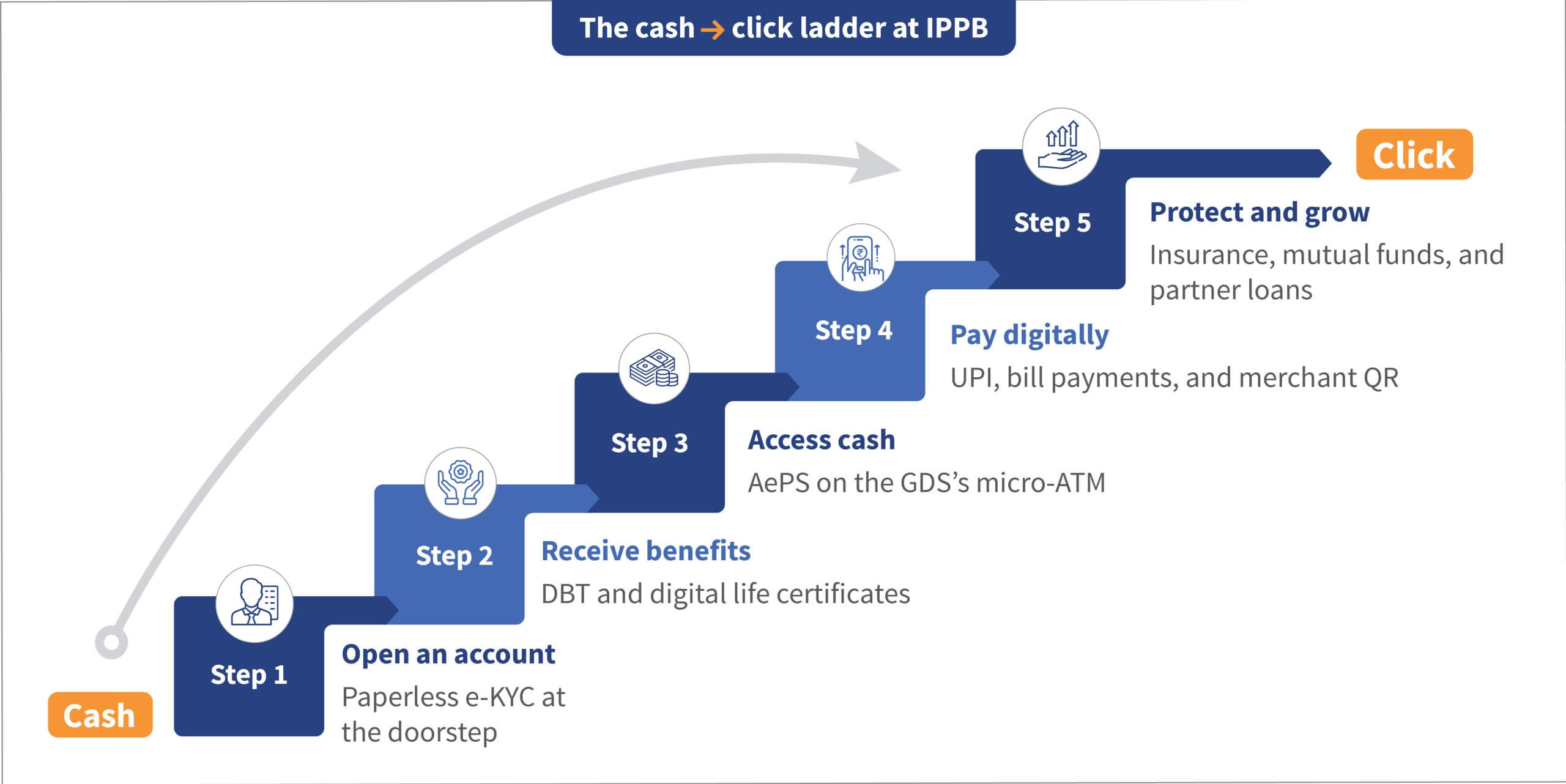
Once customers can access formal banking and make payments through assisted and digital channels, the next opportunity is to connect them with a wider range of financial services. IPPB has expanded its offerings through partnerships and digital platforms covering credit, insurance and investments. These services can widen the range of financial needs that customers are able to address through IPPB’s channels. Their contribution to financial inclusion, however, depends on whether customers understand the products, can afford them, meet the eligibility requirements and can access appropriate support.
The broader opportunity is therefore not simply to add more products, but to make relevant financial services accessible, understandable and usable for customers like Sunita who have traditionally faced barriers to formal finance.
Recently, IPPB announced three new platforms which represent an important expansion- from enabling everyday banking and payments to creating greater access to protection, investment and financial security for their customers:
From cash access to digital transactions
- DakPay sound box for merchants;
- Digital insurance technology platform;
- and Digital mutual fund platform
 Source: PIB Step 5 platforms launched on 1st September 2026.
Figure: The cash to click ladder at IPPB
5. The road ahead
- IPPB has successfully transformed India’s postal network into a high-trust digital banking channel for 132.5 million customers. Yet the next challenge is to understand how effectively this access translates into regular, confident and safe use. These three questions are particularly important for the future of last-mile financial inclusion:
- How can financial inclusion be measured through regular and meaningful account use, rather than account ownership alone?
- What support do customers need to use digital payment channels safely and independently when they choose to do so?
- How can frontline banking channels connect customers with appropriate savings, credit, insurance and investment options without compromising informed choice?
The task ahead is to ensure that this reach translates into sustained customer value – so that access to formal banking becomes a foundation for meaningful, secure and informed financial participation.

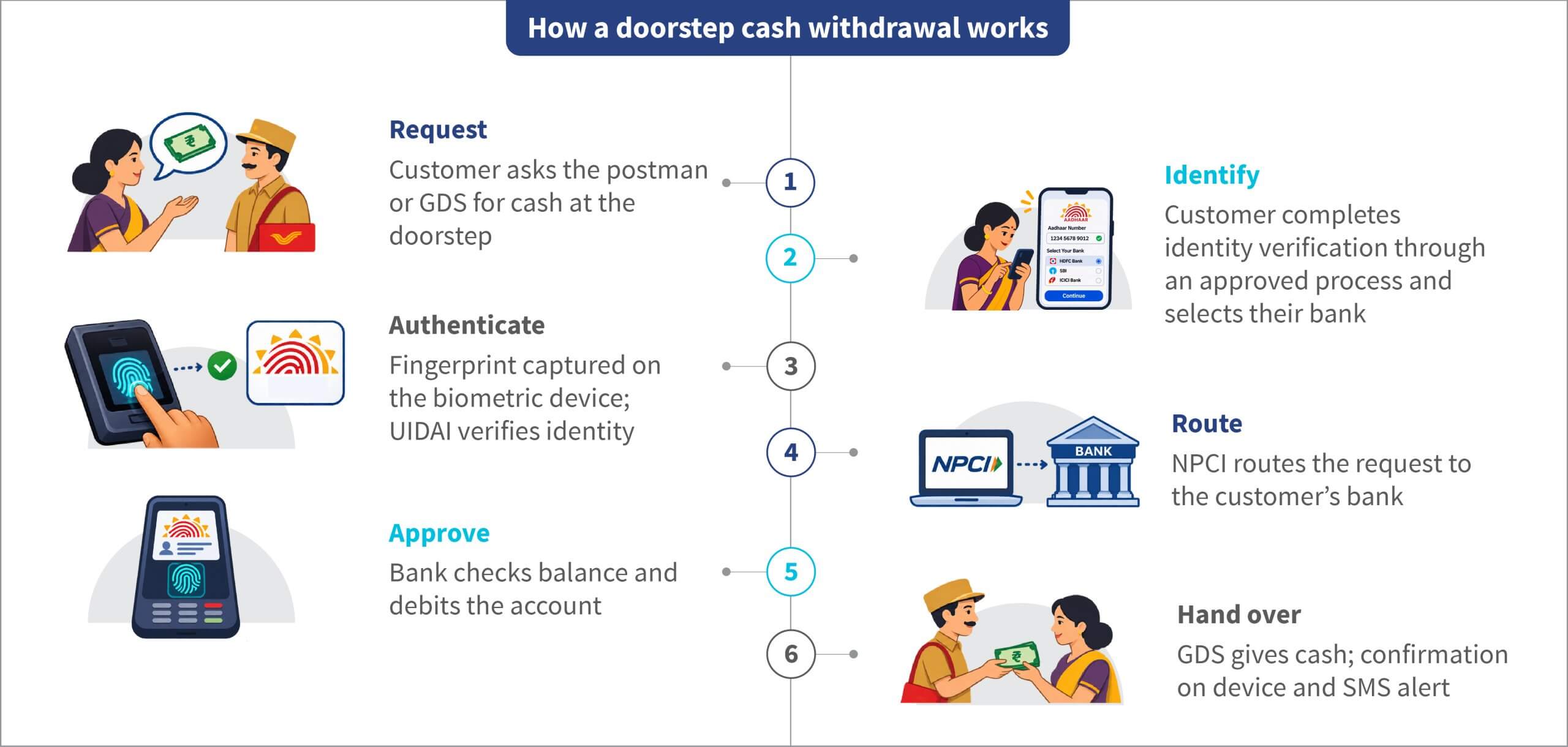 Figure: How a doorstep cash withdrawal works
 Source: PIB, 1
Written by

Aditi Singh
Associate
Abhikalp Purohit
Assistant Manager
Leave comments