Integrating climate into India’s digital agriculture solutions: The case for a climate-resilient agricultural system (CRAS)
 by Allina Tiwari, Diganta Nayak, Vikram Sharma and Kushagra Harshavardhan
 Mar 13, 2026
 6 min
6 min


We propose CRAS as a climate advisory layer that takes advantage of India’s agri-digital infrastructure, such as AgriStack and Bharat VISTAAR, to transform agricultural advisories and empower farmers to adapt to increasing weather volatility.
Over the past few years, the weather across India’s farmlands has shifted from unpredictable to unsettlingly erratic. One season brings a relentless heatwave that scorches crops before they can grow. The next brings erratic rains that drown freshly sown seeds altogether. In 2022, an intense heatwave across Punjab and Haryana from March to May reduced wheat yields by 10% to 15%. With more than 357 million tons of annual foodgrain production that support nearly 810 million National Food Security Act (NFSA) beneficiaries, climate shocks are more than agricultural events. These pose systemic risks to India’s procurement system, buffer stocks, and food price stability.
Farming has always been risky. Yet for many, it has now become an even higher-stakes gamble. An article published in Agricultural Reviews by the Indian Council of Agricultural Research (ICAR) warns that without adaptation, national productivity could fall by 40% by the 2080s. While better seed varieties and irrigation systems can help, they cannot compensate for the absence of timely, precise information reaching the farmer who needs to act on it.
Amid intense climate volatility, India’s digital initiatives and innovations during the past decades have emerged as a beacon of hope. Initiatives, such as fertilizer delivery through the Direct Benefit Transfer (DBT) mechanism and the creation of foundational registries under AgriStack have begun to transform Indian agriculture. The nationwide soil health mapping through the Soil and Land Use Survey of India (SLUSI) and the national Soil Health Card (SHC) program have strengthened the foundation of digital agriculture.
Together, these efforts address long-standing challenges in agriculture and help establish a strong digital backbone. This foundation also creates new opportunities for innovation, such as Krishi DSS, a geospatial decision support system, and Bharat VISTAAR. The latter is an AI-powered digital public infrastructure launched recently by the Government of India. It integrates agricultural data, advisories, market information, and government programs to help farmers make better farming decisions.
The climate gap in India’s digital agriculture foundations
Each of these digital interventions was designed to address a specific challenge and largely functioned in isolation. These verify identity, deliver inputs, and manage subsidies. However, none were built with climate considerations in mind. As a result, the data remain siloed, while the outcomes generated by these systems lack a climate lens. A farmer may know the soil’s nutrient profile, receive a timely fertilizer subsidy, and be registered in a crop database. Yet the absence of integrated early warning systems prevents the farmer from being able to act when a heatwave or unseasonal rain threatens the harvest.
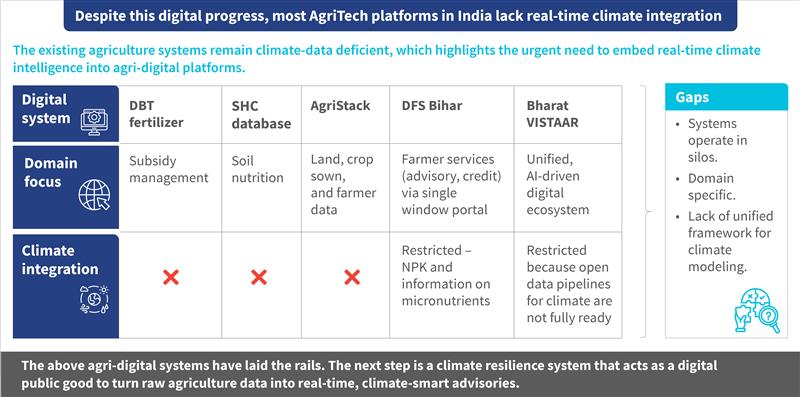
Figure 1: India’s agri-digital systems lack real-time climate integration
The above agri-digital systems have laid the rails. The next step is to create and integrate a climate resilience layer that works in tandem with existing systems and digital public infrastructure. This integration would transform agricultural advisory into climate-smart advisories that can be disseminated to farmers through multiple channels. Without a dedicated “climate layer” embedded within India’s digital agriculture ecosystem, the risk of farmers being exposed to climate hazards increases significantly.
Therefore, the climate-resilient agricultural system (CRAS) illustrates how a network of agricultural data, when combined with a climate intelligence layer, can enable the delivery of climate-specific advisories. Embedding climate analytics into farm-level decision-making enables the generation of hyper-local, data-driven advisories that can be accessed through any farmer-facing platform.
The CRAS can use Bharat VISTAAR and other such open networks and platforms to expand its reach. This will enable interoperable dissemination of these climate analytics and advisories across multiple digital platforms. It will ensure that actionable insights reach farmers through any farmer-facing platform. At its core, the system consist of the following capabilities:
- Using existing data sources: The CRAS will draw upon agriculture and climate-related datasets available across existing government and partner systems, fertilizer use, and subsidy records under Direct Benefit Transfer (DBT). Weather forecasts from the India Meteorological Department (IMD) will also serve as key inputs. Satellite imagery will help monitor crop stress, vegetation health, and heat exposure. The CRAS will not centrally aggregate all datasets. Instead, it will use relevant data from these pipelines and interoperable registries, such as those under AgriStack, to generate climate-aware insights that can support agricultural planning and localized advisory services.
- Climate analytics: The CRAS will integrate existing climate advisory models with climate and agricultural datasets to generate localized climate intelligence. These advisory models include the ICAR’s InfoCrop Model and the . An additional artificial intelligence (AI) layer in the farmer-facing applications will help identify patterns across weather, soil, and crop data. This will enable personalized use cases for farmers, such as early warning systems, hyper-local advisories, and climate-resilient recommendations on risks, which include droughts, pest outbreaks, and extreme weather events.
- Bharat VISTAAR layer: The CRAS climate analytics layer will generate insights that can be shared across agriculture service providers through Bharat VISTAAR. Multiple applications and service providers within the digital agriculture ecosystem will access these climate-informed insights directly.
- Farmer-facing dissemination: Farmer-facing platforms, such as Bihar Krishi, MahaVISTAAR, and the TNAU AgriTech Portal can translate these insights into personalized, localized advisories and services. Farmers may receive hyper-local weather alerts, crop planning recommendations, pest and disease warnings, and supply chain notifications. They may also receive financial triggers, such as subsidy eligibility and credit support, through SMS, WhatsApp, mobile applications, or extension networks.
The CRAS will not reinvent the wheel but connect the spokes. The digital systems are already in place. The challenge and opportunity are to make them speak to each other in a climate-aware language.
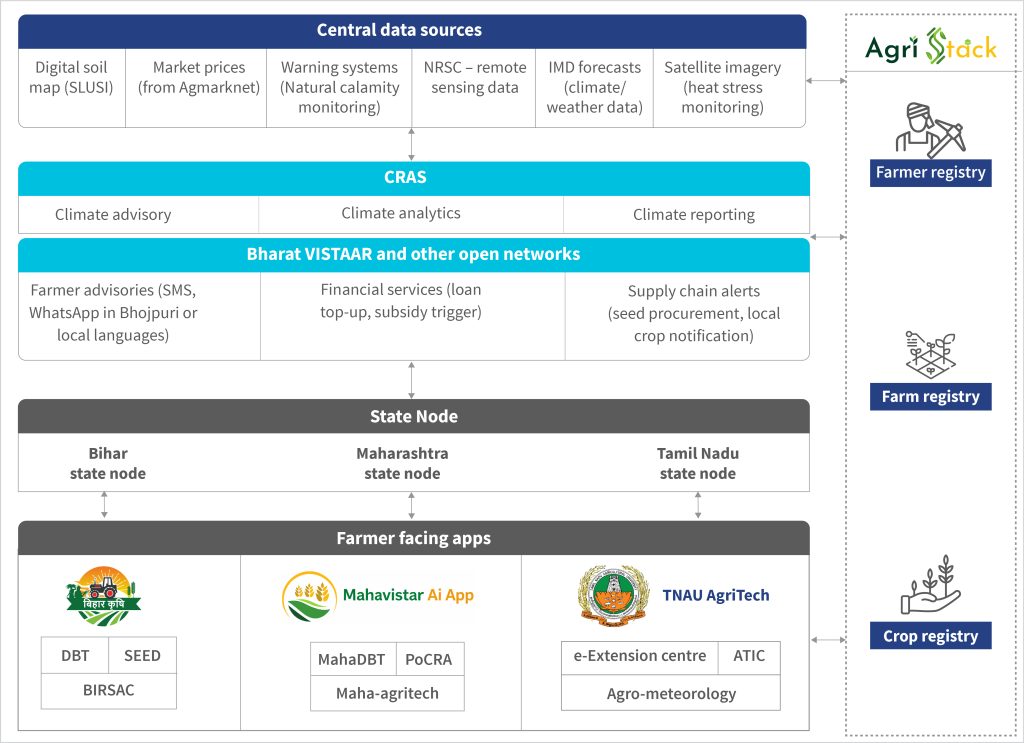
Figure 2: Data architecture of CRAS
Recent efforts by the government to connect platforms, such as Bharat VISTAAR with AgriStack, indicate a move toward greater interoperability in digital agriculture. However, we must distinguish between roles. The CRAS functions as a climate intelligence and advisory layer. It will integrate weather data, climate models, and agricultural system data to generate climate-informed advisories that strengthen farm-level decision-making. It can also be imagined as a node for other open networks.
As more platforms and datasets connect to this network, Bharat VISTAAR can create a compounding network where improved data exchange and wider participation continuously enhance the precision, reach, and usefulness of climate-informed agricultural advisories.
Use cases: CRAS in action
Once operational, the CRAS could reshape decision-making for farmers, researchers, and financial institutions alike. A successful CRAS would enable the following use cases:
- Climate-smart crop planning: Once enabled, the CRAS would integrate farm-level data with climate intelligence to generate localized, climate-resilient crop recommendations by combining soil profiles, crop histories, and climate forecasts. It would account for soil moisture, rainfall variability, and monsoon onset. This would guide farmers away from high-risk, water-intensive crops and deliver real-time advisories on irrigation, fertigation, and pest management. Such steps would help reduce yield losses, stabilize incomes, and align farm decisions with evolving climate and market signals.
- Climate-informed financial decision-making: Once implemented, CRAS would enable financial institutions to make more informed decisions by using its unified data and climate intelligence layers. This approach would support more targeted and responsive financial investments in the context of climate shocks. Access to farm-level data, such as crop type, soil quality, and land ownership, combined with insights from the climate intelligence layer, could enable institutions to develop more accurate risk profiles of farmers and significantly reduce uncertainties
- Localized climate and pest early warning system (EWS): The CRAS architecture could aggregate data from multiple sources to enable a localized EWS that issues hyper-local alerts for extreme events and pest outbreaks. Paired with short-term, actionable advisories, these alerts would allow farmers to take preventive action and reduce losses before impacts occur. Simultaneously, the CRAS would anticipate changes in demand, availability, and product types required across regions to enable companies to optimize their supply chains. Furthermore, farmer reports collected before and after events would strengthen CRAS as a resilient and trusted system.
Learning models from around the globe
While the CRAS will take time to become operational, several promising efforts already exist. In Telangana, the Data in Climate Resilient Agriculture (DiCRA) platform, developed in collaboration with the UNDP, uses satellite data and open-source AI to provide location-specific climate risk advisories. Its modular, plug-and-play design has allowed it to expand to other Indian states and into pilot programs in Latin America.
Beyond India, the Agricultural Climate Resilience Enhancement Initiative (ACREI) is another initiative led by the World Meteorological Organization in collaboration with the Food and Agriculture Organization (FAO). It has been rolled out in Ethiopia, Uganda, and Kenya, and reaches approximately 1,800 farming households. It combines integrated early-warning systems, real-time climate data, and on-ground farmer training.
Conclusion
Over time, the CRAS could expand beyond crop agriculture. Linking it with the National Digital Livestock Mission (NDLM) and forest and vegetation datasets could enable a more comprehensive view of emissions and carbon sinks across the agriculture, forestry, and other land use (AFOLU) sector. Together, this integration would reduce information asymmetries, strengthen climate risk assessment, and help unlock greater public and private investment in climate-smart agriculture.
Written by

Allina Tiwari
Assistant Manager
Diganta Nayak
Manager
Vikram Sharma
Senior Manager
Leave comments