Building India’s climate stack – why agriculture comes first
 by Allina Tiwari, Kushagra Harshavardhan, Ritesh Rautela and Vikram Sharma
 Mar 11, 2026
 7 min
7 min


The blog introduces the concept of a climate stack, a federated digital public infrastructure that links climate datasets across sectors. Climate stack will initially focus on agriculture and integrate emissions, carbon sink, and vulnerability data to support real-time climate intelligence and coordinated resilience.
A looming crisis stares down at India. As the world’s most populous nation and one of the fastest-growing economies, the country faces intensifying climate risks that directly threaten lives, livelihoods, and development gains. Over the past five years, extreme climate events have affected more than 75% of India’s districts and damaged more than 36 million hectares of crops. These numbers underscore the sheer scale, frequency, and systemic nature of climate shocks.
Despite this growing exposure, several constraints hold back India’s ability to plan for, finance, and implement climate adaptation and resilience. Climate systems and decision-support mechanisms are fragmented, siloed, and slow, with limited integration across sectors, such as agriculture, water, urban development, health, and finance. Even where sector-specific systems are available, they often lack a coherent climate risk and resilience lens. The result is reactive responses rather than anticipatory, risk-informed action. Such structural weaknesses can directly hurt effective climate finance.
In the section below, we discuss the challenges with a data lens.
- Fragmented and outdated climate data ecosystem: Climate data in India is scattered across sectors and stored in inconsistent formats. The Ministry of Agriculturecollects land-use data through the Annual Crop Production Survey, while the Forest Survey of India conducts biennial assessments of forest cover. The Central Pollution Control Board monitors industrial emissions. Each of them uses different methodologies, timelines, and standards. This makes cross-sectoral analysis nearly impossible and creates blind spots.
- Delayed emission mapping and reporting: Current greenhouse gas (GHG) inventories and biennial update reports (BURs) rely on episodic submissions rather than continuous monitoring. For instance, India’s third biennial update report(BUR-3), submitted to the United Nations Framework Convention on Climate Change (UNFCCC) in 2021, reported emissions data from 2016, a gap of five years.
- Siloed vulnerability and climate action tracking: Climate risks across sectors are currently assessed in isolation, with limited integration between ministries and programs.. For example, the Pradhan Mantri Fasal Bima Yojanaor crop insurance scheme could benefit from stronger real-time integration and data interoperability with the India Meteorological Department’s early warning systems and the National Disaster Response Force’s preparedness programs.
- Weak integration of climate data in budgeting and planning: At the grassroots level, recent efforts, such as the Climate Resilience Planning initiativeby the Ministry of Panchayati Raj and the UNDP, seek to integrate climate risk data into Gram Panchayat Development Plans (GPDPs). However, many panchayats still lack the capacity or tools to fully operationalize this data.
A unified digital public infrastructure (DPI) for climate can provide a transformative pathway to build resilience, enhance credibility, and position India as a global leader in climate action. Once operational, the DPI for climate could have an impact comparable to that of the India stack, which comprises Aadhaar-based eKYC, e-sign, and UPI in the financial sector. It could also have a similar impact to what the under-development AgriStack is expected to achieve for agriculture through the creation of reliable farmer- and farm-level data.
Introducing the climate stack: A unified climate intelligence system
The climate stack represents a paradigm shift from fragmented datasets to a unified, dynamically linked infrastructure that serves as a single source of truth on climate intelligence. Rather than create another database, the climate stack brings together a collection of core interoperable registries that address the following fundamental questions:
- Emission registry: Which areas emit greenhouse gases, and how much?
This registry tracks greenhouse gas emissions across space and time to provide granular visibility into emission sources and trends. - Green assets and sequestration registry: Where are the carbon sinks, and what solutions are available?
This registry maps India’s natural capital, such as forests, wetlands, grasslands, and agricultural soils, which sequester carbon and provide ecosystem services. - Climate vulnerability registry: Which areas and communities are most at risk?
This registry assesses exposure, sensitivity, and adaptive capacity across India’s diverse landscapes and populations. It maps adaptation and mitigation actions, such as irrigation expansion, resilient seeds, watershed projects, afforestation, and renewable energy uptake, and also tracks their impact on reducing vulnerability over time.
The emissions profile spans four major sectors – energy, agriculture, waste, and industrial processes and product use (IPPU), each with distinct characteristics and data needs. In 2020, India emitted 2,958,589 Gg of CO₂-equivalent GHGs from the following sectors; thus, the climate stack should serve these four critical sectors:
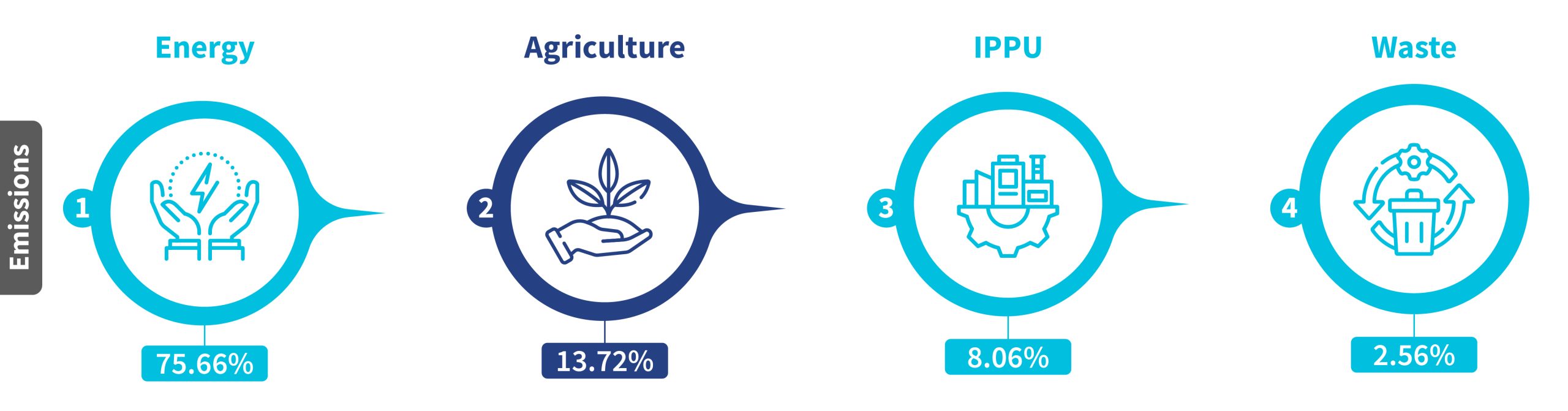
Share of sectors in emissions as per BUR-4 MoEFCC, 2011
India BUR-4.pdf
Why should agriculture be the starting point?
- Agriculture is a major source of emissions, a sector of high vulnerability, and a domain with a high potential for mitigation.
- A major source of emissions:Agriculture contributes 13.72% of India’s total GHG emissions (BUR-4), primarily from enteric fermentation, rice cultivation, and fertilizer use. Globally, the agriculture, forestry, and land-use (AFOLU) sector accounts for 22% of emissions (IPCC AR6).
- Highly vulnerable to climate change:More than 59% of India’s workforce depends on agriculture. Between 2016 and 2021, climate extremes damaged 36 million hectares of crops, which caused losses worth USD 3.75 billion. Yield losses could rise 10–25% by 2050 without adaptation (ORF).
- High mitigation and adaptation potential:Climate-smart practices can deliver 30%+ of India’s total mitigation potential by 2030. Soil carbon enhancement and restoration of degraded farmlands offer some of India’s lowest-cost mitigation opportunities.
- Agriculture already has data systems that map directly onto the three climate stack registries. These operational data systems can be integrated immediately.
- Emissions registry: The major emission categories of agriculture—fertilizer use (N₂O), rice cultivation (CH₄), enteric fermentation and manure management (CH₄/N₂O), and crop residue burning—all have existing digital data sources. These include AgriStack, the Soil Health Card, DBT fertiliser systems, and the livestock stack. Together, these categories represent more than 80% of agricultural emissions. This makes agriculture the most natural starting point for the proposed emissions registry.
- Sequestration registry: Data for carbon sinks is more complex to source, though some are available readily in existing systems. These include the Forest Survey, which captures forest biomass, canopy density, and carbon stock, and the Soil Health Card, which tracks soil organic carbon for croplands. The AgriStack further provides data on cropland area, land use, and residue cycles. Since croplands and forests form the bulk of India’s terrestrial carbon sinks, governments can digitize and geotag datasets to build the sequestration registry.
- Vulnerability and climate action registry: Agriculture produces the richest hyperlocal climate-risk signals. These signals cover exposure measured through maximum and minimum temperatures, and sensitivity measured through annual rainfall and disaster proneness. Adaptive capacity is captured through irrigation access, extension reach, and credit penetration. These align directly with the exposure–sensitivity–adaptive capacity framework used by the ICAR.
What should the climate stack’s data architecture look like?
The climate stack is conceived as a federated digital public infrastructure that unifies India’s climate-relevant datasets without centralizing them. The architecture described below represents the climate stack’s overall design logic and is intended to remain consistent across sectors. However, as agriculture, forestry, and land use form the natural starting point, the illustration below presents the same architecture through an AFOLU lens. This version does not alter the core design. It simply maps the data ingestion layer to AFOLU-relevant systems to show how existing datasets flow into the federated registries. These systems include agriculture databases, remote sensing platforms, climate models, and disaster management systems.
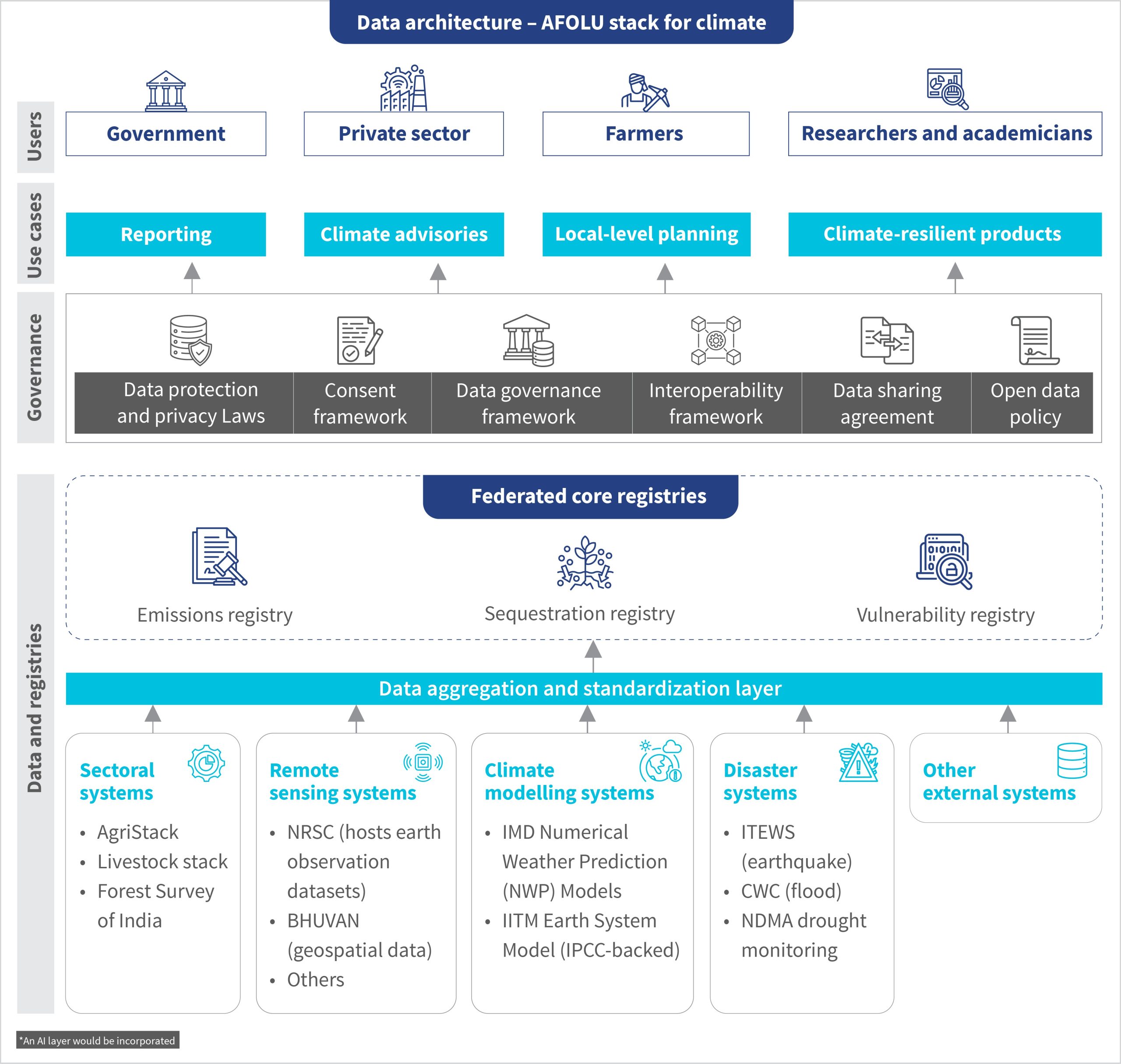
Data architecture for climate stack (for AFOLU sector)
The climate stack will not replace existing systems. It will link them through shared standards and interoperable APIs. A data aggregation and standardization layer harmonizes diverse data sets using common taxonomies, identifiers, metadata standards, and quality protocols. This enables integrated analysis across satellite data, sectoral records, weather feeds, and disaster information. These harmonized inputs feed into three federated core registries, namely, emissions, sequestration, and vulnerability. Each of these answers a fundamental climate question and leaves raw data with respective custodians.
A dedicated governance layer ensures the stack is trusted, secure, and institutionally sound. It draws on existing legal and policy frameworks for data protection, privacy, consent-based sharing, interoperability, and stewardship. Clear data-sharing agreements and accountability mechanisms provide confidence across ministries, states, and stakeholders.
The stack unlocks value through clearly defined use cases. It enables high-integrity emissions and sequestration reporting, and real-time and hyper-local climate advisories. It also integrates climate intelligence into local and district planning and ensures the development of climate-resilient financial and insurance products. It supports mitigation and adaptation objectives as it structures climate intelligence into decision-ready formats.
This data architecture serves a diverse set of users. Governments can gain reliable intelligence for reporting and policy, while farmers receive actionable advisories. Local bodies can embed climate risk into planning, and private sector and financial institutions can build resilience-linked products. This is how the climate stack will shift India from fragmented data systems to coordinated, data-driven climate action.
The climate stack offers India an integrated, future-ready approach to climate action, with agriculture as the natural entry point. Its design is intentionally modular, and as India advances digitalization across sectors, the stack can expand to cover energy, waste, and IPPU. Energy is already the next frontier, with early groundwork underway for an energy stack.
Written by

Allina Tiwari
Assistant Manager
Kushagra Harshavardhan
Manager
Ritesh Rautela
Associate Partner
Leave comments