A practitioner’s framework to move beyond compliance in fisheries programs
 by Lois Eva Adongo and Catherine Atieno
 Jul 7, 2026
 6 min
6 min


This blog outlines a practical framework for integrating safeguarding into fisheries programs. It outlines how schools, livelihoods, infrastructure, community systems, and psychosocial support address structural vulnerabilities before they lead to harm.
At a landing site on Lake Victoria, the day begins before sunrise. Boats return. Buyers gather. A quiet negotiation begins before the fish changes hands. Adhiambo, a teenage girl, stands at the edge. She waits for a trader who controls whether she can get fish to sell and earn enough to take food home. The rule stays unspoken yet understood. Access to fish depends on access to her body. Everyone present knows how the system works.
This is the second blog in a two-part series. Blog 1 examined the structural drivers of safeguarding failure in fisheries communities. This blog outlines what programs must do differently.
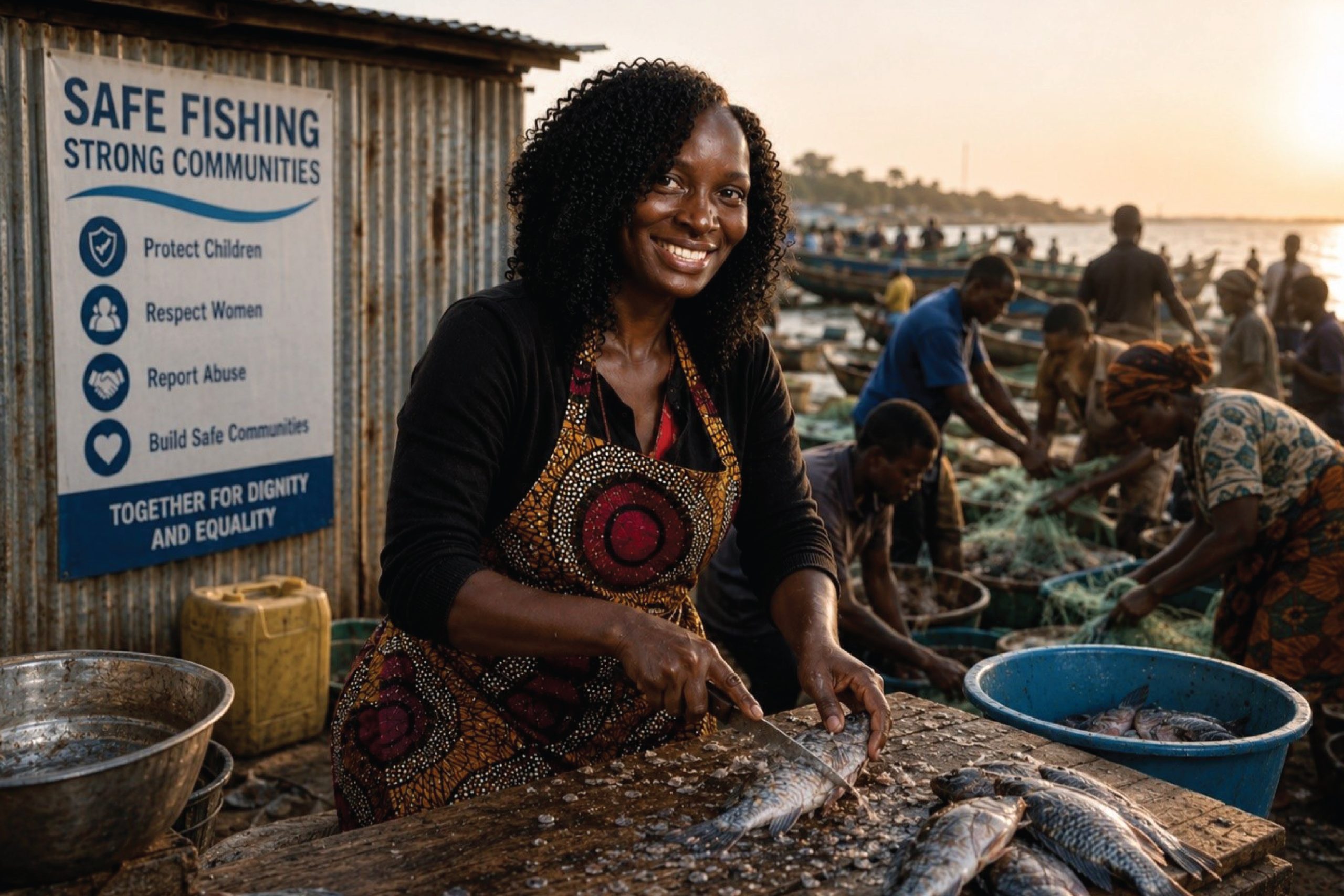
The vulnerability that development programs encounter in fisheries communities is embedded in market structures, community infrastructure, and the life cycles of the people those programs serve.
Genuine safeguarding must, therefore, begin earlier, reach deeper into communities, and connect directly to program design rather than remain a compliance exercise.
- Interventions must begin in schools rather than in workshops
The single highest-leverage safeguarding investment a fisheries program can make is to keep girls in school and to influence what boys learn while they are there.
Research in Siaya County, Kenya, has established a direct relationship between fishing activity and school dropout rates among girls. Once a girl leaves school, economic and sexual vulnerabilities increase rapidly. Programs should establish or contribute to scholarship pipelines that target children, particularly girls, in their areas of operation. This is safeguarding infrastructure and should be treated as core program design.
Beyond retention, programs should partner with local schools to integrate age-appropriate education on body autonomy, consent, and healthy relationships into curricula. Programs must be codesigned with teachers and community leaders. Girls need to learn early that jaboya is not a market law but a power imbalance that can be named and refused. Boys must learn that exploiting a woman’s economic desperation constitutes abuse and not entitlement or negotiation.
- Diversify economic options to reduce dependency and risk
Jaboya does not persist because women lack awareness. It persists because, for many, the alternative is no fish and no income. When fishing is the only visible livelihood, fish scarcity becomes a total crisis, which deepens safeguarding risks.
Programs can expose young people to realistic, lower-barrier alternatives through career talks and livelihood showcases. Sector-adjacent options, such as fish processing, cold-chain logistics, and boat repair, reduce dependency on the daily catch without abandoning the community’s economic identity.
Digital opportunities deserve a place as well. Content creation and mobile commerce are accessible to any young person with a smartphone. MSC’s analysis of youth entrepreneurship consistently shows that combining economic opportunity with skills, mentorship, and market linkages is far more durable than access to finance alone. The goal is to keep communities in fishing while ensuring that it remains a safe choice rather than becoming a trap.
- Build physical infrastructure as a core safeguarding feature
Blog 1 documented the WASH deficit at most landing sites. For women and girls, this entails a daily risk of protection rather than mere inconvenience.
Organizations should treat investment in gender-segregated, lockable sanitation and bathing facilities as a core safeguarding expenditure. Where budgets do not allow direct investment, organizations should advocate with county governments, water authorities, and infrastructure donors to secure these facilities. Programs cannot credibly claim to protect women while leaving them exposed to menstruation without privacy. The physical environment forms part of the protection framework.
- Build community-led protection systems that outlast the project
Formal reporting mechanisms, such as hotlines, safeguarding officers, and written complaint processes, frequently fail at landing sites. They are distant, often unknown, and mistrusted by communities with long experience of institutions that do not follow through.
Programs should invest in community safeguarding champions. Trusted local individuals can receive concerns, provide first-line support, and escalate cases appropriately. Jaboya is sustained by demand, and efforts to change that demand must engage men and youth as community champions.
Peer mentorship is equally important. Evidence from MSC’s gender-inclusive aquaculture work in India and from Nyamware Beach on Lake Victoria confirms this finding. When women gain control over productive assets, such as boats, savings groups, and processing infrastructure, they shift power dynamics more durably than training alone. A protection system succeeds only if it remains after the program team leaves.
- Integrate psychosocial support to address existing harm and future risk
Safeguarding frameworks must address existing harm as well as future risk. Frameworks that fail to do both remain incomplete by design.
MSC’s work on meaningful financial inclusion for women has consistently shown that the physical, social, and psychological barriers women face cannot be addressed by economic programming alone. Psychosocial dimensions must be embedded into program design.
Communities experience high levels of trauma where jaboya is normalized, housing offers no privacy, and economic precarity is constant.
HEDSO’s mental health programming directly links the jaboya system to depression, anxiety, substance abuse, and suicidal tendencies among young women. A UNICEF-commissioned report by ODI and LVCT Health found that one in three adolescent girls aged 15 to 19 in Homa Bay County are mothers or pregnant, which is nearly twice the national average.
Implementing organizations must identify available services and establish referral pathways before implementation begins.
For instance, LVCT Health runs a toll-free youth counseling hotline that is available 24/7. HEDSO delivers community-based mental health support across the lake region, and Farm Africa’s YISA program targets jaboya prevention through women’s asset ownership and cage aquaculture.
Mapping these services is necessary but insufficient, since most remain concentrated in county towns far from landing sites where risk is highest.
Program mapping may reveal that the nearest gender-based violence (GBV) counseling service is 45 km from a primary landing site. Such findings indicate systemic gaps in service provision rather than isolated safeguarding challenges. Programs should document these gaps and use the evidence to inform donor reporting, engage county governments, and shape policy discussions. Program learning should support system-level change and should not remain confined to safeguarding documentation.
Programs must also simultaneously advocate for decentralized outreach models, co-fund mobile or community-based psychosocial services where possible, and build first-aid psychosocial capacity into community champions. This ensures that some support exists at the landing site while longer referral chains are strengthened.
A framework for practitioners
The five interventions above extend beyond the scope of most safeguarding frameworks. Safeguarding and program design are not separate workstreams. The conditions that keep women and children safe in fisheries communities also enable economic empowerment programs to succeed. If safeguarding is to remain meaningful, it must address the conditions that make them vulnerable in the first place.
Before we finalize any safeguarding plan, we must ask:
- Does our risk assessment name jaboya or equivalent transactional sex dynamics?
- Does our community mapping include children under 18 who are already active in the fisheries economy?
- Have we assessed WASH and housing infrastructure at our target landing sites, and do we have a response?
- Are any school partnerships and scholarship commitments written into program design?
- Do community champions include men and youth, and are they resourced to continue after project closure?
- Are psychosocial referral pathways identified and functional before implementation begins?
Any negative answer indicates a need to redesign the program.
Samaki hukunjwa angali mbichi. If the fish must be folded while fresh, safeguarding must begin while the fish is still fresh, in schools, in communities, and in the design rooms where programs are built. It is at these entry points that risk can be reduced before it hardens into harm, and risks the lives of Adhiambo and many like her.
MSC works across financial inclusion, agriculture, fisheries, gender equality, and youth economic empowerment in more than 65 countries. Visit our library at www.microsave.net/library to explore fisheries finance work across Asia and Africa. The insights in this series are based on on-the-ground work with fishing communities.
Written by

Lois Eva Adongo
Senior Manager
Catherine Atieno
Senior manager
Leave comments