Bank-led individual enterprise loans for SHG women: Promise, practice, and field realities
 by Ravi Kant, Vaishaly Shrimall and Priyali Das
- Aug 27, 2026
- 7 min
 by
by  Aug 27, 2026
 7 min
7 min 


Banks are offering enterprise loans to help women in self-help groups (SHGs) scale their businesses. However, rigid documentation and appraisal requirements limit access for informal rural enterprises. Success depends on tailored product design, alternative data, and enterprise-readiness support.
Could the next wave of women-led economic growth be emerging from India’s self-help groups?
For decades, self-help groups (SHGs) have been at the heart of India’s financial inclusion story, helping millions of women build savings, access credit, and strengthen their economic resilience. Through years of disciplined savings, timely repayments, and collective support, SHG women have established a proven track record as reliable borrowers. Yet, as their enterprises grow and ambitions expand, many face a familiar challenge: accessing the larger amounts of capital needed to scale their businesses.
Today, a new generation of enterprise loan products is helping address that gap. Across India, public sector banks are moving beyond traditional group-based lending and introducing individual enterprise loans for women SHG members. These products mark an important shift in the SHG finance journey. By offering higher-ticket loans above INR 75,000 (USD 786), they enable women entrepreneurs to invest in business expansion, acquire productive assets, and meet larger working capital requirements.
The Deendayal Antyodaya Yojana–National Rural Livelihoods Mission (DAY-NRLM) and the State Bank of India (SBI) helped drive this progressive shift to support women’s economic advancement. In September 2023, SBI launched Svayam Siddha, an individual enterprise loan product for women in SHGs. The bank designed the product as a step towards the Government of India’s Lakhpati Didi scheme. The scheme seeks to enable SHG women to achieve an annual household income of at least INR 100,000 (USD 1044). Since then, other public sector banks (PSBs) and regional rural banks (RRBs) have launched similar products. These include Star Sakhi, Union Nari Shakti, IND MSME Sakhi, and Digi Shrestha.
Moving from group loans to individual enterprise loans
Traditional SHG-bank linkage loans are extended to SHGs, which then lend internally to their members. Enterprise loans represent a further stage in this journey. While SHG credit linkage enables women to access formal finance and build a credit history, individual enterprise loans help them expand businesses and make larger investments.
Under these products, the individual SHG member becomes the borrower. However, their SHG journey remains relevant to the lending decision as it provides banks with useful information on membership history, savings discipline, previous credit linkage, and repayment performance.
These indicators can help reduce information asymmetry between banks and women entrepreneurs, particularly where conventional financial records remain limited. The shift from group lending to individual enterprise lending does not replace the SHG model. Instead, it builds the institutional relationships, financial discipline, and credit history that SHG participation develops.
How are these products working in practice?
Individual enterprise loan products can serve as an important bridge between financial inclusion and enterprise growth. Through state rural livelihoods missions (SRLMs) cadres, banks identify potential loan applicants and source applications. These cadres also support entrepreneurs in preparing proposals, handling documentation, and conducting initial validation.
For women entrepreneurs, these products create a pathway to individual credit that recognizes their economic activity beyond the group framework. They can provide larger or more flexible financing for enterprises that exceed group-based borrowing limits.
However, MSC’s (MicroSave Consulting) field experience indicates that implementation remains a work in progress. The products appear to work better when applicants have an operating enterprise, formal documentation, visible cash flows, and clear business ownership. Implementation becomes more difficult when enterprises operate informally, rely on family members, or depend on local procurement practices. These features are common among rural enterprises but often conflict with conventional banking requirements. Banks typically require clear processes for appraisal, documentation, procurement, and disbursement.
This gap highlights the need to align product processes more closely with the realities of rural enterprises.
Challenges across the credit journey
MSC’s work to scale enterprise financing for SHG women entrepreneurs across multiple states in India has highlighted challenges at different stages that may limit product uptake, timely credit delivery, and impact despite collaboration with banks, NRLM, SRLMs, community institutions, and women entrepreneurs.
1. Loan application stage
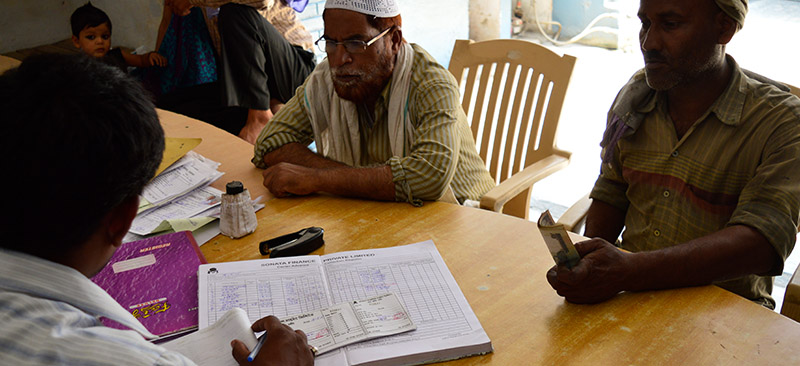
Bank processes often require additional documents, land records, rent receipts, quotations, and registrations. While necessary for risk management, these requirements can pose challenges for rural women entrepreneurs operating informal enterprises with limited documentation.
Common issues include mismatched identity and business details, assets registered in family members’ names, and limited familiarity with loan procedures, resulting in incomplete applications. This may lead to repeated branch visits, increasing the time and cost of accessing credit and discouraging eligible borrowers.

2. Appraisal stage
During appraisal, banks assess the borrower’s repayment capacity, enterprise viability, cash flow, and overall credit risk. Branches generally prefer applicants with established businesses, stable income, and adequate supporting documents.
Enterprises in agriculture-allied sectors face additional scrutiny. Disease outbreaks, livestock mortality, and income volatility create risks for these enterprises. These risks do not necessarily make such enterprises unviable. However, they highlight the need for sector-specific appraisal tools.
From the borrower’s perspective, several factors make it difficult to demonstrate individual repayment capacity. These include limited credit history, weak business plans, and a lack of formal records. Limited branch-level sanctioning authority and staffing constraints can further extend processing times. They can also increase the risk of borrower drop-off.

3. Disbursement stage
At disbursement, banks may require vendor verification, formal invoices, or Goods and Services Tax (GST)-compliant documents to independently verify the transaction and end use of funds through conventional documentation.
In practice, rural entrepreneurs typically purchase inputs and assets from multiple small local vendors and informal suppliers, many of whom do not provide invoices, hold GST registrations, or accept direct bank payments. When banks require formal procurement channels, borrowers face higher costs and lower enterprise returns, sometimes prompting them to abandon the loan process. This reflects a structural mismatch between formal banking requirements and the practices of informal businesses.

A balanced way forward
The field challenges do not undermine the relevance of individual enterprise loan products. Bridging the gap between formal banking requirements and rural enterprise realities requires action at three levels: product design, operational processes, and the broader policy environment.
1. Product-level
a. Align credit products with enterprise needs
Financial institutions should focus not only on expanding credit but also on offering the right type of credit. While banks are often more comfortable financing fixed assets through term loans, many micro and small enterprises primarily need working capital, creating a product mismatch that can constrain growth and increase repayment risk. A simplified cash-flow-based assessment of working-capital requirements can help lenders design more appropriate products and improve portfolio quality.
b. Refine operational guidelines
Product features and operating guidelines should reflect the sector, enterprise stage, loan purpose, and borrower profile. Banks can allow alternative procurement verification where formal invoices are not feasible. Options can include SHG or federation certification, local vendor confirmation, transaction receipts, or post-purchase asset checks.
Banks can retain supplier payments where practical and allow borrower-account disbursements in suitable cases, with safeguards and post-disbursement verification.
c. Use alternative data for credit assessment
Where formal credit histories are limited, banks can supplement conventional underwriting with alternative data sources, including behavioral, transactional, and digital indicators such as bank account statements, utility payment records, gig-work earnings, and UPI/digital payment records.
In the SHG context, savings discipline, internal lending, repayment records, and bank account transaction data can provide valuable insights into members’ financial behavior. The Account Aggregator (AA) framework can also enable secure, consent-based sharing of relevant SHG data. This can strengthen women’s financial identities while preserving their control over how their data is used as borrowers.
MSC’s whitepaper on the AA framework and SHG ecosystem shows how verifiable financial and behavioral data can improve credit assessment. This approach can potentially expand credit access to more than 100 million SHG women. Banks should use this data through transparent, context-specific scoring methods. Community validation and safeguards should support these methods to prevent exclusion or misuse.
2. Process-level
a. Strengthening enterprise-readiness support
Access to credit alone may not ensure successful enterprise growth. Borrowers often need support with business plans, documentation, investment estimates, cash flow management, and procurement plans.
MSC’s experience across Bihar, Uttar Pradesh, and Uttarakhand shows that training and support through community cadres can improve borrower preparedness.
Enterprise-readiness support should therefore form part of the financing ecosystem. It should cover business diagnostics, financial management, application support, digital literacy, and post-disbursement mentoring.
Community cadres and SHG federations can help borrowers prepare stronger applications. They can also help borrowers manage enterprises after disbursement, thereby improving both credit access and outcomes.
3. Policy level
a. Risk-sharing support for financial service providers
Under the traditional SHG Bank Linkage Programme, SHGs’ collective guarantee and peer accountability largely manage repayment risk. Enterprise finance lacks this social collateral, thereby increasing banks’ perceived risk of individual borrowers.
A dedicated risk-sharing facility can complement existing guarantee mechanisms, such as the Credit Guarantee Fund Trust for Micro and Small Enterprises (CGTMSE), particularly where lenders find the available cover inadequate from a risk-management perspective. Long cooling-off or claim-settlement periods can also require lenders to make provisions before guarantees are realized, affecting their balance sheets and appetite for enterprise lending.
Banks, NRLM, and SRLMs can therefore explore more responsive risk-sharing arrangements, including appropriately structured first-loss mechanisms, while maintaining prudent underwriting and borrower accountability.
b. Waiver of stamp duty on loans
Stamp duty adds to the cost of borrowing and can increase the financial burden on entrepreneurs. The Assam Cabinet has approved a waiver of stamp duty on loans of up to INR 1 million (USD 10,445) availed by SHG members under ASRLM, helping reduce the cost of accessing formal credit. Other states could consider similar measures to lower borrowing costs and encourage enterprise development and livelihood generation among rural women.
Conclusion
Bank-led individual enterprise loans for SHG women are an important step in the pathway from financial inclusion to enterprise growth. However, scale and impact require more than product availability.
Banks can bridge the gap between formal banking requirements and rural microenterprise realities through better-aligned products and processes, as well as alternative data-based underwriting. Credit guarantee support and strong enterprise-readiness systems can further strengthen this approach. Together, these measures can create a more inclusive and sustainable enterprise finance ecosystem and support the next phase of the Lakhpati Didi scheme, enabling an additional 30 million Lakhpati Didis.
Written by



Leave comments