Why wait for a complaint? How automation and AI can detect missed social protection entitlements
 by Arshi Aadil
 Sep 14, 2026
 7 min
7 min


Digital systems can detect failed or missed social protection payments before beneficiaries report them. This blog explores how proactive case detection can combine rule-based reconciliation with AI-assisted analysis to reduce grievance burdens, improve government efficiency, and strengthen trust in social protection systems.
When a tranche of social protection payment does not arrive, the government’s digital systems know about it before the beneficiary does.
Usually, in such cases, one system records that the person is enrolled. Another shows that payment is due. A payment platform records whether an instruction was issued, while the receiving bank returns a failure code. Yet, these signals frequently remain scattered across institutions. The burden of joining them together falls on the person who has not received the benefit.
The recipient must notice that an installment is missing and check whether others have received it. They must then check the online status and interpret any unfamiliar error message. Finally, they must identify the right institution to approach, such as the bank, the local administration, the program helpline, or the identity service provider. The complaint may then move between departments because no official has a complete view of the delivery chain.
As social protection systems become increasingly digital, governments should ask a simple question: If the state can detect that an expected entitlement has not been delivered, why should it wait for the beneficiary to report the failure?
This blog uses India as its main example because the country’s Direct Benefit Transfer (DBT) programs combine large beneficiary registries with digital payment systems. The underlying proposition is more broadly relevant, particularly to countries with transaction-level program and payment data.
From reactive grievances to proactive analysis
Governments can solve this issue by building a reconciliation and case-detection layer on top of existing social registries, program management systems, and payment infrastructure. This layer would reconcile what a person was expected to receive with what the delivery system confirms they received.
The process should begin with a rule engine rather than an artificial intelligence (AI) model at this stage. For recurring payments, a rule may identify the following discrepancy:

Most coded failures could be diagnosed and routed through predefined rules. AI could address the remaining cases where the response is generic, records are conflicting, or the available code does not reveal the underlying cause. In such cases, AI could assemble the evidence, compare the case with verified history, and suggest a possible cause for official review. It could also convert fragmented records into a short operational report, as illustrated:

The case-detection layer would assign the case, start a resolution clock, and notify the program recipient. If the recipient is needed to act, the system would send a message that explains the required action and suggests the next steps. If the failure is internal, the administration should retain responsibility for correction.
How could the approach work?
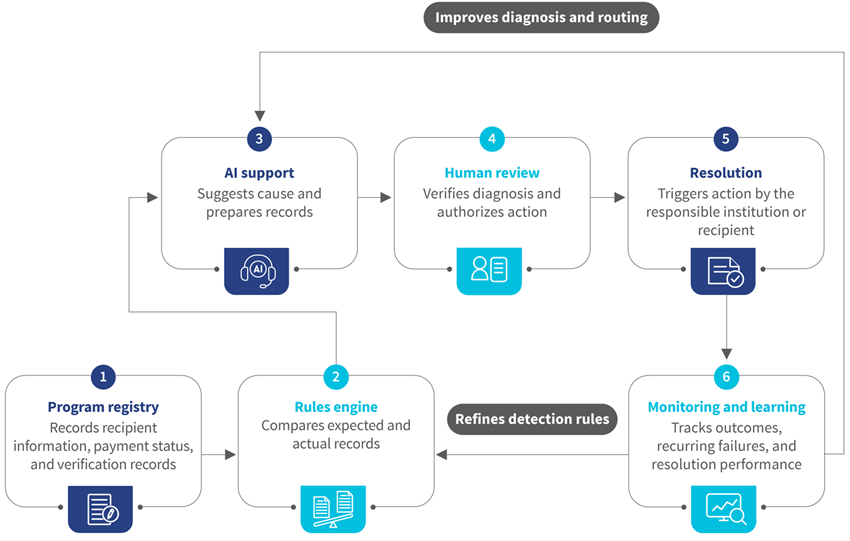
These layers in the approach are distinct. Rules identify and route known discrepancies, while AI assists with unresolved diagnoses, summarization, and pattern recognition. Meanwhile, humans verify the assessment and authorize consequent action.
AI should never independently terminate a benefit, alter eligibility, modify a bank record, or close a case. Where records conflict, the model should flag the inconsistency rather than choose which database to believe. Only an authorized official should make any decision that could reduce or stop assistance, with an intelligible explanation and an opportunity for the beneficiary to respond.
Privacy by design, instead of unlimited data access
Proactive problem resolution must not justify the creation of a centralized profile for every beneficiary. An AI model does not need unrestricted access to Aadhaar numbers, bank accounts, balances, biometrics, or complete household histories.
A secure gateway could provide only the minimum necessary information. This gateway could include whether a payment was expected, whether it was initiated, the failure category, and whether relevant conditions were complete. Direct identifiers could be replaced with case references. The underlying information would remain with the institution responsible for it. Authorized officials would access identifiable records only when needed to resolve matters. Purpose limitation is equally important. Data accessed to restore an entitlement should not later be used for any other purpose.
How much time and effort could this save?
The potential savings begin before the formal grievance clock starts. In India, central government grievances resolved through the Centralized Public Grievance Redress and Monitoring System (CPGRAMS) took an average of 14 days in 2026. This figure, however, measures the period after a complaint is registered. It excludes the time a beneficiary spends when they notice a missing payment, find its probable cause, and locate the responsible institution. MSC’s research on PM KISAN, an income support program for farmers in India, found that recipients had to visit offices multiple times to resolve their grievances.
India’s standard operating procedure for DBT payments already provides daily status updates and detailed success or failure responses, including failure codes, to flow back to the implementing ministry. Once daily payment data are reconciled, the system could flag a possible missing payment and send it for review within one working day. It would, therefore, replace an uncertain period of discovery and institutional navigation with near-immediate administrative awareness.
It would not make every correction instantaneous. Notably, a bank account problem, a disputed land record, or an eligibility review may still require human action. The realistic benefit would be faster detection, more accurate routing, and fewer visits. The following table presents an illustrative India-based scenario that shows the potential effect of the intervention:
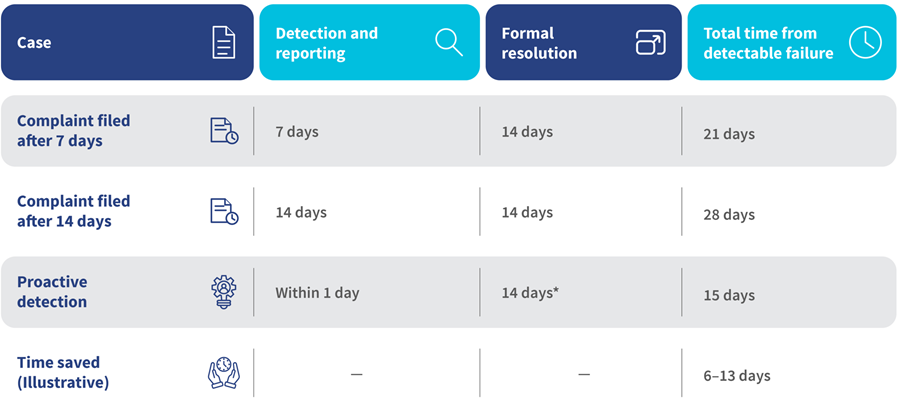
*Note: These scenarios are illustrative. The one-working-day period is a proposed service standard after the failure becomes visible in the reconciled payment date. The seven- and 14-day complaint periods are assumptions. The 14-day period is the FY25–FY26 CPGRAMS average disposal time for central government grievances.
Why should this matter to the government?
Early detection would also make program administration more efficient. An unresolved payment can generate repeated work across program teams, grievance officers, local offices, banks, and auditors. Identifying the problem at its source would reduce the need for complaint handling, case transfers, manual reconciliation, payment reprocessing, and follow-up. It would also allow officials to correct a common failure that affects a bank, payment batch, or district once, rather than address it separately for every recipient. This would free staff capacity for more complex cases and other delivery priorities. Early detection would also strengthen public trust by showing that the program can act on failures without waiting for people to pursue multiple institutions.
How can governments test this approach?
In many programs, particularly in low- and middle-income countries (LMICs), the first challenge will be to connect fragmented data and establish who can act on the resulting alert. A pilot should therefore test the underlying infrastructure and the proposed intervention.
1. Assess readiness and select a viable program
The pilot should map the journey from eligibility approval to final delivery. It should establish:
- Whether the program has a reliable record of who was due to receive what and when;
- Transaction-level payment outcomes;
- Identifiers that can link the records;
- Sufficiently frequent data updates.
The assessment should also identify the legal basis for data exchange and the institution authorized to resolve each type of failure. The first phase in the pilot should focus on building these foundations where they are absent.
2. Connect the data and test the reconciliation rules
The next step should be to create a controlled link between program and payment records, using secure data extracts or APIs where available. This step would begin with clear rules that compare expected and confirmed payments. AI-assisted diagnosis should be introduced only where standardized failure codes or sufficiently verified case histories are available. Some pilots may initially remain entirely rule-based until the data are sufficient to support AI analysis.
3. Run a human-led case-management pilot
The AI-based system should first run in shadow mode. During this phase, officials should verify flagged cases, assess the suggested cause, and route each case to the responsible institution. They should record every action, including whether the alert was correct, what information was required, and whether the responsible institution could resolve the case. Officials should also verify AI recommendations, investigate conflicting records, and authorize any action that affects eligibility or payment. A case should close only after delivery is confirmed or officials communicate a clear decision to the beneficiary.
4. Evaluate feasibility before scaling
The pilot should measure data completeness, the proportion of records successfully matched, alert accuracy, false positives, detection and resolution times, entitlements restored, and the effort required from officials and recipients. The evaluation should also estimate the cost to address infrastructure and coordination gaps. Scaling would make sense only where alerts are reliable, and the institutions that receive them can act.
AI is already finding its way into public programs, often through complaint analysis and monitoring. A less explored opportunity is to use AI for earlier case detection. Instead of waiting for a beneficiary to discover a missing benefit and navigate the grievance system, the administration could identify the failure first. This could flag a possible exclusion, rejected payment, or missing benefit before the affected person must navigate the grievance system.
Social protection programs should build on these early uses and test applications that improve day-to-day delivery, including early identification of missed or failed payments. This would allow administrative action to start sooner. The result will save time and resources for both governments and program recipients.



Written by

Arshi Aadil
Senior Manager
Leave comments