Are we addressing the real constraints to health-worker performance?
 by Kavya Shah, Pooja Parmar and Boijayanti Sarker
 Sep 24, 2026
 6 min
6 min


This blog examines why performance gaps among health workers do not always reflect training gaps. It explores how role clarity, supervision, deployment, facility readiness, and system constraints shape performance. The authors present a framework for diagnosing gaps, identifying actors to address those gaps, and matching interventions accordingly.
A woman in labor develops a complication that requires urgent referral. The Auxiliary Nurse Midwife (ANM) attending to her recognizes the danger signs, follows the protocol, and initiates the referral. But the ambulance is unavailable. The nearest referral facility does not have the capability to manage the complication and the blood that may be required is not available. The woman does not receive the care she needs in time.
Where, in this case, did the failure occur? Was it a gap in the ANM’s knowledge or skills? Did she fail to recognize the complication or act on it? Or did the breakdown occur elsewhere in the pathway that should have enabled her actions to translate into care?
The answer matters because how we diagnose the problem determines how we try to fix it. When poor service delivery is attributed to health-worker performance, the distinction between a competency gap and a system constraint is often overlooked. As a result, training can become the response to problems it was never designed to solve. When a health program underperforms, a common response across ministries, donors, and implementing organizations is to retrain the health workforce. This instinct is not unreasonable. Human resources for health (HRH) are the point of contact between health systems and the people they serve, and their knowledge and skill genuinely matter. But the problem arises when we default to retraining without first understanding what is causing poor performance.
This is not to argue that training doesn’t work. Where a cadre genuinely lacks the knowledge or skill a role requires, training closes that gap well. Evidence from Peru shows that training alone is not a sufficient intervention because it leaves untouched the deeper problems like attrition and weak supervision that shape how a worker behaves on the job. The question then is whether poor performance reflects a genuine competency gap or whether constraints elsewhere in the system are preventing the worker from performing effectively.
Figure 1: World Health Organization’s (WHO’s) six building blocks of a health system
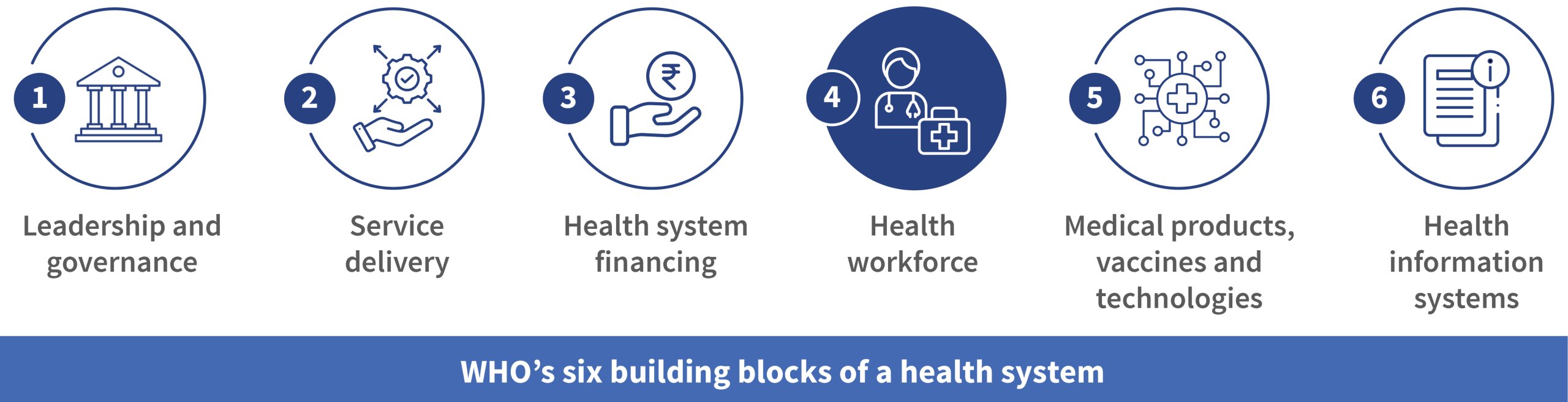
One lens to address this question comes from the WHO’s health systems framework (Figure 1). The framework’s emphasis on interconnectedness highlights that health-worker performance depends partly on how well the surrounding health system functions. This implies that a health worker’s performance is not something they generate on their own. It depends on whether their role is clearly defined, whether they have access to the medicines, equipment and information they need and whether the facilities and referral systems around them are capable to respond.
A “system” failure hence is not a single black box. It is usually a chain of decisions, a district store that under-ordered, and a supervisor who never visited. Yet, it is often the health worker who absorbs the blame because they remain the most visible actor in that chain. A dysfunctional referral pathway, a non-existent supervision structure, or a deployment decision made several levels above them sit further back in the system and can therefore go unexamined and unaddressed. This also helps explain why retraining so often becomes the default response even when the actual constraint sits elsewhere in the system.
The pathway from training to better service delivery, therefore, has several links: training must build competency, competency must translate into performance, and that performance must connect with a functioning service-delivery pathway. A failure at any one of these points can produce the same visible result: poor service delivery.
Illustrative examples of where and how the system might break down
- Unclear roles: Before competency can be verified, there has to be clarity on what a health worker is expected to do. Without this clarity, we risk adding tasks and training to cadres without considering whether those tasks belong within their role. Getting the right person, with the right competencies, to perform the right role, therefore starts with clearly defining what each cadre is expected to deliver.
- Inadequate supervision: Even when roles are clearly defined, health workers may not receive the supervision needed to translate those expectations into practice. Studies consistently show that supportive supervision measurably increases direct patient care. In practice, however, supervision can remain focused on compliance rather than on assessing competencies, identifying performance gaps, and supporting workers to improve.
- Poor deployment: A well-trained and supervised worker cannot compensate for being posted in the wrong place. For instance, in Indonesia, only 4 of 38 provinces have one doctor per 1,000 people. The challenge, therefore, is not only the workforce size but how effectively it is distributed in relation to population need.
- Facility-level constraints: Even when the right worker is in the right place, performance can still be constrained by the absence of basic inputs. A trained health worker cannot deliver services effectively without the medicines and equipment required for their role. This holds particular relevance for Community health workers in low- and middle-income countries, who face stock-outs of essential medicines nearly one-third of the time.
Together, these examples show how a performance gap that appears at the level of the health worker may originate elsewhere in the system. They are not exhaustive. Financing, workload and staffing, referral systems, technology, governance, and other system-level factors can similarly shape whether health workers are able to perform effectively. The specific constraint will vary across contexts, which is precisely why identifying where the performance gap lies must come before deciding how to address it.
What actually moves the needle
Rather than defaulting to training, the first step is to understand what is driving the performance gap and where in the pathway does it occur. The framework below provides a simple way to diagnose whether the constraint lies in the worker’s role, competency, enabling environment, ability to sustain performance, or the wider health system.
A framework to identify where the performance gap lies in the health system:
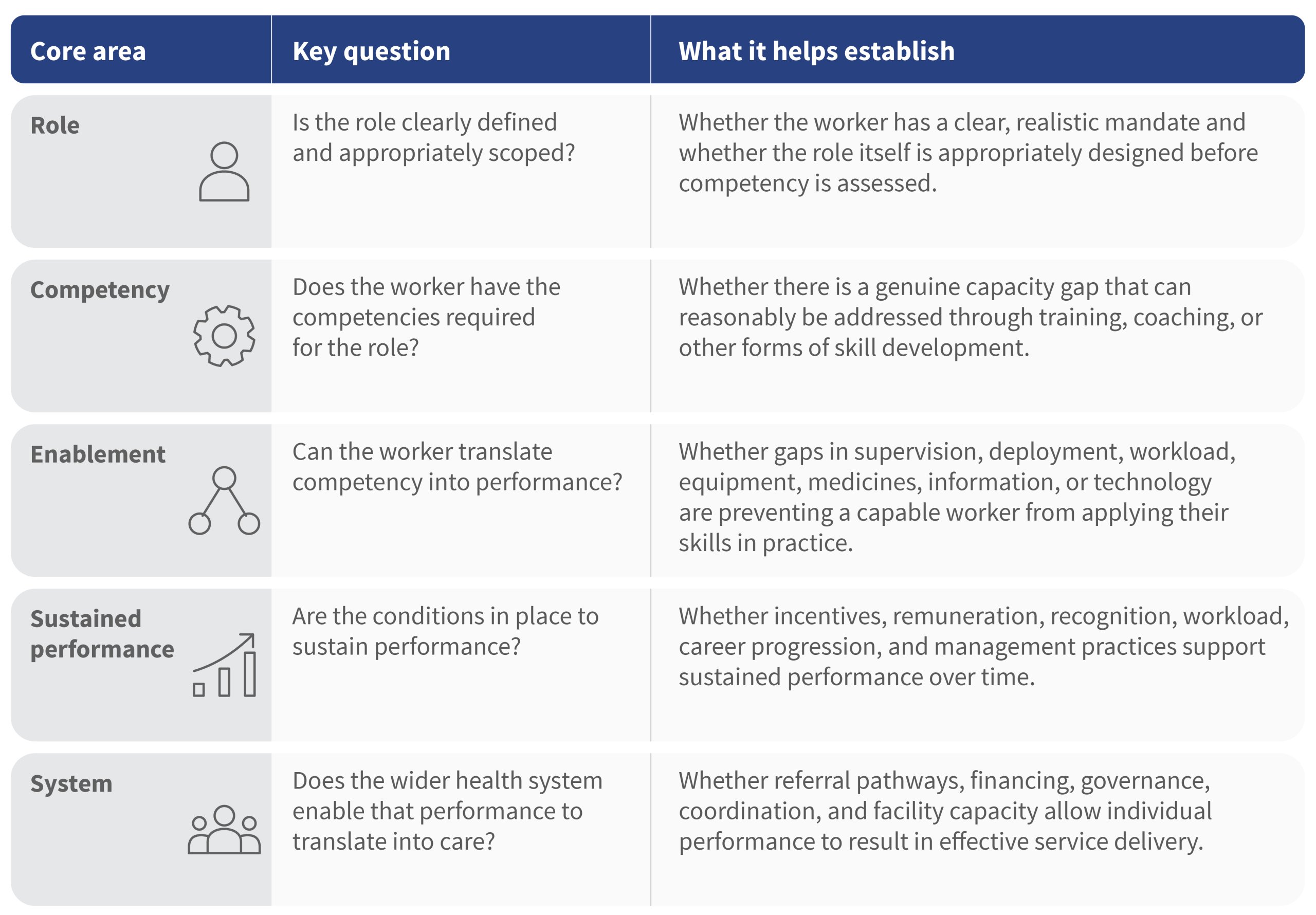
Identifying where the performance gap lies is only the first step. The next is determining who is best placed to investigate its cause and act on it. This should not automatically be the actor closest to where the failure becomes visible. Instead, ownership of the diagnosis should follow three simple questions:
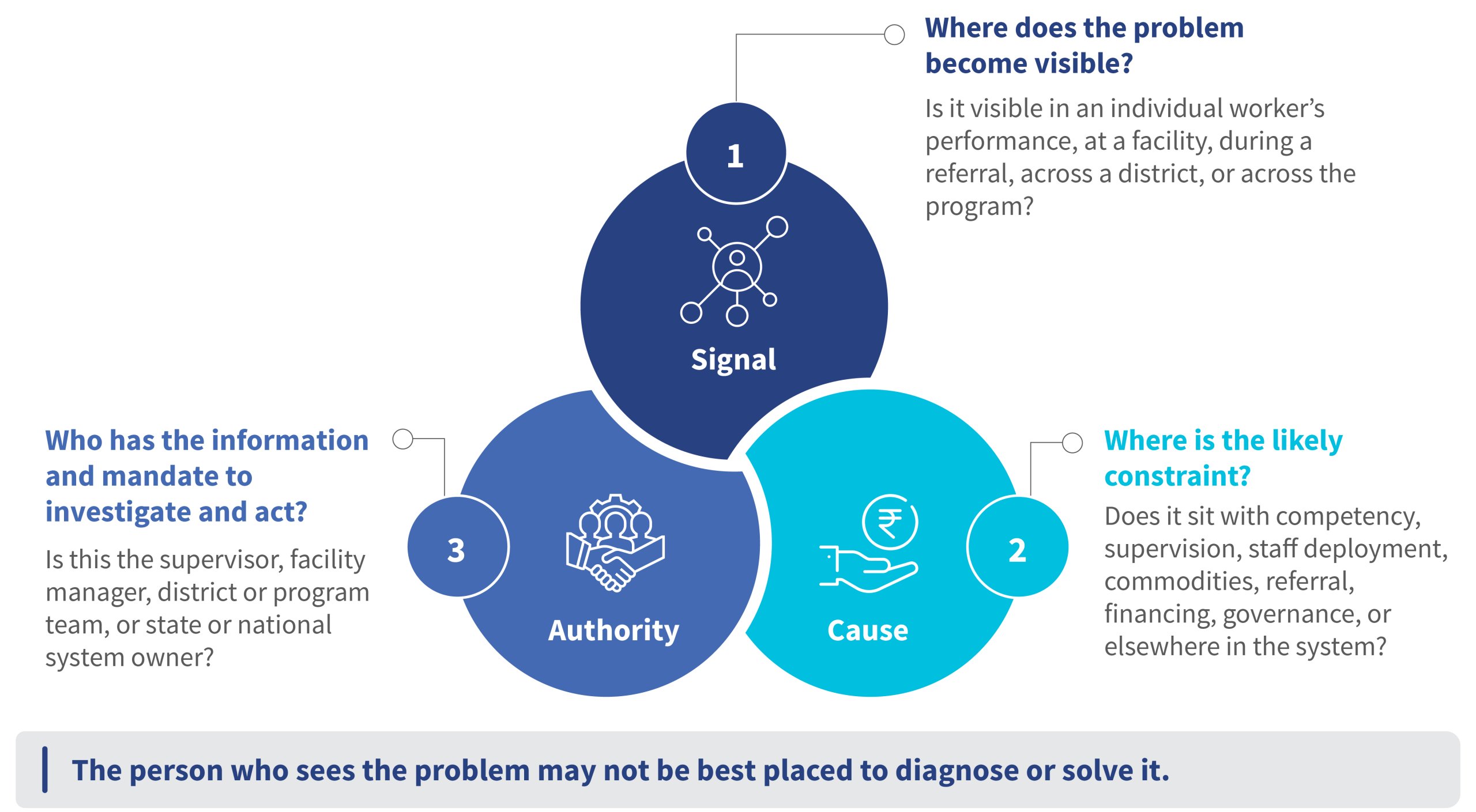
For example, if a health worker is unable to demonstrate a competency required for their role, a supervisor or clinical mentor may be best placed to diagnose the gap. If trained workers across a facility are unable to deliver services because essential commodities are repeatedly unavailable, the diagnosis needs to involve facility and district management. If patients are consistently lost between referral points, the district or program team may need to bring together the actors responsible for referring, transporting and receiving patients. Where the same deployment, financing, or governance constraint recurs across multiple districts, diagnosis may need to move further upstream to the state or national level.
The principle is simple: the actor at whom a problem becomes visible should not automatically become the actor held responsible for diagnosing or fixing it. The person who experiences the constraint, the person best placed to diagnose it, and the person with the authority to address it may all be different actors.
Conclusion
The aim is not to train less, but to diagnose better. Not every performance gap is a training gap, and the actor closest to the problem may not always be the best placed to address it. When service delivery falls short, the first task is to understand where the pathway is breaking down, what is causing the gap, and who is best placed to act on it.
The diagnosis should then guide the programmatic response. A competency gap may require training, an unclear role may require role redesign or clearer responsibilities, an enabling gap may call for better supervision, deployment, commodities or tools, and constraints in the wider system may require changes to referral pathways, financing, governance or coordination. The value of the framework is therefore not simply in identifying the problem, but in helping programmes match the right intervention and the right actors to the gap they are trying to solve.


Written by




Leave comments