From prevalence to program response: How the NFHS-6 and the Poshan Tracker can strengthen nutrition decision-making
 by Dipanshi Sood, Dr. Manmohan Singh, Dr. Puneet Khanduja and Sidharth Prusty
- Oct 27, 2026
- 5 min
 by
 Oct 27, 2026
 5 min


In this blog, we explore how India can combine population-level insights from NFHS-6 with real-time Poshan Tracker data and frontline evidence to identify nutrition risks, strengthen service delivery, and enable interventions to improve child nutrition outcomes.
What does it take to turn nutrition data into action?
In India, the answer lies not in a single database or survey, but in a connected information ecosystem. Periodic household surveys, routine beneficiary monitoring, health and supply systems, and an extensive frontline network each provide a different piece of the puzzle. Together, they power an integrated decision cycle that answers four critical questions: Where is the burden greatest? Which households need support now? What intervention is most likely to help? And are those efforts delivering results?
Answering these questions requires looking at nutrition through multiple lenses. Each data source has a distinct role at both the population and individual levels. The National Family Health Survey-6 (NFHS-6) provides a population-level view of nutrition outcomes, their distribution, and associated factors. The Poshan Tracker brings the picture closer to real time and offers insights into beneficiary growth patterns and the continuity of program responses. Additional health, supply, entitlement, and community data help explain what lies behind the numbers, which enable decision-makers to identify likely drivers and tailor interventions accordingly.
The NFHS-6 presents a varied picture of progress in child nutrition. Stunting among children under five declined from 35.5% in NFHS-5 to 29.3% in NFHS-6. Severe wasting also fell from 7.7% to 5.2%. However, overall wasting changed only marginally, from 19.3% to 19.0%, while underweight declined from 32.1% to 31.8%. Complementary feeding practices improved, although few children receive an adequate diet.
These findings highlight two priorities. First, India must consolidate gains in reducing chronic undernutrition. Second, it must strengthen responses to acute undernutrition and multiple forms of deprivation. This requires early detection of growth faltering, tailored case management, and closer assessment of service, behavioral, and household factors associated with persistently poor diets.
These findings support strategic prioritization rather than causal attribution. As a cross-sectional survey, the NFHS estimates population patterns at specific points across survey rounds. It does not follow individual children over time or isolate nutrition services from concurrent improvements in health care, sanitation, food security, education, or social protection. Separate evaluation designs are necessary to establish causal links. For program management, the NFHS-6 identifies priority outcomes, geographic areas, and vulnerable groups that require targeted action.
While the NFHS-6 helps establish strategic priorities, the Poshan Tracker supports decisions about individual beneficiaries and service delivery. The two sources answer distinct but complementary operational questions. The NFHS-6 estimates the prevalence and distribution of nutrition outcomes and highlights associated maternal, household, and service factors. The Poshan Tracker records repeated physical measurements and service contacts for registered beneficiaries. When measurement quality and record continuity remain adequate, these observations show whether a child grows as expected, begins to falter, or recovers after support.
Connecting both sources preserves their distinct purposes. The NFHS-6 provides a population benchmark for national, state, and district priority-setting. The Poshan Tracker supports active case management and operational oversight between survey rounds. Decision-makers can assess discrepancies against differences in coverage, definitions, measurement quality, and program reach. This approach helps them interpret each source on its own terms and use the combined evidence appropriately.
Administrative and frontline data complete the decision picture. Health data provide evidence on illness, anemia screening, and referral completion. Supply systems track continuity of supplementary nutrition and equipment functionality. Social protection records confirm whether eligible households access broader entitlements. Frontline observations and community feedback provide essential context on food affordability, care practices, migration, and service delivery. A Poshan Tracker-plus framework combines these sources through structured triangulation to guide targeted action.
Together, these three layers support different decisions: The NFHS-6 informs strategic prioritization, the Poshan Tracker supports beneficiary and service delivery management, and complementary data help identify causes and select responses. An effective operating model must translate these insights into clear responsibilities, standard response protocols, regular reviews, and measurable outcomes at every administrative level.
The Poshan Tracker, launched in 2021, enables near–real-time tracking, dynamic identification of stunting, wasting, and underweight, and last-mile service monitoring. It digitizes anganwadi registers across 24 languages. Its growth-history feature provides a foundation for shifting from activity reporting to beneficiary tracking and program response management.
Programs can realize this potential through designated decision-makers, standard response protocols, regular review schedules, and clear closure criteria at every administrative level:
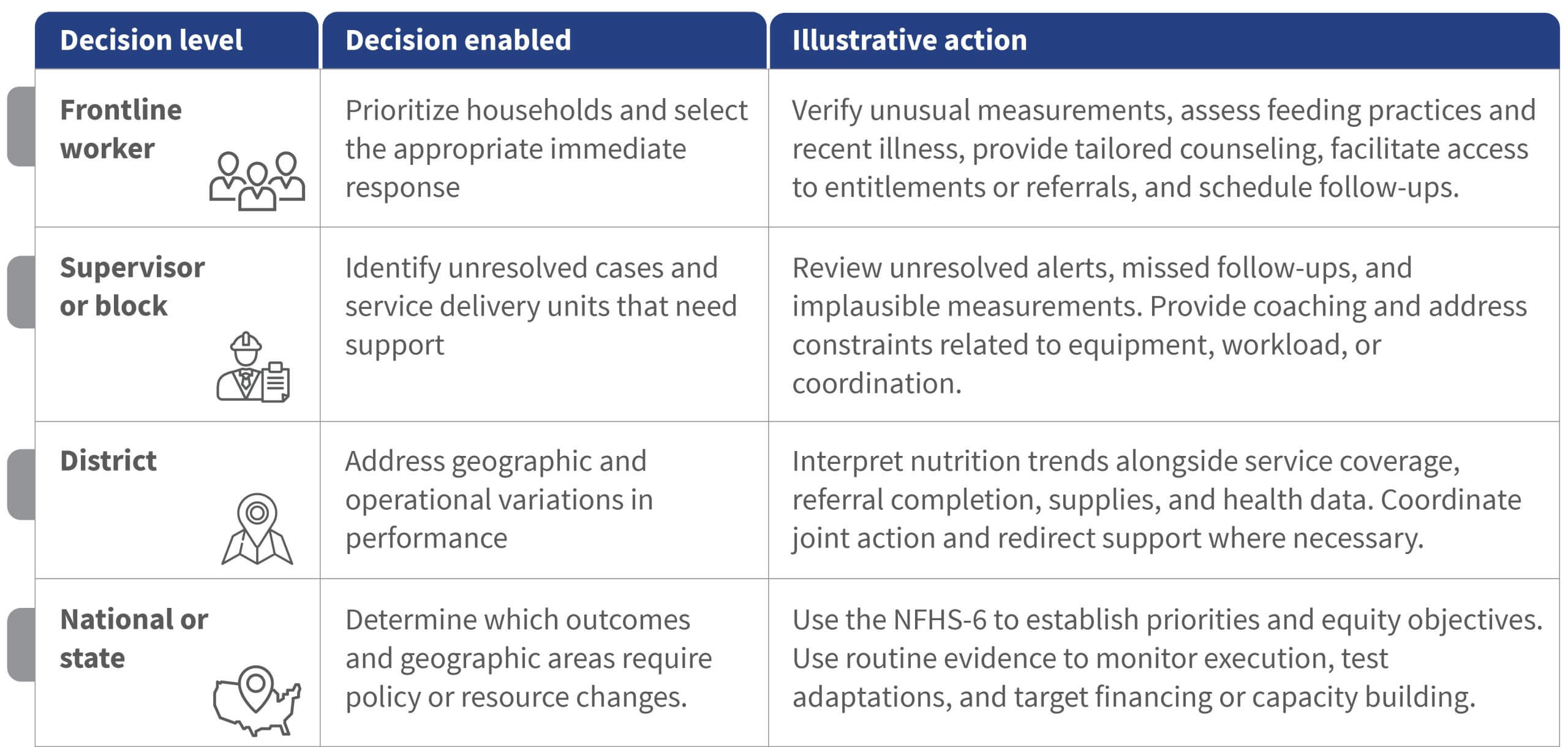
Initial implementation should target a limited set of high-value decisions. Teams should select use cases based on outcome relevance, geographic concentration, data timeliness, clear ownership, and the potential for actionable responses. Population and real-time data together help identify where problems cluster, who faces the greatest risk, what factors contribute to these problems, and which interventions offer value. Three use cases illustrate this approach:
- Childhood growth faltering: Repeated failure to gain weight or a sustained decline in growth signals an urgent need for a structured care pathway. Population data identify geographic areas with elevated risk. Real-time data trigger immediate measurement verification, feeding assessments, illness checks, tailored counseling, entitlement support, and time-bound follow-ups to track growth changes.
- Infant and young child feeding (IYCF): The NFHS-6 identifies areas where feeding practices lag, while the Poshan Tracker flags counseling milestones and gaps in contact. Community feedback helps determine whether poor diets stem from limited awareness, food affordability, time constraints, or social norms. These insights guide responses, from stronger counseling to coordination with livelihood programs.
- Implementation quality: When service coverage and nutrition outcomes diverge, structured reviews assess measurement quality, service content, supply continuity, and referral completion. Comparisons across administrative levels help distinguish systemic operational bottlenecks from local field constraints. This approach helps teams deliver timely, appropriate, and sufficiently high-quality interventions to improve outcomes.
Effective implementation requires a focused management framework that moves beyond data availability to consistent operational use. Five enablers can support this shift:
- Define the decision and supporting indicators: Link each priority measure to a specific decision, designated user, review frequency, action threshold, and expected program response.
- Track trajectories and case closure alongside status: Complement static coverage indicators with changes over time, follow-up timeliness, completed referrals, and resolution of the original concern.
- Embed data quality in supportive supervision: Use plausibility checks, sequences of missing data, and unusual patterns to guide supervisory coaching, verify measurements, and recalibrate field equipment.
- Institutionalize triangulation: Conduct monthly block reviews and quarterly district reviews. Assess the Poshan Tracker indicators alongside health, supply, entitlement, and community evidence through standardized review frameworks.
- Assess contribution before scaling: Implement defined response pathways in selected high-burden areas. Evaluate operational feasibility, implementation fidelity, and measurable outcome improvements before expanding the approach nationally.
India has the essential institutional foundations for this approach: periodic population surveys, a national nutrition monitoring platform, extensive frontline networks, and administrative systems. The next opportunity lies not in collecting more data or building more dashboards, but in linking existing evidence to defined decisions and faster program responses. Artificial intelligence (AI)-enabled analytics can accelerate this shift. These tools can integrate signals across data sources, identify emerging hotspots, prioritize vulnerable cases, and help managers select effective responses. Human judgment and program ownership must remain central to these decisions.
A mature nutrition information system tracks the entire results chain. It verifies measurements, detects emerging risks, deploys targeted responses, resolves service delivery bottlenecks, and records improvements in nutritional trajectories. By combining population-level evidence from the NFHS-6 with real-time intelligence from the Poshan Tracker, administrators can establish a coherent framework for targeted action, adaptive management, and shared accountability at every level of governance.
Written by

Dipanshi Sood
Manager
Dr. Manmohan Singh
Manager
Dr. Puneet Khanduja
Associate Partner
Sidharth Prusty
Associate
Leave comments