Unpacking the adaptation finance gap: What makes climate adaptation financeable?
 by Pranav Singh
 Nov 5, 2026
 5 min


In this blog, we examine why adaptation finance often struggles to reach viable projects, even when funding is available. It draws on research across six African countries and explores how the financial efficacy of adaptation solutions depends on their economic returns, cash flows, market conditions, and complementary support. It highlights the need to match public, concessional, and commercial capital to different use cases and test financing models under real market conditions.
What worsens the “adaptation finance gap”?
Many reports highlight the significant climate adaptation gap, but few examine how finance is deployed downstream. Recent funding shocks have reduced climate finance flows, while fiscal constraints continue to affect governments in developing economies. As a result, donor and public resources are increasingly expected to play a catalytic role in mobilizing commercial capital.
Yet, as the examples show, intention does not always translate into action. Funds secured after an arduous accreditation process may remain underutilized, while guarantees and other catalytic instruments may fail to attract private investment. A more useful question, therefore, is not simply how to mobilize more private capital. We also need to ask where and how to deploy it most effectively.
This three-part blog unpacks the challenges of adaptation finance beyond capital availability and considers the role and limitations of catalytic capital. We also explore the crucial, often underappreciated role of nonfinancial factors in the design of inclusive finance programs.
This series particularly draws on MSC’s landscaping of inclusive climate finance in six countries: Ethiopia, Kenya, Mozambique, Nigeria, Rwanda, and Tanzania. The research used a livelihood and market-systems perspective to examine the economics, cash-flow requirements, financing constraints, and broader market conditions surrounding selected adaptation solutions.
Financeability is a continuum
Adaptation is often seen as a revenue-preserving rather than revenue-enhancing investment. This perception limits consideration of commercial finance. Indeed, commercial finance may not be appropriate in several circumstances:
- Where adaptation investments have the characteristics of public goods, private returns may be insufficient or difficult to capture;
- Avoided losses, health benefits, or time savings may raise socioeconomic welfare without generating financial returns available for repayment;
- A profitable investment may still be difficult to finance if returns arrive late, vary by season, or remain highly uncertain;
- A positive expected return does not necessarily make an investment appropriate for a household that cannot absorb poor seasons or failed investments;
- Small transaction sizes, high origination and monitoring costs, and limited aggregation can make otherwise viable transactions unattractive to lenders;
- Returns may depend on complementary inputs, services, off-take arrangements, infrastructure, regulations, or data that are not reliably available.
The first two constraints are likely to be structural, while the latter four may be transitional. An adaptation measure can generate substantial economic and resilience benefits without presenting a strong commercial financing proposition. Conversely, an activity that is difficult to finance today may become financeable as cash flows, markets, data, or delivery systems strengthen. Financeability is therefore better understood as a continuum rather than a binary distinction.
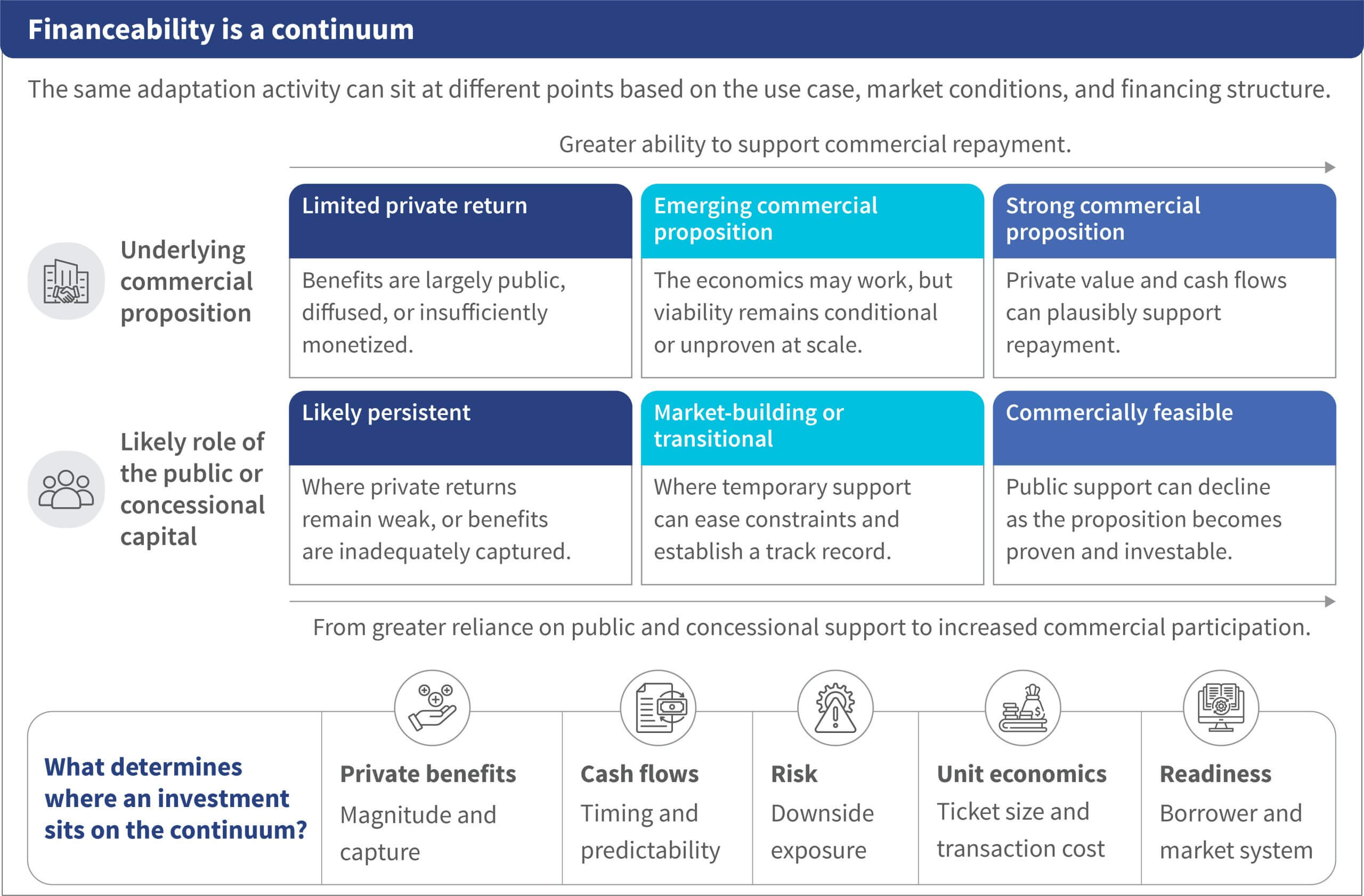
The same adaptation solution can have very different economics
MSC’s landscaping of several adaptation solutions found that financeability depends on the business or use case, not simply the technology.
Case 1: Rainwater harvesting in Ethiopia and Kenya
Our scenario analysis in Ethiopia produced the following indicative returns:
- 15% internal rate of return (IRR) when rainwater harvesting primarily supported domestic use;
- Around 32–41% when it supported productive uses.
Compared with an indicative lending benchmark of 22%, estimated using the base lending rate and a higher risk premium for small businesses, the model suggests that selected productive uses could be commercially viable. For domestic consumption alone, savings from avoided water and health costs were insufficient to service commercial finance under the modeled assumptions. In the productive-use scenarios, water tanks supported activities such as poultry rearing and small kitchen gardens. These activities generated additional income beyond avoided water expenditure. However, the model also identified an early repayment gap because productive income began to materialize only after five to six months. Repayment schedules aligned with household cash flows could therefore be more useful than a lower interest rate alone.
In Kenya, the same asset became financeable under a different arrangement. A dairy-linked asset-collateralized loan used farmers’ milk sales records for credit assessment and deducted repayments directly from milk proceeds. The water tank supported dairy productivity, while the existing cooperative and milk-payment system created a visible repayment stream.
A household water tank that mainly generates resilience and welfare benefits may require public or concessional support. The same physical asset may present a stronger financing proposition when it supports irrigated horticulture or another productive activity that generates cash income.
Case 2: Financing higher-yield livestock breeds in Tanzania
Tanzania’s dairy sector illustrates why financing higher-productivity livestock may selectively strengthen climate resilience but may also increase maladaptation risks under suboptimal conditions. Dairy upgrading can generate potentially attractive returns, but these returns vary significantly across production systems.
Our scenario analysis highlighted how a potentially profitable asset can remain unfinanceable when the complementary systems required to generate those returns are weak. A crossbred cow under optimal feeding produced an indicative IRR of around 80%. The return fell to 24% with inadequate feed and to 7% under a combined drought and poor-feed scenario. The final scenario also produced a negative net present value (NPV). These modeled scenarios do not represent observed returns for farmers. However, they raise a fundamental question: which farmers can reliably generate the cash flows required for finance, and under what production and market conditions?
So what should funders assess?
A recurring adaptation-finance bottleneck is the lack of a viable investment pipeline. A weak pipeline may reflect two very different problems. The underlying commercial economics may be poor, or promising adaptation opportunities may lack the preparation, structure, or evidence required to attract finance. Distinguishing between these problems is critical. Better evidence and investment preparation can help establish credible economics, appropriate cash-flow structures, effective risk allocation, and suitable partnerships1.
Commercial finance requires repayment. Analysis should therefore begin with the economics of the adaptation activity and the extent to which investors or borrowers can capture its returns. A well-designed adaptation finance intervention should consider the following questions:
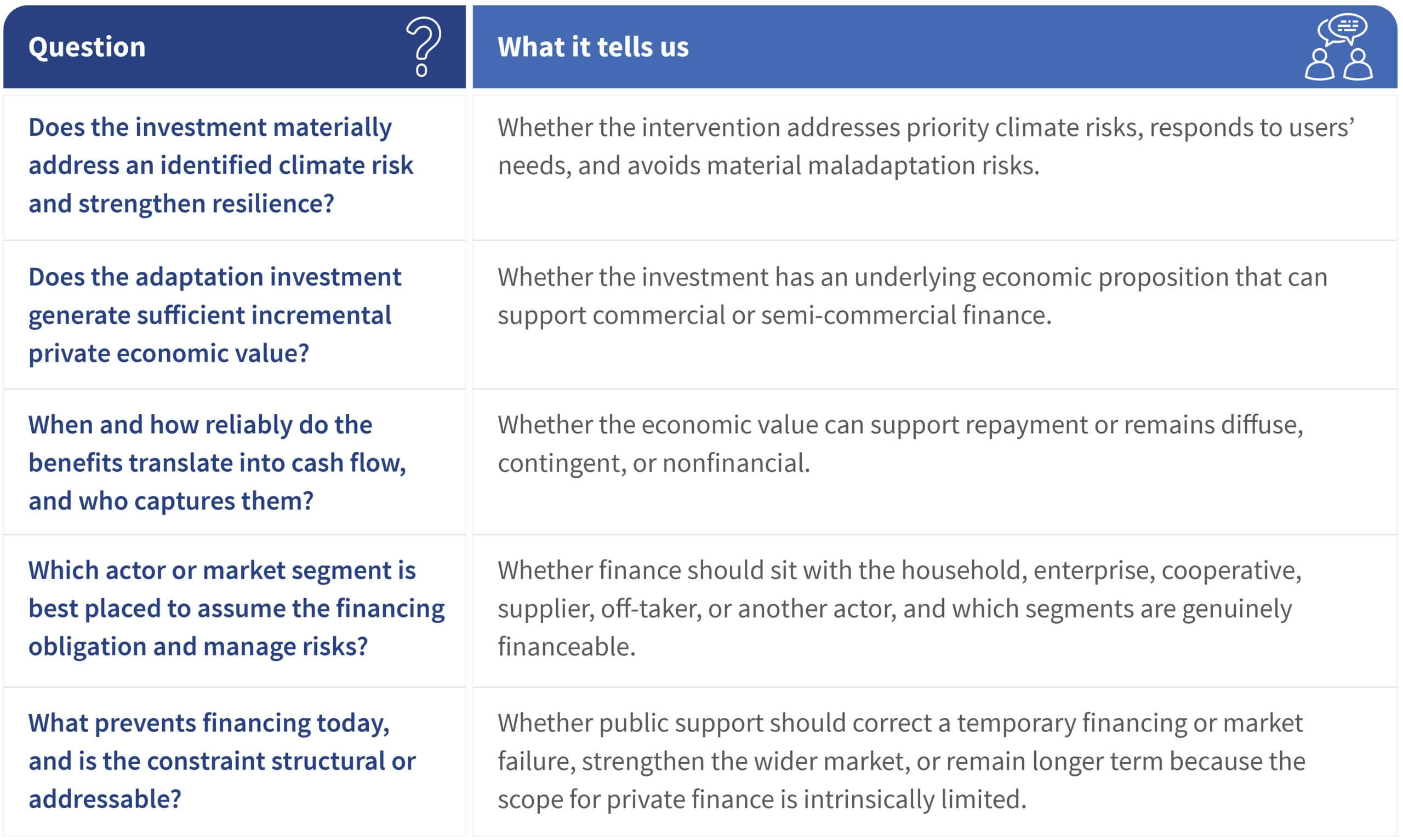
MSC’s adaptation finance framework uses a modular approach to apply these questions, identify investable adaptation use cases, and appropriate financing models. MSC’s adaptation finance stack provides a complementary discussion of the broader challenges involved in delivering adaptation finance to end users.
Conclusion
Public and concessional resources are scarce, but commercial capital cannot replace them. Using public or concessional resources where commercial economics already work may waste subsidies. Expecting private capital to participate where borrower-level economics do not work may waste time.
Successful adaptation finance initiatives can help identify promising business cases and shape future investment portfolios. The next step is to test these distinctions under real market conditions.
An adaptation finance lab could test a small portfolio of use cases, define the financing hypotheses and conditions for commercial viability in advance, and transparently track repayment, resilience outcomes, and the additionality of public support. The resulting evidence should show whether private capital can participate and, more importantly, where, for whom, and under what conditions it should.
Written by

Pranav Singh
Senior Manager
Leave comments