From digital payments to financial readiness: How India Post Payments Bank is shaping the next chapter of India’s small merchants’ growth
 by Abhinav Srivastav, Rizwan Hazari, Arpan Datta and Maansi Sharda
 Nov 27, 2026
 5 min


This blog shows how IPPB helps rural merchants expand beyond digital payments through affordable banking, financial products, and trusted doorstep assistance. The model builds confidence, improves credit access, strengthens earnings management, and supports participation in the digital economy.
India has built one of the world’s largest digital payment networks. UPI (Unified Payments Interface) now accounts for 84% of all retail digital payments in the country, and 885 million UPI QR codes had been deployed by September 2026. In FY 2025-26, 86% of person-to-merchant UPI transactions were below INR 500 (about USD 5.70), showing how deeply UPI has entered small, routine purchases. India’s small merchants have embraced UPI at remarkable speed, yet for many in rural areas, the shift remains incomplete. Digital payments have reached shop counters in villages across India, but for many small merchants, the money doesn’t stay digital for long. A study of micro-merchants by the Centre for Financial Inclusion found that 78% still paid for their stock in cash or by cheque, often because the wholesalers they bought from preferred cash. The same pattern holds on the demand side too. Among rural and semi-urban small businesses, cash remains the single largest payment mode, accounting for 37% of customer transactions, according to the PayNearby MSME Digital Index 2026. Closing this gap takes more than better apps. It needs digital tools backed by personal assistance and trust, and this is where India Post Payments Bank has built a distinctive offering.
Advanced apps, built for self-service
Payment apps have moved quickly to serve merchants beyond acceptance. PhonePe now has more than 50 million registered merchants, and its business app offers on-demand settlements, support in up to 11 languages and paperless access to digital loans. Its merchant loans are collateral-free and can be repaid through daily instalments deducted automatically from daily collections. Paytm reports 15.1 million merchant subscriptions across QR codes, sound boxes and card machines, and now sends loan pre-approval notifications directly to merchants’ devices. Merchants can also invest in gold, buy insurance and manage staff access within the same apps.
These platforms work exceptionally well for merchants who are comfortable navigating apps on their own. Their model is largely self-service, with merchants onboarding, managing transactions and resolving issues through the app and its helpdesk. Far less has been built for rural merchants who need someone to explain a failed transaction, guide them through their first supplier payment or confirm that a loan offer is genuine. For these merchants, assistance, comfort and trust matter as much as features.
Digital tools with a human touch
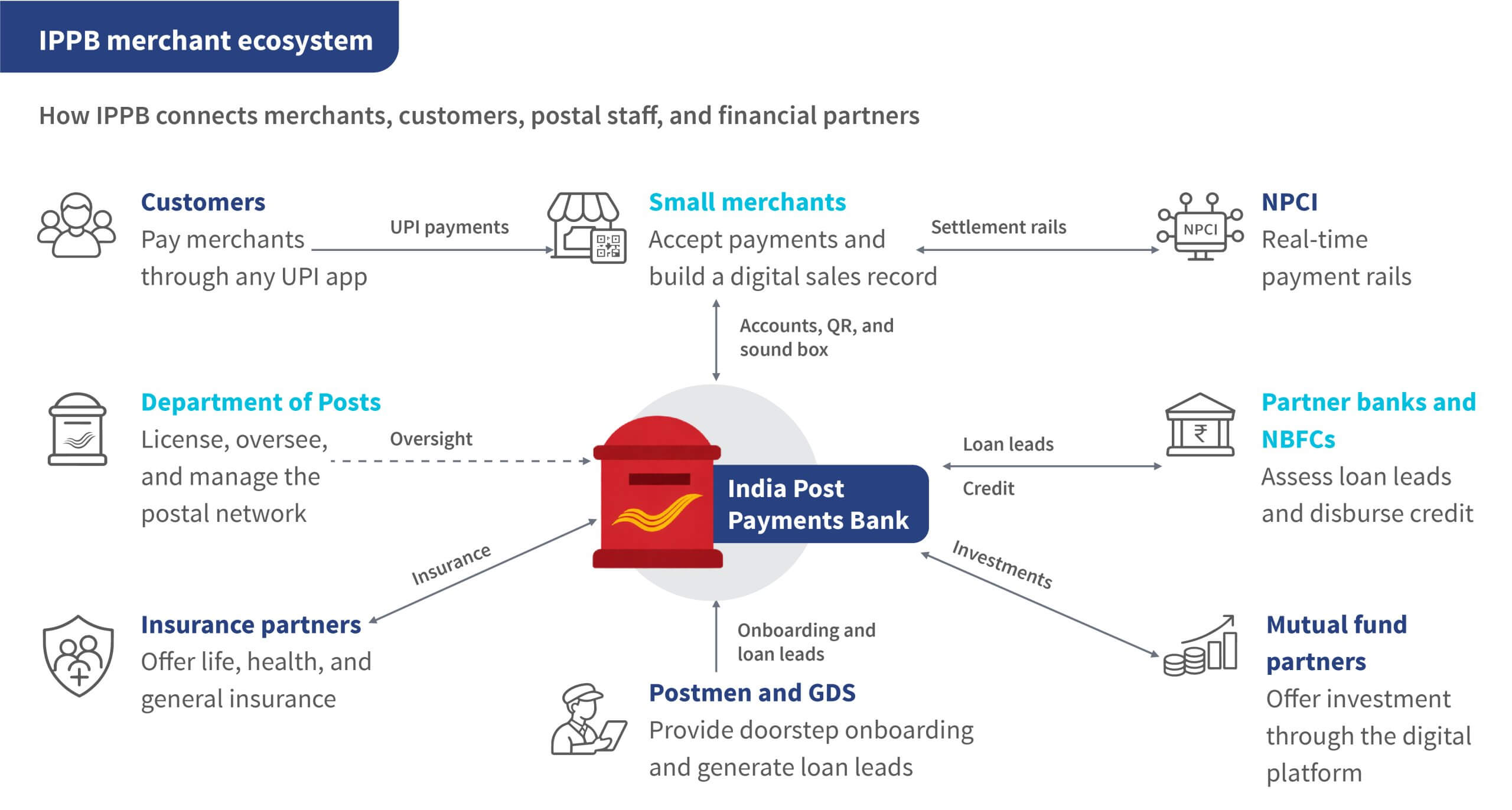
IPPB has developed its merchant offering around three key elements: cost-effective banking accounts, QR-based digital payments and convenient account opening, either instantly through a self-service digital journey or with the assistance of a GDS (Gramin Dak Sevak) at the merchant’s doorstep. The merchant app provides an affordable way for even small businesses to access digital payment services, with free registration and no charges for receiving payments. It also supports a range of payment and banking services comparable to those offered by other banks and payment service providers (PSPs).
IPPB offers merchants much of what leading payment apps provide, but with two distinct advantages, the trust of a government-backed bank and in-person support at the merchant’s doorstep. Beyond payments, IPPB extends its offering through loan referral services, connecting merchants with partner banks and NBFCs for business credit, as well as insurance, and its digital mutual fund platform which enables merchants to invest part of their earnings. IPPB accounts also offer a sweep-in and sweep-out facility through linkage with a Post Office Savings Account, automatically transferring day-end balances above INR 2 lakh (about USD 2,130) to the linked account at no extra cost, while allowing surplus funds to earn interest. A key differentiator is the trust and regular engagement that GDS and postal staff have built with local merchants through their presence in the community. Their extensive pan-India network provides doorstep assistance with account opening, digital payment adoption, first transactions and access to additional financial services. This combination of cost-effective offerings, a wide range of financial products and trusted in-person support has helped IPPB grow its merchant base from about 120,000 in September 2022 to more than 3.4 million by September 2026, an increase of nearly 29 times in just four years.
What this means for merchants
Consider Gajraj Babu, who runs a general store in a village in eastern Uttar Pradesh. For years, a UPI QR code beside his counter brought in most of his customers’ payments, yet the money rarely stayed digital. He withdrew cash each week to pay the wholesaler, travelled to the market town to settle his electricity bill and kept some of his savings at home.
Since opening an IPPB account with help from a GDS, his routine has changed. The same account that receives his customers’ payments now pays his electricity bill and his supplier, without a trip to town. When a payment failed during a busy afternoon, the GDS explained what had happened and when the money would return, instead of leaving him to search an app helpdesk. His sales history now builds automatically, and when he needed extra stock before the festival season, the GDS helped him submit a loan request to one of IPPB’s lending partners.
For Gajraj Babu, the deciding factor is trust. In his words, “Apps come and go on the phone. But the post office has always been in our village. They are not going to run away.” His experience reflects the wider shift IPPB enables.
The road ahead
IPPB’s experience offers useful lessons for financial institutions that are looking to bring small merchants into the digital economy. Its growth shows that a postal network does not need to compete with payment apps on features. Its strength lies in reaching the merchants those platforms find hardest to serve, through a trusted presence and staff who can offer help in person. Postal networks in Africa and Southeast Asia that already offer financial services and reach deep into rural areas are well placed to lead in onboarding micro merchants. Pos Indonesia serves over 6 million people through its digital app and physical points of service. Postal networks in Kenya, Zambia and Burkina Faso already offer payment and insurance services. Banks, fintechs, and other financial institutions can follow this approach by starting with existing customers who run small businesses, helping them open merchant accounts and make their first digital payment, and over time using their transaction records to offer loans, investment and insurance. Just as Gajraj Babu found a trusted partner in his local post office, a shopkeeper in a remote village in Somalia or Nigeria could one day receive payments instantly and pay bills, all through the local post office.
Written by




Leave comments