The intelligent use of AI and data science in the lifecycle of national identity systems
 by Swastik Das and Mohak Srivastava
 Feb 4, 2026
 9 min
9 min


AI must move beyond narrow biometric use to stage-appropriate intelligence that prioritizes inclusion, integrity, and citizen experience as national ID systems mature. AI deployment must align with system maturity, governance capacity, and real-world risks, not technical ambition alone.
National ID systems have evolved from administrative registries into core public infrastructure that underpins access to welfare, finance, healthcare, and education, as well as a growing range of digital services. During the past decade, artificial intelligence (AI) and data science have shaped how these systems are built and operated. In most countries, adoption of AI in national ID programs has remained narrow, focused on immediate scale challenges, such as biometric deduplication, authentication security, and fraud control. This limited adoption is often due to constraints in institutional capacity, legal and reputational risk, and rigid public procurement models.
These factors lead governments to favor proven, high-certainty AI applications, such as biometric de-duplication, over experimental or adaptive systems. Few national ID systems have deployed AI across the full identity lifecycle at scale. Beyond biometric de-duplication and liveness detection, most systems lack this capability due to governance, institutional, and risk constraints rather than technical feasibility.
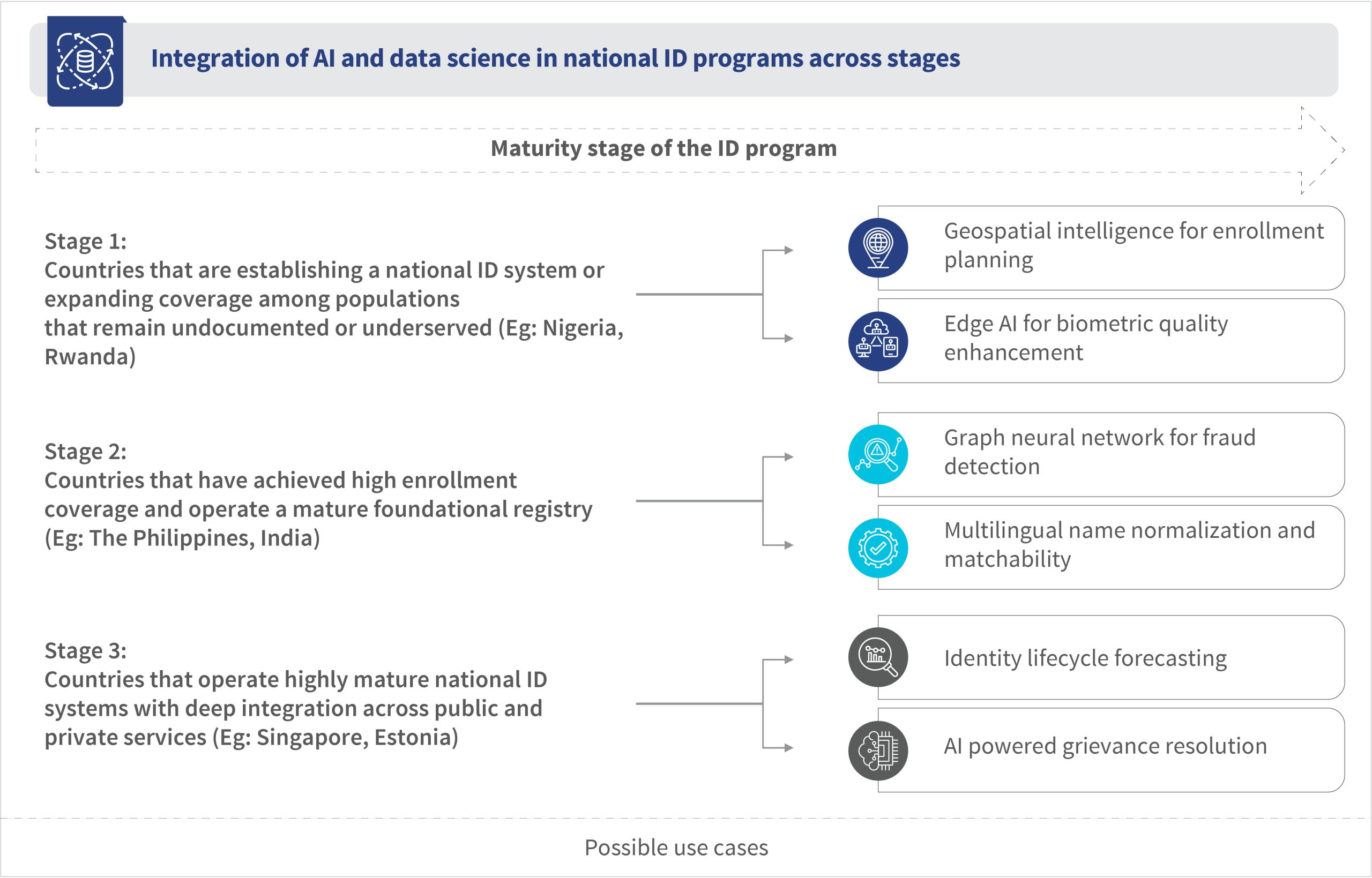
While these applications are necessary, they are no longer sufficient. As national ID programs mature, identity systems must respond to new pressures, which include changing population characteristics, rising transaction volumes, evolving threat models, and increasing citizen expectations. For this analysis, we divide countries into three groups based on the maturity or life stage of their ID systems.
Stage 1 countries are currently establishing a national ID system or expanding coverage among populations that remain undocumented or underserved. These countries include Nigeria, Rwanda, and Ethiopia. Stage 2 countries have achieved high enrollment coverage and operate a mature foundational registry, and they include the Philippines, India, Thailand, and Indonesia. Stage 3 countries, such as Singapore and Estonia, operate highly mature national ID systems with deep integration across public and private services.
These stages are not sequential. Most national ID systems span multiple stages simultaneously, as individual components mature at different rates. These components include citizen enrollment coverage, use of digital ID for access to services and programs, integration with law enforcement, and the robustness of technology and scale. The strategic question for governments today is not whether to use AI, but how to align it with the country’s identity system maturity.
Stage 1: Building and saturating a foundational ID system
For countries in stage 1, the core objective is to scale with integrity. National ID authorities must onboard millions of residents and ensure that everyone is enrolled only once, often in contexts with limited infrastructure, weak connectivity, and incomplete population data. Further, a dominant systemic risk is exclusion. Individuals cannot enroll or repeatedly fail biometric or demographic quality checks, which results in denial or delay of downstream services.
Current application 1: Automated biometric identification systems
The technological backbone of ID systems is the automated biometric identification system (ABIS). It uses machine learning (ML) to compare fingerprints, facial images, and iris scans across population-scale datasets. ABIS helps establish an individual’s identity under two functions. One is identification, which searches for the submitted biometrics in the entire database, often referred to as a 1:N match. The other is verification, where it tries to match the submitted biometrics against the single record of the same person in the database, also called a 1:1 match.
India’s Aadhaar program illustrates the centrality of ABIS. The Unique Identification Authority of India (UIDAI) governs Aadhaar. It requires multimodal biometric capabilities to process millions of data packets daily for over a billion people with a minimal error rate. This multimodal approach ensures inclusiveness through alternative biometrics if a particular one cannot be captured or registered. For example, the use of iris or face if hands are amputated or fingerprints worn away by manual labor. However, population-scale ABIS increases sensitivity to capture quality, thresholds, adjudication, and exception handling. These are areas that can drive exclusion if poorly governed.
Current application 2: Optical character recognition with natural language processing (NLP) to extract physical information
Foundational ID systems often stall before they reach maturity, not due to lack of vision, but due to enrollment challenges. Governments must first enroll every eligible resident to unlock downstream value, but this task remains complex. Authorities must reach remote populations, capture accurate demographic and biometric data, navigate language barriers, and ensure inclusion for groups with limited digital access. In several countries, enrollment still relies on paper forms and assisted registration. Operators manually transcribe details and capture biometrics through shared devices, often under time and capacity constraints.
These conditions create predictable risks, such as limited training, low awareness, and manual data entry. These risks frequently lead to missing or inconsistent information that weakens the integrity of the ID system. One emerging solution is to use optical character recognition (OCR) and NLP to digitize handwritten forms at scale. Ethiopia, for example, is developing an AI-powered solution that reads consent forms and auto-populates digital records, which reduces manual errors and speeds processing across multiple languages. However, such tools must include strong validation checks and well-trained models. Without safeguards, automation can amplify errors, compromise data quality, and unintentionally exclude the very populations these systems seek to serve.
Opportunity 1: Edge AI for biometric quality enhancement
Poor biometric capture is a major source of exclusion. Glare, dirt on sensors, motion blur, or improper positioning often result in low-quality biometric images. Many systems detect these issues only after data reaches the central server, which triggers deferred rejection that forces citizens to repeat enrollment. This increases costs, prolongs onboarding, and raises higher dropout rates.
Edge-based AI models can address this challenge through quality control at the point of capture. On-device deep learning models can assess image quality in real time, verify compliance with international standards, and provide capture coaching for operators and citizens. Advancements in generative adversarial networks (GANs) and diffusion models have theoretically been successful in fingerprint enhancement and reflection removal from iris scans, among other applications. The national ID system authorities can enable this approach when they enforce device standards and support local quality checks. Edge AI transmits biometric data only after it meets quality thresholds, and deep learning models enhance image quality at capture. This combination could reduce re-enrollment, lower backend processing costs, and improve privacy through minimization of unnecessary data transmission.
Though the performance of these techniques depends on field conditions, such as camera quality, lighting, and device constraints, such emerging technologies offer potentially viable solutions for biometrics capture. Further, the deployment of edge AI in enrollment and authentication workflows would also require certified devices, controlled model and version rollouts, and audit logs to support accountability and dispute resolution.
Edge AI-enabled enrollment devices entail higher upfront costs, but they can materially reduce downstream expenditures. This reduction occurs as such devices lower re-enrollment rates, manual adjudication, and grievance handling, particularly in remote or high-error contexts. Authorities must limit this edge intelligence to capture quality assessment and operator guidance, preserve raw biometric data, and log all transformations to avoid compromise of evidentiary integrity.
Opportunity 2: Geospatial intelligence for outreach planning
A persistent weakness in early-stage ID programs lies in the enrollment outreach plan. Traditional approaches rely on administrative boundaries, electoral rolls, or census data that may be outdated by several years. Informal settlements, migratory populations, and sparsely populated rural areas are often undercounted or entirely missed, which leads to structural exclusion that is difficult to reverse later.
ML-assisted geospatial intelligence offers a way to overcome this limitation. AI models can estimate population distribution at a finer spatial resolution through satellite imagery, settlement extraction algorithms, mobile network coverage data, and road networks datasets. These models can identify exclusion hotspots, predict enrollment demand, and generate optimized routes for mobile enrollment units.
The GRID3 initiative in Nigeria demonstrates the practical value of this approach. GRID3 enabled authorities to plan malaria campaigns in locations where affected people lived with high-resolution satellite imagery and population estimates, rather than where administrative maps suggested.
National ID authorities can adopt similar settlement layers to identify and plan enrollment campaigns in remote or rapidly growing peri-urban areas, which ensures that coverage targets translate into real inclusion. Further, the use of open-source datasets, such as Meta’s AFD datasets, for population estimation enables quick development and reduced friction in consent boundaries.
Stage 2: Driving usage and safeguarding integrity
For countries in stage 2, the strategic focus shifts from onboarding to usage. As national IDs increasingly function as trust anchors for welfare delivery, financial inclusion, telecommunications, and digital services, risk shifts from exclusion to abuse at scale. Such abuse includes spoofing, coercion, and insider fraud, which could potentially erode trust. As transaction volumes grow, systems must remain reliable, secure, and interoperable.
Current application: Liveness detection and anti-spoofing
As authentication expands to mobile and remote channels, most Stage 2 countries deploy liveness detection algorithms. They focus on facial recognition to counter presentation attacks, such as photographs, masks, or deepfake videos. These techniques have become a baseline requirement for secure digital transactions. However, liveness detection algorithms often introduce false positives and accessibility challenges, especially for the elderly.
Opportunity 1: Graph neural networks (GNNs) for fraud detection
Traditional fraud detection relies on linear rules, such as transaction frequency thresholds or static blacklists. While effective against simple abuse, these approaches struggle to detect coordinated fraud that involves networks of identities, devices, or operators.
GNNs shift the analytical focus from individual transactions to relational structures. GNNs can detect structural anomalies that indicate coordinated misuse without the inspection of personal attributes by modeling anonymized identity graphs, such as device-to-user or operator-to-location networks. Graph or ML risk scores can trigger review or step-up verification within rights-sensitive ID systems to improve governance.
Graph-based fraud detection is proven at scale in the financial sector, most notably by PayPal, where graph models identify coordinated fraud rings that evade rule-based systems. Governments can adopt this proven approach for national ID systems. However, constraints around data availability, legal mandates, technical capacity, and governance safeguards challenge practical deployment. Further, the introduction of ML-based approaches should be integrated with the transparency and appeal mechanisms that are essential and integral for a national ID program.
Opportunity 2: Multilingual name normalization and match algorithms
In linguistically diverse societies, name variation is a pervasive but underappreciated source of exclusion. Differences in transliteration, spellings, and naming conventions often cause legitimate users to fail database-matching checks, even when their identities are valid. These failures generate manual exceptions and delay service delivery.
Transformer-based transliteration models and phonetic embeddings can normalize names across scripts and languages, which produce culturally aware canonical representations. Match scores allow systems to distinguish between likely variants of the same name and true mismatches, which enable fuzzy matching without loss of accuracy. Thus, the normalization of names can improve interoperability across civil registration, banking, and welfare systems, which reduces exception handling and does not force citizens to conform to a single representation of identity.
AI4Bharat’s IndicTrans model illustrates this capability through high-quality transliteration across Indian languages. The Indian judiciary already uses this model in initiatives, such as the Supreme Court Vidhik Anuvaad Software (SUVAS). Integration of these models into identity systems could improve interoperability across civil registries, banks, and welfare platforms, which reduces manual adjudication and improves user experience.
Stage 3: Enhancement of citizen experience and system intelligence
For countries with highly mature national ID programs, the binding constraint shifts to public trust and legitimacy, as citizens expect reliability, transparency, and fast resolution when failures occur.
Current application: Reactive analytics
Most advanced systems rely on dashboards that track failures, throughput, and performance indicators. Key signals include rising authentication failure rates in specific cohorts, growing exception volumes, and grievance backlogs. These interventions are typically reactive, triggered after a transaction fails or a grievance is lodged.
Opportunity 1: Identity lifecycle forecast
Biometric attributes degrade over time due to aging, occupational wear, and environmental factors. Documents expire, and demographic attributes change. Today, these issues often surface only when a citizen attempts a transaction and is denied service.
Survival analysis and time-series models can forecast when specific cohorts are likely to experience biometric or credential failure. Through analysis of historical authentication logs and update patterns, systems can prompt proactive updates before failures occur. This shifts identity management from a fail-and-fix approach to a proactive, predict-and-prevent model.
Opportunity 2: AI-powered grievance redressal
As ID systems grow more complex, citizens struggle to navigate static FAQs and overloaded call centers. Conversational AI systems based on LLMs can provide context-aware support in local languages, which explains errors, guides next steps, and resolves routine issues instantly.
For instance, Ethiopia deployed a local-language AI chatbot to support citizen interaction with their national ID system. The chatbot delivers accurate, multilingual responses across major digital platforms, which reduces response times, manual workload, and misinformation. In the context of national ID systems, LLMs with retrieval-grounded responses can prevent policy hallucination. Clear escalation to human agents for high-stakes cases and full audit logs can significantly improve grievance resolution times and citizen trust.
Conclusion
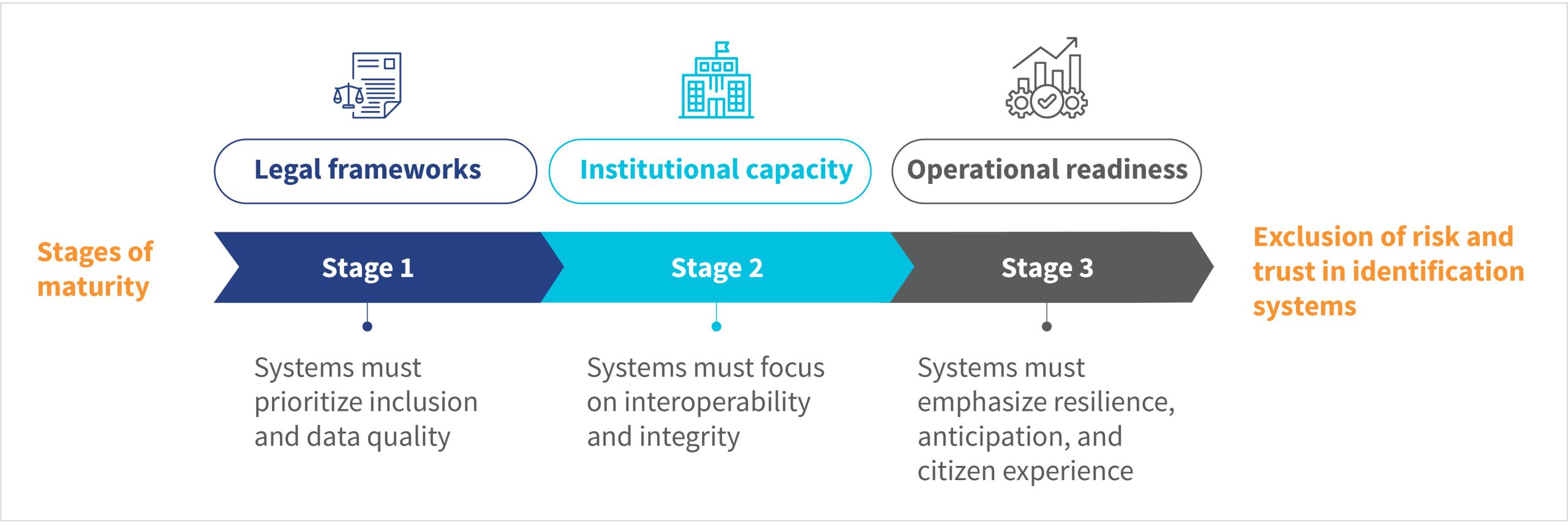
The future of national ID systems lies not in the deployment of more AI, but in the right intelligence based on the stage of maturity. Stage 1 systems must prioritize inclusion and data quality. Stage 2 systems must focus on interoperability and integrity. Stage 3 systems must emphasize resilience, anticipation, and citizen experience. These stages are not standalone technology upgrades. Authorities must sequence them with legal frameworks, institutional capacity, and operational readiness. When deployed prematurely or without adequate governance capacity, AI can amplify exclusion risks and erode trust in identification systems. The risk is especially high when systems use ID to determine eligibility or access to essential services.
With mature and aligned AI and data science, governments can transform national ID systems from static registries into intelligent public infrastructure. This infrastructure can maintain itself, remain accurate, inclusive, and trusted over time.
Written by

Swastik Das
Senior Manager
Mohak Srivastava
Manager
Leave comments