The financing opportunity inside Kenya’s fish supply gap
 by Lois Eva Adongo
- Oct 27, 2026
- 5 min
 by
 Oct 27, 2026
 5 min


This blog examines Kenya’s fish supply deficit and the financing opportunities across the fisheries value chain, highlighting how tailored financial products can help viable businesses expand production, create jobs, and meet growing demand.
Kenya’s fish market has a sizable supply gap. In 2024, the country produced 168,424 metric tons (MT) of fish, enough to meet about one-third of its estimated annual requirement of 510,000 MT.
The remaining gap, roughly 342,000 MT, represents about two-thirds of the estimated demand. For lenders, that scale raises a crucial question: how much can viable domestic fisheries businesses supply, and what finance would help them grow?
For financial institutions, that distinction matters. The opportunity extends beyond financing businesses that serve Kenya’s current production base. It also includes viable hatcheries, producers, input suppliers, traders, processors, and cold-chain businesses that can help close part of the supply gap.
The two-thirds gap does not automatically define a bankable market. Affordability, consumer preferences, infrastructure, production constraints, and market access determine how much potential demand becomes actual sales. Still, the gap’s scale suggests that the financing opportunity could extend well beyond the businesses currently visible to formal lenders.
As the first blog in this series argued, the gap in Africa’s USD 22 billion fisheries sector presents a development challenge and a potential commercial opportunity for financial institutions that understand how different parts of the value chain operate.
A large gap between potential demand and domestic supply
Kenya’s fish production is struggling to meet demand. Lake Victoria landings fell 29.9% between 2021 and 2024 amid overfishing and habitat degradation.
Kenya currently fills part of its fish supply gap through imports, using foreign exchange on a protein source that it has the land, water, and workforce to produce domestically.
How can domestic producers capture more of this demand? The answer depends on how much local supply can grow and what capital will enable that growth.
Expanding domestic production could reduce import dependence and create opportunities throughout the fisheries value chain.
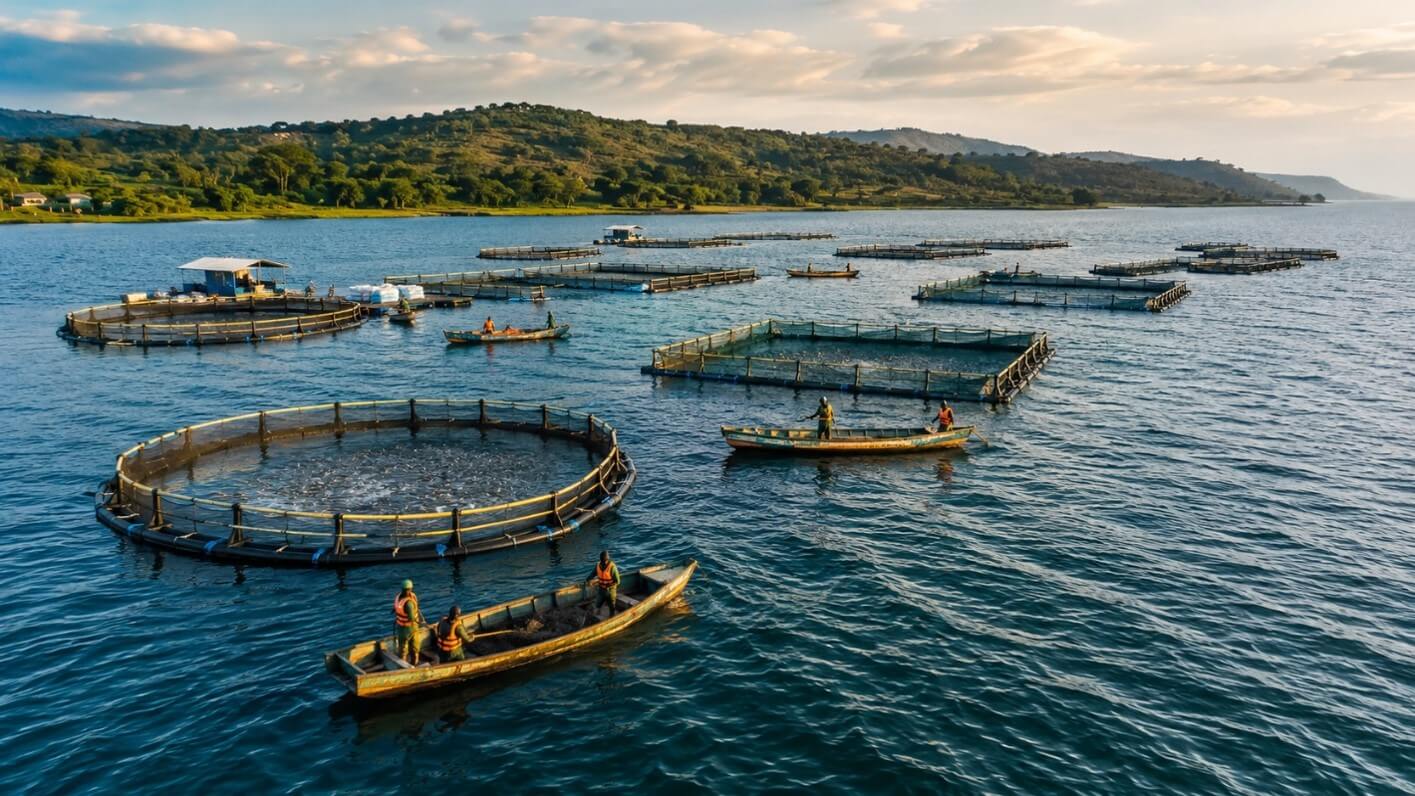
Cage farming in Lake Victoria shows how quickly managed production can reach meaningful scale. In 2024, Kenya had 5,975 operational cages managed by 634 farmers. These cages produced approximately 25,547 MT of fish and accounted for 76.4% of the country’s total aquaculture production of 33,423 MT.
Scaling fisheries production involves far more than adding cages. Farmers need fingerlings and feed. Hatcheries need equipment and working capital. Traders need liquidity to purchase fish, while processors and distributors need cold-chain infrastructure. Each business has a distinct investment cycle, cash flow, and risk profile.
Expansion, therefore, creates a series of distinct financing needs across the value chain.
One value chain, very different capital needs
MSC’s market study under the Women and Youth Economic Empowerment in Fisheries through Inclusive Market Access (WYEEFIMA) program, implemented by TradeMark Africa and the African Continental Free Trade Area (AfCFTA) Secretariat in partnership with the Mastercard Foundation program, illustrates this diversity.
MSC’s research identifies nine fisheries value-chain actor profiles whose capital needs range from KES 1,833 (about USD 14) for a micro-retailer to KES 15.2 million (about USD 117,000) for a commercial hatchery.
These differences matter for lenders. A lender cannot finance a trader seeking short-term working capital to purchase fish in the same way it finances a hatchery investing in equipment with a multi-year useful life. Similarly, a cage farmer’s repayment schedule must reflect an eight-month production cycle rather than the repayment pattern of a conventional retail business.
Yet, formal finance reaches only a small share of these enterprises. MSC’s WYEEFIMA research estimates formal credit access at 9% among women and 14% among youth in Kenya’s fisheries sector. The study also found that some actor groups, including fish traders and seaweed farmers, rely heavily on informal finance.
These enterprises have identifiable capital needs, yet formal lenders have not reached many of them.
What early lending data shows
Does additional finance help these enterprises generate enough income to justify greater lender interest?
Early data from participating financial institutions (PFIs) in the WYEEFIMA program offer an encouraging signal. The analysis associates each additional unit of capital provided to fisheries enterprises with about 7.3% additional monthly enterprise income. The relationship became statistically significant within six months.
In practical terms, every USD 1 of additional capital was associated with approximately USD 0.07 in additional monthly enterprise income. That equals about USD 0.88 over 12 months if the estimated monthly association persisted.
Employment data points in the same direction. Between August 2025 and February 2026, 115 fisheries borrowers in the program generated 63 jobs, or about 0.55 jobs per borrower. Among borrowers who received loans above KES 100,000 (USD 771), the observed ratio was 1.33 jobs per borrower.
The sample remains relatively small, so the pattern deserves further study as more lending data becomes available. Lenders often view larger fisheries loans primarily as a greater exposure risk. The WYEEFIMA data raises another question: could some fisheries enterprises productively absorb larger loans than lenders currently offer?
Why lenders need a portfolio of fisheries products
No single standardized product can close the gap.
Closing part of Kenya’s supply gap requires different forms of finance across the value chain. Traders and input suppliers may need short-term working capital. Hatcheries and producers may need longer-tenor loans. Cold-chain operators and processors may need asset finance for equipment. Larger businesses may need trade finance or guarantees to purchase inputs at scale.
Digital credit can meet some short-term liquidity needs. It cannot finance the full range of investments required to expand production and move more fish efficiently to market.
For financial institutions, the opportunity lies in building a portfolio of financing solutions matched to how fisheries businesses operate.
Yet this opportunity brings risks that lenders may struggle to assess or price. Some businesses have limited formal transaction histories or conventional collateral. Seasonal cash flows may also conflict with standard monthly repayment schedules. Capital alone cannot solve these problems.
What can help lenders enter the sector? Better transaction data, alternative collateral approaches, guarantees where appropriate, and products structured around fisheries cash flows and production cycles can help lenders assess and manage early risks.
Why the timing matters
Kenya’s supply deficit is already evident, and pressure on wild-catch fisheries is increasing the importance of aquaculture and other forms of managed production. Cage farming demonstrates that aquaculture can produce at a meaningful scale when producers have suitable production systems, inputs, markets, and capital.
Financial institutions that enter the sector now can begin building transaction histories, sector knowledge, underwriting experience, relationships with viable fisheries businesses, and portfolio data that later entrants will still need to acquire.
Yet Kenya’s supply gap alone does not justify lending. A commercial case emerges when lenders identify businesses that can use capital productively, understand their cash flows, and structure finance around the risks they carry.
WYEEFIMA’s early evidence suggests that such opportunities exist across the value chain and at widely different ticket sizes. For a financial institution sitting across the table from a fisheries client, the practical question is: where can it deploy capital productively, which enterprises are ready, and what products fit their operations?
The third blog in this series examines that question through seven concrete financing use cases across the fisheries value chain. It explains how MSC works on both sides of the financing equation to make formal-sector entry viable. The lesson here is clear: Kenya’s supply gap becomes a financing opportunity only when lenders match the right capital to viable businesses across the value chain.
Written by

Lois Eva Adongo
Senior Manager
Leave comments