Beyond the message: How AI can strengthen social and behavior change at scale
 by Sakshi Agarwal, Kavya Shah, Dipanshi Sood, Sidharth Prusty and Dr. Puneet Khanduja
 Nov 19, 2026
 6 min


This blog explores how artificial intelligence (AI) can enhance social and behavior change communication (SBCC). It shows how AI helps organizations generate audience insights, tailor messages, support frontline workers, and adapt programs in real time, while people and trusted relationships remain at the heart of behavior change.
This blog explores why information alone rarely changes health and nutrition behavior and why social and behavior change communication (SBCC) remains difficult to sustain at scale. It examines how artificial intelligence (AI) can strengthen insights, tailor communication, support frontline workers, and enable course correction, without replacing human relationships.
A health worker explains to a pregnant woman why she needs timely antenatal checkups, nutritious food, adequate rest, and prompt care when something seems wrong. The woman understands and agrees with the advice. Whether she can act on it, however, may depend on what her husband or mother-in-law believes, who controls household spending, and whether anyone at home is willing to accompany her to the clinic. The message is accurate and has been delivered, yet her behavior may not change. The barriers between knowing and doing often lie beyond the conversation itself.
The challenge extends beyond individual decisions. National program data highlights a wider gap between service availability and sustained use. According to the National Family Health Survey-6 (2023–24), 65.2% of mothers had at least four antenatal care visits, while 54.9% consumed IFA supplements for at least 100 days during pregnancy and only 37.8% did so for at least 180 days. Similarly, in Chhattisgarh, 93.8% of school-going adolescent girls received IFA tablets through the Weekly Iron and Folic Acid Supplementation program. However, only 48.1% completed at least 80% of the recommended dosage. Counseling on possible side effects led to an additional 15.4% increase in compliance with the full weekly dose. These examples do not suggest that behavior is the only constraint. Supply continuity, affordability, and service quality remain essential. They do, however, show that product or service delivery alone is not enough. People need to understand it, trust it, and incorporate it into their everyday practices.
Programs such as South Africa’s Soul City, India’s Main Kuch Bhi Kar Sakti Hoon, and Alive & Thrive in Bangladesh demonstrate the potential of well-designed social and behavior change communication (SBCC). In Bangladesh, exclusive breastfeeding in Alive & Thrive’s intensive program areas increased from 48% to 88% between 2010 and 2014. Soul City evaluations also documented shifts in knowledge, attitudes, and perceived social norms.
Despite its demonstrated effectiveness, SBCC is not always embedded adequately in the design and delivery of large-scale public programs. The result is that the availability of a service or product does not always translate into its adoption or sustained use. The challenge, therefore, is not simply to communicate better but to build behavior change into the way development programs are designed, implemented, and evaluated.
The challenge: Maintaining behavioral relevance at scale
The factors that make SBCC effective also make it difficult to sustain across large programs. Effective behavioral strategies require an understanding of behavioral drivers, tailored communication, and consistent reinforcement. These approaches depend on continuous community engagement, which becomes harder as programs expand across geographies and population groups.
Understanding why people adopt or resist a practice is rarely straightforward. A woman’s nutrition choices, for instance, may be shaped by her knowledge and preferences, but also by household decision-making, affordability, food availability, and family expectations. These influences vary across communities and households. Formative research and continuous audience engagement are therefore essential, but resource-intensive to undertake at scale.
This complexity also makes it difficult to keep communication relevant. The same behavior may require different approaches for pregnant women, their husbands, and mothers-in-law, each of whom may influence maternal nutrition differently. Messages must also reflect local languages, food practices, and individual motivations. However, developing and adapting content for diverse audiences requires time and resources. As programs expand, they often default to standardized messages, which can weaken contextual relevance.
Finally, behavior change requires sustained reinforcement, trusted relationships, and consistent engagement. Frontline workers and community institutions play a critical role in this process. However, large programs face growing challenges in maintaining the quality of counseling, supporting workers, and responding to community feedback. Without consistent supervision and support, the quality of engagement can vary, weakening the translation of communication into sustained behavioral change.
Where AI can make a difference
Artificial intelligence (AI) offers an opportunity to strengthen how SBCC is designed, delivered, and adapted. Rather than replacing the human relationships central to behavior change, AI can help programs better understand audiences, tailor communication, and maintain delivery quality at scale.
A key opportunity lies in generating deeper audience insights. AI can help synthesize qualitative data from focus group discussions, interviews, helplines, and frontline worker interactions. This can help identify recurring concerns, misconceptions, and behavioral patterns across audience groups. Chatbots and voice-based interfaces can further provide opportunities to engage communities and understand the motivations and barriers that shape their choices. This can make formative research more continuous and help programs respond to emerging insights rather than rely solely on periodic assessments.
These insights can inform more targeted communication. AI can help adapt messages across audience segments, languages, and local contexts while retaining a consistent behavioral objective. For instance, a maternal nutrition program could develop differentiated communication for pregnant women, husbands, and mothers-in-law, addressing the distinct motivations and constraints that shape their decisions. AI-assisted content development and translation can make this process more efficient, provided outputs undergo human review, local validation, and pre-testing.
AI can also strengthen interpersonal engagement by equipping frontline workers with contextual counseling prompts, guidance on addressing common misconceptions, and refresher learning. This can help workers respond more effectively to individual concerns and maintain consistent counseling quality. It can do so without automating human interaction at its core.
Beyond communication delivery, AI can enable more responsive program management. Analysis of audience feedback, engagement, and implementation data can help identify which messages resonate, which groups remain unreached, and where interventions need adjustment. When linked to service utilization and behavioral outcome data, these insights can support timely course correction. However, engagement and message reach must not be mistaken for evidence of behavior change.
Finally, AI can automate routine tasks such as transcription, translation, qualitative analysis, and reporting. This can reduce the operational effort required to run large-scale SBCC programs, freeing resources for community mobilization, interpersonal counseling, and local validation.
The opportunity, therefore, is not simply to expand the reach of SBCC, but to make it more adaptive, evidence-driven, and responsive to the people and contexts it seeks to influence. Governments, funders, and implementing organizations should consider seven principles when integrating AI into SBCC:
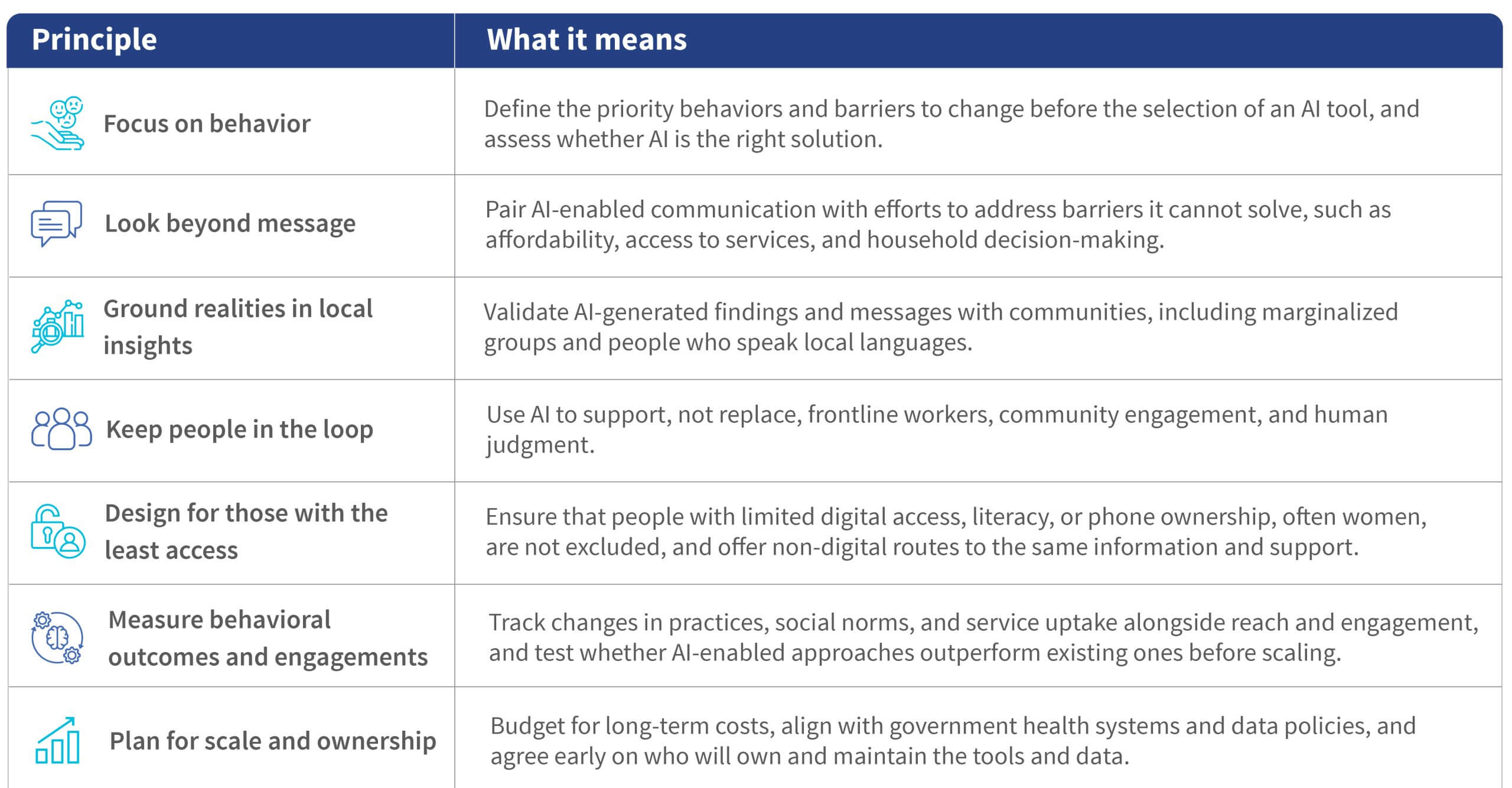
The way forward: Embedding AI in the next generation of SBCC programs
Realizing AI’s potential in SBCC requires more than introducing digital tools into existing programs. It calls for embedding behavior change more deliberately into program design, implementation, and evaluation. This process must start with a clear understanding of the behaviors, audiences, and social and structural factors that shape decisions.
For governments and program designers, this means treating SBCC as an integral part of large-scale program delivery rather than an activity that focuses primarily on awareness. Program design and monitoring should incorporate behavioral objectives, audience research, differentiated communication, and reinforcement mechanisms from the outset. AI can support this approach by making audience insights more actionable and enabling communication strategies to respond to local needs.
For philanthropy and development partners, the priority is to invest in the evidence and capabilities required to realize this opportunity. This includes supporting experimentation with AI-enabled approaches, financing formative research, local validation, strengthening frontline capacities, and commissioning rigorous evaluations. Investments must look beyond technology adoption and message reach to assess whether interventions lead to meaningful and sustained behavioral outcomes.
For implementing organizations, the opportunity lies in bringing together behavioral science, communication expertise, and AI capabilities to develop interventions that remain grounded in community realities. This requires retaining the central role of frontline workers and community institutions, building appropriate safeguards, and using implementation evidence to continuously refine approaches.
Ultimately, the ambition should be to move beyond standardized communication at scale towards behavior change interventions that continuously learn, adapt, and respond to the people they seek to influence. AI can enable this shift, provided it is deployed to address the underlying barriers to behavior change rather than simply make communication more efficient.
Written by

Sakshi Agarwal
Assistant Manager
Kavya Shah
Associate
Dipanshi Sood
Manager
Sidharth Prusty
Associate
Dr. Puneet Khanduja
Associate Partner
Leave comments