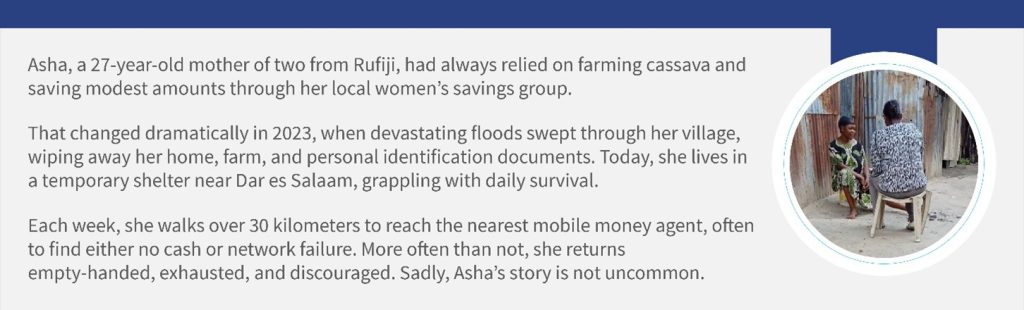
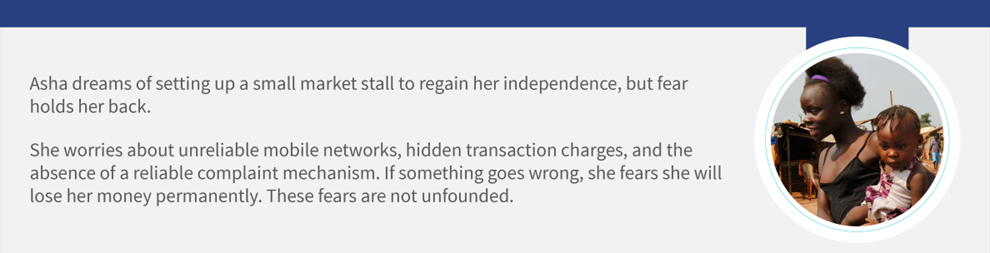
A sudden flood, cyclone, typhoon, drought, earthquake, or tsunami can force you to leave your home in an instant. Your bank account becomes unreachable overnight. Your documents vanish, and your ability to earn an income disappears. This is the reality for Asha and the other 122 million people worldwide who have been forcibly displaced by mid-2025. In Tanzania alone, more than 46,000 people were displaced by climate-related disasters in 2024. These people are not only statistics. They are parents looking for ways to provide for their children, young people eager to continue their studies, and entrepreneurs trying to restart small businesses. Yet, they face barriers that lock them out of the very financial systems that could help them rebuild their lives.
We often focus on food, shelter, and humanitarian aid. But financial access rarely makes the headlines, even though it may be one of the most powerful ways to restore dignity and hope. Displacement does not just strip away homes and belongings. It also erases critical connections to social and financial systems. Although Tanzania reports an 89% financial inclusion rate, this statistic conceals a harsh reality: Internally displaced persons (IDPs) are systematically excluded from the financial services that could help them rebuild their lives.
The hidden cost of displacement
Displacement disrupts lives in many ways. Beyond the loss of housing or safety, IDPs lose access to money and the ability to manage daily expenses. Without formal identification, they cannot open bank accounts, and without stable addresses, credit becomes unattainable. In such contexts, mobile money is often cited as a lifeline. Yet, even mobile solutions remain frustratingly out of reach for those displaced far from urban centers.
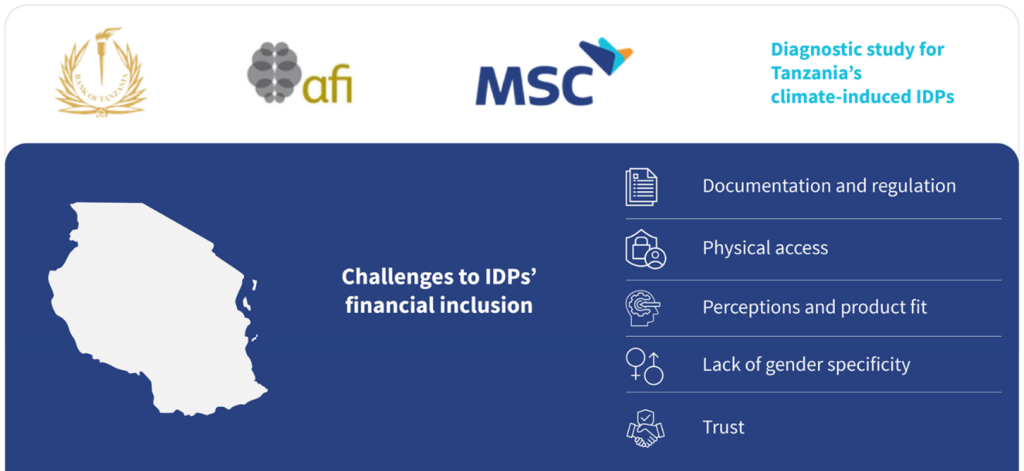
A joint diagnostic study by MSC, the Alliance for Financial Inclusion (AFI), and the Bank of Tanzania (BoT) on financial inclusion for climate-induced IDPs in Tanzania revealed the extent of these challenges:
- Documentation and regulation: Many displaced people, especially women, lack valid identification, which makes it difficult to meet bank requirements. Rules designed to prevent money laundering or terrorism financing often block them from opening accounts or accessing services.
- Physical access: Camps and settlements are usually far from bank branches, and digital connectivity is weak or unreliable. Mobile money agents, crucial access points in rural and peri-urban areas, are scarce, and travel distances are very long. Even where they exist, liquidity problems make transactions unreliable.
- Perceptions and product fit: Financial service providers (FSPs) often see displaced persons as high risk or low value. Products are not designed for irregular income or people without collateral.
- Lack of gender specificity: Women face compounded exclusion and are often less likely to possess formal identification, own mobile phones, or control household financial decisions. Displacement disproportionately affects women’s economic autonomy and places them at greater risk. Solutions for financial inclusion that overlook these gender-specific challenges risk the perpetuation of inequality rather than its resolution. Stakeholders should design inclusive financial services that recognize and address the unique hurdles women face in displacement scenarios.
- Trust: Without knowledge of consumer protections, recourse mechanisms, or even basic financial literacy, displaced people remain reluctant to engage with formal financial systems fully. More than one-third of IDPs from MSC’s diagnostic study had trust-related concerns.
Consequently, financial services remain distant dreams rather than accessible realities. The impact is a cycle of dependency. Without access to safe savings, credit, or insurance, displaced people remain vulnerable to shocks and unable to rebuild.
The difference financial inclusion makes for IDPs
When climate disasters strike and IDPs lose their homes and their financial identities, access to financial services becomes more than just a matter of money. It represents choice, control, and the possibility to plan for a future beyond survival. Savings accounts can help families avoid harmful coping strategies, such as selling off essential assets during times of crisis. FSPs must effectively communicate how to maintain key physical and digital IDs and financial documents, and change their processes to allow account recovery after climate events.
Credit enables small businesses to recover and expand. Small businesses create livelihood opportunities in both displaced and host communities. Insurance cushions against health shocks and climate-related risks, while digital payments reduce fraud and provide safer, faster ways for people to receive the funds they need.
Yet, despite this potential, MSC’s work shows that financial services remain significantly out of reach, as 62% of the diagnostic study’s IDP respondents do not save, and 87% do not borrow formally. As a result, many turn to informal coping mechanisms. Hence, 36% of the study’s IDPs save, and 77% borrow informally, respectively. These include borrowing small amounts from neighbors or selling productive assets. Traditional banking models require collateral, steady income, or credit history requirements that displaced people, by their very circumstances, cannot meet. While informal stopgaps may provide short-term relief, they ultimately deepen vulnerability and erode resilience in the long run.
This gap is where inclusive digital financial services can make a tangible difference. Mobile money accounts, agent networks, community savings groups, and flexible credit products customized to displaced populations can bypass traditional barriers. Partnerships between banks, FinTechs, humanitarian agencies, and regulators already show how displaced persons can be integrated into formal systems. This integration restores their livelihoods as well as their dignity.
When customized appropriately, financial tools offer hope. In East Africa, the World Food Programme’s digital cash transfers reduced fraud and gave women greater control over household finances. Platforms, such as M-Pawa in Tanzania and Timiza in Kenya, show how simple, mobile-based savings and micro-credit services can provide access without collateral or credit histories. These platforms prove their effectiveness even in fragile contexts. Their benefits extend far beyond individuals like Asha, who achieve their dreams. When displaced people actively participate in local economies, they contribute to growth, reduce dependency on aid, and promote social cohesion. Host communities gain new customers, business partners, and entrepreneurs, transforming displaced populations from being seen as burdens into being recognized as vital economic actors.
The relevant stakeholders must commit to these solutions and design with the intention to scale. They should build agent networks that reach camps and host communities. They need to offer products in local languages, which will ensure consumer protection, and coordinate across humanitarian and financial stakeholders. For Asha and countless other displaced persons, financial inclusion becomes more than an economic tool. It charts the pathway to resilience, dignity, and shared prosperity.
Way forward
Displacement robs people of more than just homes. It strips away financial identity and independence. Despite Tanzania’s high financial inclusion rate, internally displaced persons (IDPs) remain mainly excluded, which leaves them trapped in cycles of vulnerability. We need to work toward solutions that close the gaps in basic access and address the realities of displaced communities effectively.
In Part 2, we will explore how financial inclusion can empower IDPs through practical strategies, collaborative efforts between governments, financial service providers (FSPs), NGOs, and gender-sensitive approaches. We can transform financial systems into lifelines and help displaced communities move from survival to self-reliance. This shift will restore dignity, rebuild opportunities, and enable long-term resilience.