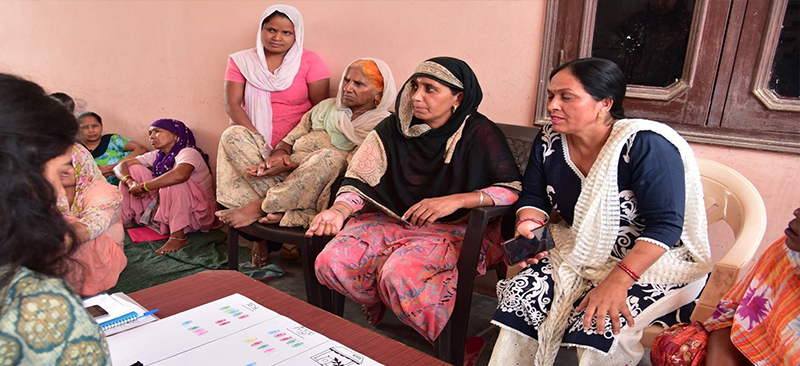
Digital transformation continues to revolutionize the future of work, especially after the COVID-19 pandemic hastened its pace. However, financial constraints still hinder the growth of the LMI workforce. This video highlights how start-ups under the FI lab have been trying to solve these challenges through human-centric solutions for an inclusive future.
Blog
Entitled: A synonym for empowerment of blue-collar workers through customized financial services
This blog talks about a start-up called Entitled, part of the Financial Inclusion Lab accelerator program, which is supported by some of the largest philanthropic organizations across the world – Bill & Melinda Gates Foundation, J.P. Morgan, Michael & Susan Dell Foundation, MetLife Foundation and Omidyar Network.
In India, more than 170 million people are classified as blue-collar workers. Most are semi-educated migrants from rural areas, who often lack formal financial history. Most blue-collar jobs do not provide any form of social protection, unlike white-collar jobs in the country.
A combination of a lack of financial literacy, low income, and lack of financial data has rendered this segment extremely vulnerable. The recent migrant worker crisis in India, brought about by COVID-19 further amplified this vulnerability. Traditional financial products that are designed for the top-of-the-pyramid customers often fail to meet the needs of this segment, leading to their exclusion.
Sana Qureshi is a 23-year-old woman who works at a healthcare platform in Mumbai. She faced the pain of such exclusion when she could not source a loan for her sick father’s medical treatment. Information asymmetry and fear of getting scammed worsened her conundrum as she searched desperately for options. This is when Sana came to know about Entitled—something that she recalls, “gave her hope”.
The fintech was founded by Anshul Khurana, Krishna Yadav, and Arpan Jain in 2019. It uses technology to provide access to a range of financial products, such as health insurance, emergency credit, and savings solutions for blue-collar workers, such as Sana.
It takes three to tango
Two of the founders, Anshul and Krishna, met at an organization that works with a large number of blue-collar employees. Here, they saw that blue-collar workers struggled with exclusion from formal financial services. These workers frequently needed loans and salary advances. They lacked knowledge about Employee State Insurance (ESIC), provident fund (PF), and other statutory deductions as well as workplace benefits. Moreover, the workers spent close to a tenth of their income each month on unnecessary expenses like bank withdrawal charges and late payment fees.
This spurred the idea of a platform to engage employees through financial products.
Solving problems for employees: What Entitled does
The two co-founders had another profound learning. They realized that they should focus on two interconnected aspects to solve these problems for the workers. The first is to educate them about financial management. The second is to counsel them to bring about effective lifestyle changes through a mindful selection of financial solutions suited to their context and needs. So, they started looking for a “partner-in-crime” who could help them add this dimension of education and counseling for their targeted customer segment.
Fortunately, they soon crossed paths with Arpan who shared the vision to support blue-collar workers. The trio was completed and their brainchild was formally given a name, Entitled. Combining their expertise, they began to engage employers in Mumbai to gather employee details. Gradually, Entitled began to offer financial wellbeing products to empower workers while bringing cohesion and clarity in their financial lives.
Entitled: A full-service financial wellness platform for blue-collar employees
Entitled helps blue-collar workers to access a range of financial services and rewards through its financial wellness platform.
How does Entitled do this? It links up with employers to offer services on the platform as employment benefits to these workers. The product suite includes:
- Financial counseling;
- Access to emergency funds;
- Insurance;
- Long-term saving instruments; and
- Rewards programs for employees based on their use of financial products.
The platform uses the employment information of the workers to build profiles and map the appropriate services to the employees.

Figure 1: User engagement of Entitlement
Sana Qureshi, 23, who is employed at a healthcare platform in Mumbai was introduced to the Entitled team by her employer and became an early adopter of the platform. Entitled not only provided her access to credit but also handheld her through the onboarding process and helped her to learn and leverage other features of the platform.
How does Entitled ensure the efficacy of its platform?
While providing financial wellness products, Entitled also captures the impact they have on their users. Entitled maps impact against specific metrics and tracks them continually. For instance, these metrics:
- Gauge the convenience and simplicity of formal products for workers who access them for the first time;
- Map product usage patterns against employee awareness and knowledge to design similar products for other segments; and
- Benchmark each of the platform’s products and services against the market rates at which these can be accessed through formal banking institutions be it lending or savings products, as applicable.
Such impact assessment helps Entitled in multiple ways.
- Enable increased awareness or understanding of formal financial products
- Create and deepen financial history for its users
- Catalyze their users’ access to financial institutions in the future.
Impact assessment helps Entitled ensure the financial wellbeing of users like Sana Qureshi, who we met earlier in our blog even during the pandemic. The Entitled team provided her guidance and timely nudges to meet every repayment in full and on schedule. This improved her credit score, which will enable her to avail cheaper and easier loans in the future. Sana is one among many others whom Entitled have helped in their nascent journey—a fact that is not lost on happy employers.

Trials along the way
While some employers are yet to recognize the importance of offering financial health initiatives and providing workplace benefits to their workers. Others simply fail to prioritize the financial health of employees. This leads to delayed interventions and denies employees critical financial aid and advice.
The first significant challenge for Entitled is user capability. The employee’s lack of awareness about technology and financial products requires significant handholding. Owing to the COVID-19 pandemic, user engagement has deteriorated.
Secondly, regulations, such as the moratorium announced by RBI in March 2020, have diminished investor willingness to lend—which in turn has impeded customer traction for Entitled. Nevertheless, the resolve of the founding team is strong and the team has invented ways to overcome the hurdles. The team has quickly adapted and shipped new product designs to ease the onboarding flow in a self-service delivery model.
Support from the FI Lab:
Entitled has been part of the Financial Inclusion Lab accelerator program, which receives support from some of the largest philanthropic organizations in the world—Bill & Melinda Gates Foundation, J.P. Morgan, Michael & Susan Dell Foundation, MetLife Foundation, and Omidyar Network.
The Lab has offered a cohesive and holistic support package to Entitled, ranging from mentor hours and grant capital to field studies led by financial inclusion experts in the areas of consumer and market insights. This has helped Entitled to gain a deeper understanding of its customers and build resilient, impactful solutions for them.

Vision for the future
While the pandemic has had an impact on Entitled, the company was able to refine its strategy to move forward and engage with more users on the platform. Based

on its knowledge of users’ behavior and familiarity with WhatsApp, Entitled has designed a customized WhatsApp bot for digital on-boarding. Such an approach tackles the first set of challenges that new users face while onboarding in the absence of over-the-counter interactions.
Figure 3: Entitled’s WhatsApp onboarding flow
Entitled has taken an efficient path to move forward by remaining lean and agile with minimal operational staff and by prioritizing product development for features based on customers’ needs. It continues to move toward improved digital features on the platform through a mobile application. The mobile app will make interactions easier, more efficient, and explanatory for users while adding a positive dimension to the financial lives of their customers once on-boarded.
This blog post is part of a series that covers promising FinTechs that are making a difference to underserved communities. These start-ups receive support from the Financial Inclusion Lab accelerator program. The Lab is a part of CIIE.CO’s Bharat Inclusion Initiative and is co-powered by MSC. #TechForAll, #BuildingForBharat
The many aspects of financial inclusion
Latest Episodes

MicroSave Consulting (MSC) is a boutique consulting firm that has, for 25 years, pushed the world towards meaningful financial, social, and economic inclusion. These podcast series are hosted by MSC for dedicated founders, start-ups, investors, and other stakeholders in the startup ecosystem. Through this bouquet of curated conversations around developments in the financial inclusion space, we offer insights and lessons based on our research and expertise.
In this podcast, MSC’s Inclusive Financial Ecosystem experts, Violet Kamau and Jackson Kamau, discuss how to enhance financial inclusion for forcibly displaced persons (FDPs). They address key barriers, highlight the impact of financial access, and share global lessons on how inclusive financial systems can empower FDPs, also highlighting successful countries that lead the way in inclusion.

Delivering social assistance during COVID with a “digital-first” approach: Lessons from India
As the COVID-19 pandemic started to exact a toll on lives and livelihoods in early 2020, countries imposed strict lockdowns to stem the spread of infections, disrupting economies and societies across the world. With pandemic-induced constraints on in-person interactions, many countries adopted a “digital first” approach to delivering social assistance, primarily cash transfers. How did these digital systems perform? What worked and what did not? And, as the world still grapples with COVID disruptions, including periodic lockdowns, how can governments better design and implement social assistance in an increasingly digital environment?
In a new CGD policy paper, we look at India’s experience to begin answering these questions. Together with a strict lockdown and information campaign, India’s early response to the COVID-19 pandemic included the launch of the Pradhan Mantri Garib Kalyan Yojana (PMGKY), a major social protection package covering both in-kind food distribution and cash transfers to women, the elderly, and farmers. We draw lessons from a nationally representative household survey conducted in India during April and May 2020, shortly after the launch of the program, and find that while PMGKY was by many measures successful in delivering benefits, there remains room for improvement.
How India implemented PMGKY
Unlike countries such as Colombia, Brazil, and Pakistan, India did not immediately launch a major new program targeted towards the “new poor”—the mostly informal-sector workers and urban wage laborers who lost their livelihoods and left cities for rural areas in the aftermath of the lockdowns. Instead, PMGKY built on five of India’s many existing social programs and one new program targeted at women to deliver additional benefits. For nearly a decade prior to the pandemic, India had invested in building digital platforms to transfer social benefits directly to beneficiary bank accounts, as well as to help manage the public distribution system for food rations. By early 2020, the vast majority of households were included in the “JAM”—the combination of digital ID (Aadhaar), Jan Dhan bank accounts, and mobile phones—making it possible for the government to implement a “digital first” social assistance strategy.
What did we find?
First, a caveat. The early stages of the lockdown were extraordinary times, with severe disruptions to the “real” economy—local and country-wide transport, commerce, and the functioning of supply chains. School closures suspended India’s school feeding program—the largest in the world—affecting nearly 144 million children and imposing an additional burden on poor households, especially women. These disruptions made transactions of any sort difficult, including those conducted digitally within aid programs, as physical goods must eventually be delivered to those in need. There is, therefore, a limit on what can be expected from even well-functioning digital systems, starting from the point at which they interface with real activity.
That said, in general, the survey results point to a relatively successful rollout of social assistance at scale: India’s relief measures reached nearly a billion people in a short time, with many households benefiting from multiple programs. Digital systems were instrumental in sustaining and rapidly scaling up financial assistance, no doubt helped by the decision to route benefits through existing programs rather than create new ones. However, many registered beneficiaries faced challenges in realizing the assistance, partly because they were not fully aware that it had been provided to them, and also because of perceived and real difficulties at points-of-service.
The in-kind public distribution system also played a vital cushioning role, possibly with the highest percentage of recipients receiving and realizing their benefits.
Based on survey responses, many people reported not receiving their full benefit in addition to the extra PMGKY food allowance, but it is not clear whether everyone who received the additional ration actually understood that it had been distributed to them because it was free.
Our analysis suggests that the delivery systems were not biased against any particular set of beneficiaries.
The patterns of responses do show statistically significant differences in the experience of different groups (urban/rural, male/female, etc.) but these are not large enough to undermine the general picture. Gender effects were limited, place of residence had only a modest effect on survey response with no consistent pattern, and there is no evidence that poor households had less success in accessing benefits.
Smartphones provided key benefits for communications, including awareness of social assistance as well as information on COVID-19.
Smartphone owners were more likely to be aware of at least one coronavirus symptom and more likely to report receiving information about the virus through six of the seven media channels polled, especially social media and YouTube. Smartphone owners were also more likely to receive information on the PMGKY package, with less need to check bank balances manually on passbooks or through local officials.
Among our respondents, 74 percent reported that at least one person within their household possessed a smartphone, indicating deep penetration both in rural and urban India.
Moreover, the survey provides no indication that smartphone ownership is dependent upon income; although men and urban dwellers were statistically more likely to report owning one. In short, a smartphone is no longer a luxury in India.
Despite unprecedented pressure to deliver benefits, the payments systems themselves appear to have worked reasonably well.
However, it was not always easy for people to get the benefits. The first impediment to realizing the financial transfers was that beneficiaries were not consistently aware that these had been paid into their accounts. In many cases, beneficiaries needed to verify bank balances manually, a process that was often complicated by lockdown conditions. The second related to the logistics of safely accessing cash-out facilities while complying with COVID prevention measures, a common problem across many countries that delivered social assistance digitally.
India offers lessons on the interaction of “real” and “digital” relief programs during an unprecedented emergency. Digital mechanisms have played a vital role. But even in a country that has made huge investments in digital ID and payments infrastructure, our research highlights the importance of local institutions and human resources to reach large numbers of people.
The Center for Global Development first published this blog on 22nd July, 2021.
AgriTechs: Shaping the future of agriculture in India
Agriculture is the life of the Indian economy. However, several structural challenges, such as intermediaries throughout the value chain and limited access to technology, credit, and markets, hinder this sector from reaching its full potential. This video highlights how AgriTech start-ups under the FI lab have been shaping the agriculture sector through technology and innovation.
NXTFIN-XaasTag: Technology-enabled mainstreaming of farmers’ collectives
This blog discusses XaasTag, a start-up under the Financial Inclusion Lab accelerator program. Some of the largest philanthropic organizations across the world support the FI Lab, such as the Bill & Melinda Gates Foundation, J.P. Morgan, Michael & Susan Dell Foundation, MetLife Foundation, and the Omidyar Network.
India has 145 million Indian farmer households, of which 87% are small and marginal farmers, who own less than 2 hectares of land. Although these farmers contribute to 60% of the total production of food grains and more than half of the country’s production of fruits and vegetables—they face numerous issues across the value chain.
While agriculture supports around half of the population in India, the average monthly income of farmers in the country is only INR 6,426 (USD 87). Small and marginal farmers struggle to access good quality and affordable inputs, market linkages, and credit. This is due to the small and fragmented landholdings and the absence of an adequate institutional framework to safeguard their interests. They are unable to integrate with the broader agriculture value chains and face the risks and challenges of volatility in the prices of commodities, crop failure, and expensive credit.
The lack of market access remains one of the major issues, which compelled Shiv Kumar and Gaurav Sharma to start XaasTag as a solution to empower farmers to secure better returns.
The lightbulb moment:
Shiv Kumar, a computer science and management graduate, served in the Indian Air Force. He took voluntary retirement in 2004 and started a venture from his garage. Over the years, Shiv worked at different places and co-founded three organizations around telecom services in small-town and rural India. During his association with e-Sahaj, one of the SREI group of companies, he met Gaurav. During their time with e-Sahaj, they closely observed the plight of the farming community, especially small and marginal farmers. Initially, the absence of health insurance services for the farming community struck them the most.
This gave birth to the idea of XaasTag. Shiv and Gaurav co-founded the organization and partnered with Religare Health Insurance to create an insurance product for rural India, which also included livestock insurance. They realized that retail insurance involved huge costs after running small pilots with a select group of farmers. Instead, they opted for a group-based model for insurance, credit, or both. Hence, XaasTag decided to work with farmers’ collectives, such as the farmer producer organizations (FPOs).
After multiple iterations and tweaks to their product offerings, the team identified access to reliable markets with a predictable price for their produce as the major need of farmers. They also analyzed the demand side, mainly institutional buyers who purchase from FPOs in bulk, such as intermediaries for retailers who supply to BigBasket, a large online commerce player. These intermediaries need a regular supply of agri-produce with consistent quality and price. These analyses prompted Shiv and Gaurav to pivot their product into a marketplace to connect FPOs and buyers.
In its current avatar, XaasTag links FPOs to institutional buyers with an overarching goal to provide farmers with assured and enhanced income through reduced price volatility and better predictability.
What makes XaasTag unique?
XaasTag’s NXTFIN is an online marketplace to connect FPOs on the supply side and agri small and micro enterprises (SMEs) on the demand side. NXTFIN enables agri-SMEs to work closely with farmers in providing easy access to low-cost loans and insurance services. NXTFIN hosts the following tools and services developed with its partners and affiliates:

The platform is a curated and diligently crafted marketplace. It carefully screens FPOs based on various parameters like the quality and quantity of produce. It also maps their supplies to the right buyers through the match-making algorithm XaasTag employs at the backend. The team works with farmers from planning to harvesting to the final supply of goods to institutional buyers. The team also prescribes a suitable “package of practice” for the crop, and conducts a physical verification before the goods are supplied.
Impact on LMI segments: Small and marginal farmers
The traditional process at mandis
An Agricultural Produce Market Committee (APMC) mandi is the traditional market where most farmers sell their produce under a spot trading system. A set of traders, also called arhatiyas, depress spot prices, armed with the knowledge that farmers have already spent enough on the transportation of their produce. Hence, farmers have to sell at suboptimal prices. Unfortunately, the government’s electronic auction system, eNAM, has not helped farmers much in the discovery of better prices.
Here comes XaasTag
XaasTag makes a direct impact on farmers in two ways, as depicted in the image below.


The roadblocks
Like any startup, XaasTag faces its share of challenges. These are focused on the following three aspects:
- FPO onboarding: Since XaasTag is new and relatively less known in the market, the team has found it challenging to convince and onboard FPOs who rely heavily on long-standing relationships to partner for the business.
- Scalability: The onboarding of FPOs is completely manual, which makes the process laborious and time-consuming.
- Retention: It lacks a value proposition for FPOs to build lifetime customer value (LTV) and strengthen their engagement with XaasTag.
Support from the FI Lab:
As part of the Financial Inclusion Lab accelerator program, XaasTag received assistance based on the challenges it faced, which helped them in the following ways:
- To overcome issues around scalability, the Lab helped develop an FPO onboarding assessment toolkit. XaasTag can integrate this scorecard-based FPO assessment tool with the NXTFIN platform. The scorecard accepts existing data that registered FPOs have shared over NXTFIN as input. The tool assesses multiple parameters ranging from scalability to the governance of an FPO and helps XaasTag identify promising FPOs for its platform. It provides a consistent, auditable, and objective assessment of the FPOs to help anyone in the team evaluate an FPO. With this, the team no longer needs to visit every FPO personally to assess its fitment.
- To build the value proposition for FPOs and to retain them with XaasTag, the Lab has been developing a training toolkit on business planning for FPOs. The toolkit is in the form of a digital comic book that will capture the importance of business planning, its components, and the process to build a sustainable business plan for an FPO. To build the internal capacities of FPOs, XaasTag will circulate this digital comic free of charge among its registered FPOs. This should help build trust and stickiness between the FPOs and XaasTag.
Vision for the future
XaasTag plans to partner with many more FPOs and engage more actively with farmers through a bigger team. XaasTag wants to utilize its huge database of FPOs and map the production to the right buyer. It also plans to set up production hubs. These hubs will act as small transit storage spaces for less perishable produce and a point for some level of processing, such as grading and sorting, among others, for enhanced efficiency.
This blog post is part of a series that covers promising FinTechs that make a difference to underserved communities. These start-ups receive support from the Financial Inclusion Lab accelerator program. The Lab is a part of CIIE.CO’s Bharat Inclusion Initiative and is co-powered by MSC. #TechForAll, #BuildingForBharat