
Farmer Producer Organizations (FPOs) can enhance access to both input and output markets for farmers and reduce inefficiencies in agricultural value chains. However, most FPOs struggle to gain better access to the market and lack adequate opportunities. This report is based on stakeholder consultations Samunnati and MSC conducted with a range of experts in the agriculture sector. It provides recommendations to aid the viability and sustainability of FPOs and enhance the incomes of millions of farmers in India.
Impact of COVID-19 on youth- Opportunities and challenges on youth livelihoods.

The COVID-19 pandemic has sent shockwaves across the entire world. The youth have borne the brunt of the pandemic due to the disruption in education and employment globally. The youth in the informal sector are more disadvantaged compared to their peers as they work in sectors that have been hit hard by the pandemic.
This video highlights MSC’s analysis of the impact of COVID-19 on youth and the immediate steps which the government and private stakeholders have taken to support youth livelihoods during the crisis. It also touches on what more can be done to ensure the interventions put in place are sustainable for the long-term.
Necessity is the mother of disruption: How Indonesia’s Fintech Startups can survive the do-or-die situation of COVID-19

Indonesia is a silent giant in the startup ecosystem. As per the Startup Ranking site, with over 2,200 startups nationwide, Indonesia ranks among the top five countries in terms of the number of startups.
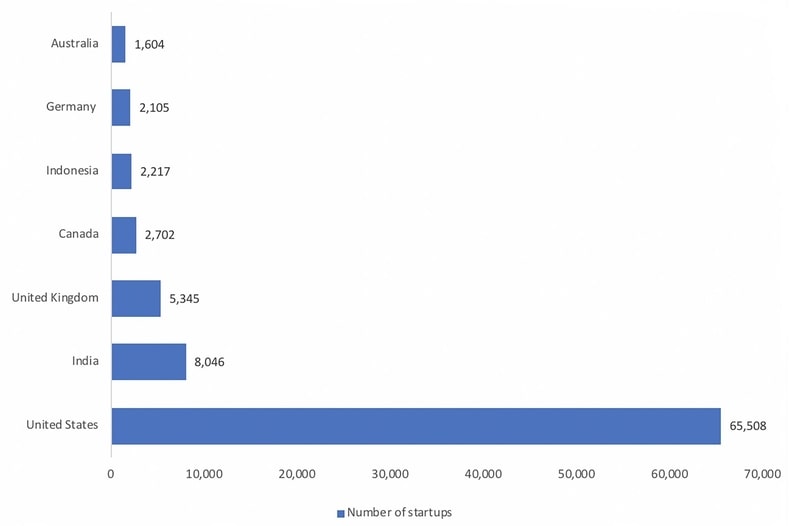
It is also the second-largest recipient of investments in Southeast Asia, which is an intensely competitive region.
Fintech is the biggest segment within Indonesia’s startup ecosystem. Fintechs in Indonesia have been hailed as the agents of change that can close the financial inclusion gap in the country and help conquer the digital divide. According to the World Bank’s Global Financial Inclusion index database, the country has made impressive strides toward financial inclusion. In 2018, approximately 50% of Indonesian adults owned bank accounts, up from 20% just four years earlier. At the same time, the country has made rapid strides to boost its digital economy, which is predicted to reach US $133 billion by 2025.
Super platform fintechs such as Gojek, Tokopedia and other large person-to-person lenders can take most of the credit for this success. They have promoted inclusion for underserved communities, such as small merchants and ride-hailing drivers. Together, these superplatforms and fintech startups have channeled loans worth approximately US $7 billion to date – with shorter turnaround times and lower overhead costs than banks.
However, with the onset of the COVID-19 pandemic, all the progress made by Indonesian startups is at risk of dissipating.
The impact of COVID-19 on fintechs in Indonesia
Our study on the impact of the pandemic on fintech in Indonesia revealed some alarming trends:
- Person-to-person fintech startups that target microenterprises and the low- and middle-income community have seen a 10-15% rise in non-performing loans.
- Platforms that cater to equity crowdfunding saw a 40-50% drop in the number of new investors, as investors have adopted a bearish attitude and want to conserve funds.
- Across the board, fintech startups have 5-6 months of runway for operations.
These trends are in sharp contrast to the experience of established fintechs – i.e.: those that have advanced beyond series-A funding. Here are some prominent examples:
- Less than 3% of borrowers at Koinworks have applied for payment relaxation to date.
- Investree continues its expansion with forays into other markets.
- On average, the volume of e-money transactions in Indonesia saw a 20% reduction by May 2020. Dana, however, reported a 15% increase in the volume of transactions.
- OVO reported an increase in volume of e-commerce, online education and cash top-up transactions.
- Established Insurtechs, such as Futuready and Simas Insurtech, reported no adverse impact of COVID-19 on their businesses in terms of revenues or sales. They are, in fact, optimistic about the growth of digital Insurtech.
- In general, established players have benefited as first-movers through wider and deeper market exposure, operational stability and strong funding support. These players have encouraged the use of sophisticated technologies, such as AI and Big Data analytics, to overcome the impact of the pandemic.
The coping strategies of startup fintechs
Most startup fintechs we interviewed had to implement coping mechanisms to survive and extend their runways. For instance:
- An early-stage startup in the field of over-the-counter digital payments laid off 30% of employees.
- An early-stage Insurtech renegotiated office rents and introduced pay cuts for staff to save money for a planned product launch later this year.
- To mitigate increased non-performing loans, some early-stage credit startups have stopped extending new loans. They are instead focused on collections and are implementing a door-to-door collection protocol.
Tweaking or pivoting business models is another survival strategy. For example:
- E-wallet providers are collaborating with remittance and e-commerce players to explore new use-cases.
- Before COVID-19, equity crowdfunding platforms were doing their own due diligence on small and medium-sized enterprises. However, they are now allowing users to decide which of these enterprises should go for initial public offerings on their platforms. Effectively, the due diligence process has been outsourced.
- Insurtechs are innovating and now offer microinsurance packages. Demand for higher ticket-size policies is waning.
Recommendations for fintech stakeholders
An old saying says that “Necessity is the mother of invention.” But in today’s world, necessity has become the mother of disruption – and stakeholders must support young businesses in that process. Ignoring startup fintechs in Indonesia would undermine their potential to solve existing problems through scalable solutions. This would be a big mistake, given that startups are poised to change the business landscape in the country. We recommend the following measures for fintech in the startup ecosystem, which can fast-track Indonesia’s economic recovery from the pandemic:
- Fintech startups should build strong use-cases and work with established players. Mergers amongst startup fintech that provide complementary solutions or support can also be a way forward. Eventually, the market needs to see a strong value proposition.
- It is time to focus on profitability rather than scalability. This approach will build business resilience and attract investors, even during these bearish times.
Recommendations for government and policymakers
The government can and should be the main catalyst for the survival and growth of fintech startups. But to date, the government of Indonesia has no specific regulations or measures to support fintechs, big or small. Instead, it is offering a general package of assistance for small and medium-sized enterprises, and fintechs are expected to accommodate themselves to it. This package does not really address the needs of tech-enabled startups.
A tailored and sustained push from the government for fintech startups could include:
- The allocation of emergency funds and well-structured guarantee programs to help startup fintechs extend their runways. The support would also catalyze positive investor sentiments for the entire fintech sector.
- The replication of initiatives implemented by the government of Singapore. Singapore has provided free API access and a “Digital Acceleration Grant” to fintech startups with less than 200 employees. The objective of the grant is to help these startups adopt a suite of digital tools to upgrade their enterprises while ensuring business continuity.
- Efforts to enhance the resilience of the fintech sector and support rapid scale-up. In particular, it would be helpful to pass a personal data protection bill and to increase access to the national ID database to enable electronic know-your-customer processes that can streamline customer onboarding for fintechs. Both of these regulatory actions would bolster customer confidence in the fintech industry, and lower customer acquisition costs through digitalization.
- The government of Indonesia could also invite fintech startups to support the distribution of government-to-person programs, such as People’s Business Loans, Ultra Micro Loans, or the Non-Cash Social Assistance Program. Using digital channels such as e-wallets and direct bank-to-bank money transfers to distribute these payments would reduce the costs associated with physical distribution channels, and also enable the contactless delivery of money. It could also promote the use of digital payment systems instead of cash.
Even though the current situation facing Indonesia’s startup ecosystem looks bleak, pushing the potential of fintech as a complement to traditional banking is our best hope for recovering its momentum. Fintechs are more agile and adaptive than traditional banks which still rely on legacy technology of its core systems. Hence, FinTechs will adopt automation and digitalization of banking processes in a much more agile manner and provide relevant use cases for banks to leverage this strength. Dedicated support from the government and more enabling regulations for these businesses can give a boost to the economy, and retain Indonesia’s position as a top destination for startups in the ASEAN region.
The blog was also published on Next Billion on 27th August 2020
Survival, recovery, and building resilience: Transformation of financial institutions in the times of COVID-19 – Part 2

In the previous blog, we discussed the impact of COVID-19 on individuals and businesses, much like Philip the fruit seller in Nairobi. The recovery of individuals and businesses depends on the revival of financial institutions. Further, we discussed actionable strategies for financial institutions to survive the crisis. In this blog, we discuss how financial institutions may build upon the survival strategies to recover and transform during the pandemic and afterward.
Different financial institutions will have suffered varying degrees of disruption due to the pandemic. Some might not even survive. They need critical knowledge and financial expertise for adaptive leadership and business continuity.
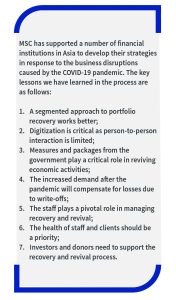
To recover, financial institutions must revive their portfolio, execute new funding strategies, manage costs, and engage in digital transformation. The recovery phase may anchor on the assessment of key customer segments, including the low- and moderate-income clients and entrepreneurs that the institution. The institutions may set up a responsive structure to help clients recover after the pandemic. Thereafter, the institutions may begin to assess the utility of digital processes and channels. Aligning digital initiatives to the needs of its users will provide an edge to the institution in its recovery. The design of digital initiatives should suit the context where the virus remains a reality. Besides, the institutions may create strong marketing, branding, and communications functions to reach out to customers.
We project that full person-to-person interaction will be feasible not before four to six months, and quite possibly in the months further ahead, subject to careful hygiene protocols. Thus, the digital solutions will need to be built on the understanding of the customers and a humane approach to the customer problems in the current context. A high-tech and human touch model may be enabled through the relationships, data, innate customer awareness, and local understanding.
Based on MSC’s experience with financial institutions, we make the following recommendations for financial institutions to recover and build resilience in the post-COVID-19 phase.
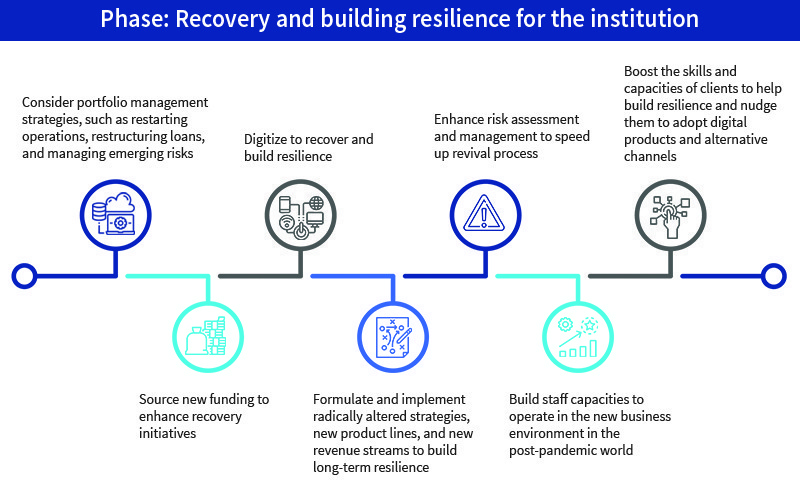
6.Consider portfolio management strategies, such as restarting operations, restructuring loans, and managing emerging risks
In the recovery phase, financial institutions may revive their portfolio by restarting operations in the areas that have either recovered or are less infected. The institutions may devise portfolio planning and management through a mix of segmentation, risk analysis, and stress testing scenarios.
As the businesses/daily lives of the clients are affected due to the pandemic, the institutions may need to restructure and refinance. This will enable clients to use additional credit to recover their businesses. However, the institution may use a segment-wise portfolio analysis to decide on the set of clients to restructure loans. Financial institutions may develop a matrix to score clients and segments to decide appropriate actions. The scoring matrix may consider the impact on the business, finance, workforce, and households; coping strategies; and outlook. Using a simplistic scoring tool, the institutions may prioritize the clients segments to focus upon and action plans.
The institutions may also need to focus on managing risks associated with the recovery phase. Some of the risks to focus upon include financing the operations and business, credit and recovery, and fraud and misrepresentation.
7.Source new funding to enhance recovery initiatives
As financial institutions build recovery strategies, they will need to execute new funding strategies. To do so, they will need to reposition the institution as they rebuild after the pandemic. They will also have to understand the current priorities of donors and investors. The financial institutions may identify the funding opportunities to assist the recovery efforts. The institutions may also identify the key government support programs for the financial sector. Thus, financial institutions may raise funds for the recovery phase by utilizing government programs, donors, and investor responses.
8.Digitize to recover and build resilience
As the period of the pandemic and after is and will be characterized by digital engagement, financial institutions may assess the digital inclusion infrastructure and environment and determine opportunities in the market for financial institutions. Financial institutions may recover and build long-term resilience through digital transformation.
The first step to digital transformation for any financial institution is the assessment of its digital transformation readiness. An ideal digital transformation readiness assessment may include the following elements:
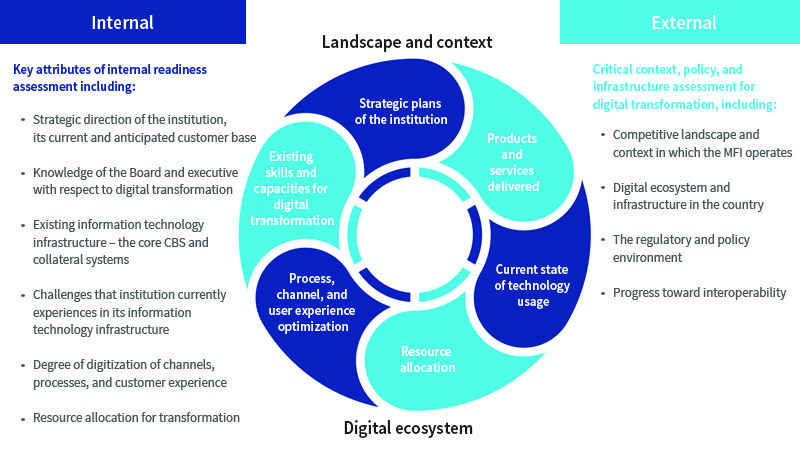
Digital transformation for organizations is about offering the right combination of 1) digital solutions or tools, 2) delivered digitally, 3) riding on digital technology, 4) that provide a seamless user experience. Digital transformation for financial institutions may include:
- Business model and products: Digitization fosters innovation across the business model and products
- Processes: Automation of repetitive, low-value, and low-risk processes; digitization helps in enhancing the efficiency and managing risks for the back-end and front-end processes
- Channels: Digitization of the traditional channels
- Engagement and user experience: Enhanced engagement with customers, employees, and suppliers; use of technology to offer superior user experience
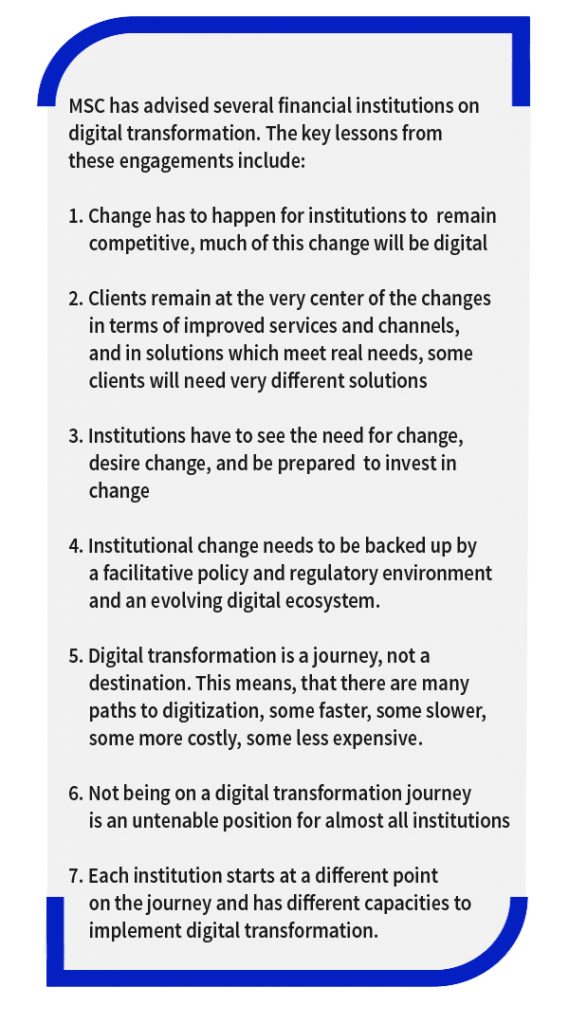
Financial institutions should use the crisis as an opportunity to digitize their business model and operations. We have seen that a growing number of financial institutions are now gearing up their digital transformation efforts and will quickly eat into the markets of analog financial institutions.
During the pandemic and after, financial institutions may use digital transformation to:
- Use digital channels to optimize loan disbursement and repayment
- Increase digital client engagement through client relationship management
- Build or revise the existing digital credit-scoring module for existing and new clients
- Develop digital staff engagement workflows and integrate into the human resource management plan
- Digitize client engagement through tablets that can capture biometrics and other loan application requirements
- Create an electronic data management system to manage client-related data and to run advanced analytics
- Digitize internal business processes to optimize costs and increase efficiency
- Utilize digitization to engage with new and existing clients
- Re-orient staff to digitization; this may include new business processes and new business tools anchored on technology
- Revamp the client relations management system to include regular client engagement messages. Text message blasts, interactive video responses, and comics to deliver to clients
The digital transformation strategy for each financial institution needs to be customized and contextualized. The financial institution may need to develop unique, individual, and customized digital solutions that build on the current limitations of using physical touchpoints as is the case now.
9.Formulate and implement radically altered strategies, new product lines, and new revenue streams to build long-term resilience
In the next phase, the institutions will need to transform radically to build resilience based on the level of preparedness, macro-economic conditions the financial institution operates in, and the context.
As part of the revival and resilience-building efforts, institutions may develop new product mixes, such as new credit lines and innovative savings initiatives geared to insulate clients against future disasters. Further, institutions may build partnerships to offer products like wholesale lending credit lines for businesses to revive.
The institutions may assess and focus on serving the top-performing client segment post-pandemic. Through constant market intelligence, the institutions may develop a list of top-performing sectors. These sectors will have businesses and activities that have faced minimal disruption and risks due to the ongoing pandemic. Besides, institutions may develop or strengthen partnerships in the delivery of financial services. They may need to identify new opportunities, such as that of money transfer and payments to tap into a new market. They may also explore new revenue streams, such as disbursement of government benefits to the low- and moderate-income populations.
10.Enhance risk assessment and management to speed up the revival process
The institutions will need to enhance the risk management approaches significantly, especially for their credit portfolio. They can do so by identifying the existing and new risks, assessing the nature of risks, and validating the existing risk management framework. They may need to re-calibrate the indicators and triggers of all risks in line with shocks and impact on the institutions’ portfolio, besides refining the institutional risk management approaches and mitigation measures.
11. Build staff capacities to operate in the new business environment in the post-pandemic world
Financial institutions may need to develop and disseminate content for their staff to prepare them better to work in the new business environment. The institutions may enhance employee awareness on preparedness to manage shocks that may have an impact on the business operations of their clients in the future.
12. Boost the skills and capacities of clients to help build resilience and nudge them to adopt digital products and alternative channels
Financial institutions may need to connect with the clients and ensure regular client engagement through a digital client management platform. The institutions may support individuals and enterprises to build skills and capacities through access to training modules. These modules may cover digital capability and financial education for individuals, and business skills for the entrepreneurs. Such skills and capacity building measures may encourage clients to adopt digital products and alternative channels.
With these measures, financial institutions may align business operations with user needs and utilize digitization to deliver client-centric solutions. Financial institutions will also be able to respond better to the economic disruption and make a faster recovery within the current social and economic situation. Thus, they will be able to support businesses, much like Philip, whom we met in the first blog, as he rebuilds his livelihood. If financial institutions revive and re-engineer, they can offer some hope for people like Philip and their enterprises.
Coping with COVID-19 in Kenya

MSC conducted research to understand how the low and middle income (LMI) segments cope with the COVID-19 pandemic. To examine how this pandemic has affected their lives, we spoke with 150 LMI households across Kenya. Our report offers a glimpse into their remarkable achievements, underlying challenges, and new opportunities amid COVID-19. It delves deeper into the coping strategies LMI segments have adopted to mitigate the effect of this disruption. We explore how the pandemic has triggered the uptake of digital technologies and provides policy recommendations to help LMI segments survive.
Survival, recovery, and building resilience: Transformation of financial institutions in the times of COVID-19 – Part 1

In the bustling City Park Market in Nairobi, Philip runs a fruit stall. The market has other fruit stalls but they are no match for his excellent service, which delights customers. His efforts have grown his business in the past 12 years since he began. Philip attributes his success to regular access to credit from a financial institution. His business has not always grown steadily though and came to the brink of collapse, twice.
The first time Philip almost had to quit his business was in 2016, immediately after the government imposed an interest rate cap when the market saw a squeeze in general credit. The second time Philip’s business hit a roadblock was in 2017. The election crisis in the country led to a lot of uncertainty and economic instability. In both cases, Philip was optimistic and indeed his business recovered in due course. Yet with COVID-19, he has lost all hope.
Philip is not unique. He represents over 300 million enterprises from emerging economies across the world. The global pandemic has affected the lives, health, and livelihoods of entrepreneurs, and they have been struggling to repay loans from financial institutions. These financial institutions face a vicious cycle, as poor asset quality continues to pressurize both liquidity and profitability. The financial crisis may erode a decade of gains in financial access if financial institutions cannot get timely support.
The global pandemic also amplifies the need and opportunity to initiate digital transformation. Such a transformation will be both a response to this crisis, which may well persist for years to come if no fully effective vaccine is found, and a response to an increasingly uncertain future. Viruses mutate, so this year’s vaccine may not be effective next year, as is the case with the flu. Moreover, as humanity’s destruction of the natural environment continues, similar future pandemics become more likely.
In this and the next in the series of blogs, we discuss how donors and investors should support financial institutions during this uncertain time.
The following are some recommendations from MSC for financial institutions to survive in the wake of COVID-19.
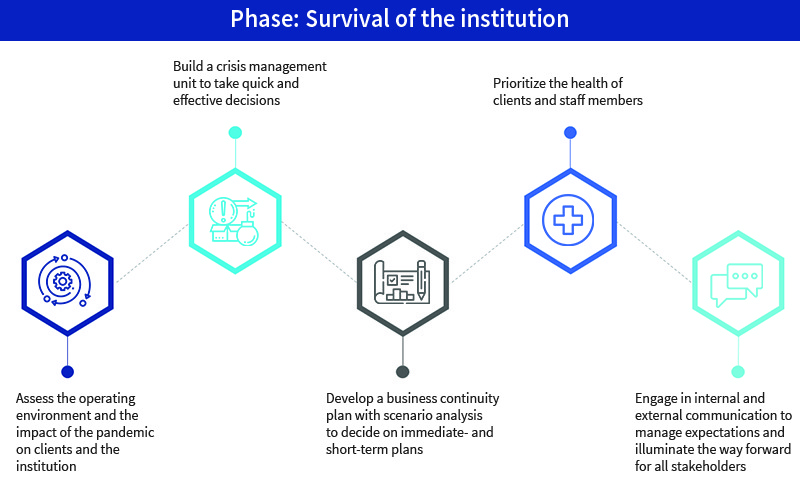
1. Assess the operating environment and the impact of the pandemic on clients and themselves
Financial institutions need to understand their new operating environment to build survival strategies. Governments have implemented several policies and measures for financial institutions. The institutions must assess these measures and see how best to use them to benefit from the policy, regulatory, and supervisory frameworks.
 Financial institutions must assess the impact of the pandemic on the financial sector in the country. The institutions may also assess how COVID-19 has affected the clients. A dipstick assessment of the impact of their pandemic will help to understand the needs, attitudes, perceptions, and behaviour of customers. This will determine how best an institution can prioritize various strategic steps to support the recovery.
Financial institutions should assess the impact at an institutional level to determine steps to survive, recover, and build resilience. Some aspects the institutions may focus on include:
a) Financial aspects including capital adequacy and funding structure, funding mix, and use of financial instruments to mitigate various risks;
b) Portfolio aspects, such as asset quality, concentration, and diversity;
c) Risk management strategies;
d) Human resources aspects to focus on redundancies, the impact on staffing levels, and the need to repurpose staff members to other tasks.
We must note that not all individuals and enterprises are the same. Our research on enterprises shows that 20% of businesses—the “essential services” in particular—have not been affected badly. Such businesses may be encouraged to continue to repay.
The financial institutions can then develop survival strategies using these insights.
2. Build a crisis management unit to take quick and effective decisions
As the first step, the institutions may build a unit to manage the crisis during and after the pandemic. Ideally, the unit should have executive powers and should be willing and able to take decisions immediately and proactively. The unit should develop quick strategic and institutional responses to manage the immediate- and short-term risks. These responses should be developed and implemented with an unwavering eye on the future and the institutions’ digital transformation strategy.
3. Develop a business continuity plan with scenario analysis to decide on immediate- and short-term plans
The next step would be to develop a business continuity plan across various time frames. The institutions may conduct stress tests across several scenarios to include assumptions around when the pandemic is going to end, what funding resources are or will be available, and which expense items may be rationalized. As the institutions build their business continuity plans, they must revise business plans in light of the emerging situation and the impact, build scenarios, and refine budgeting for the various scenarios. The institutions may need to optimize expenses, reduce costs, and revise product pricing accordingly.
4. Prioritize the health of clients and staff members
As the high-touch model of financial institutions has the potential to expose the staff members to the risk of infection, the institutions may need to create awareness among the staff members on health precautions. Staff could minimize the risk of infection during meetings with clients, serving clients, and handling cash. The institutions may focus on explaining the concepts of disinfecting facilities, social distancing, and the use of protective equipment. Institutions should also repurpose the role of field staff members to that of community health advisors. As part of demonstrating corporate good citizenship and caring for clients, field staff members should educate customers on preventive measures and guide those suspected with the disease to visit the right place for screening or testing.
5. Engage in internal and external communication to manage expectations and illuminate the way forward for all stakeholders
In the immediate term, financial institutions need to communicate well with staff, clients, donors, investors, and other stakeholders. The institutions may focus on internal communications around restructuring roles, safety and wellness of the staff, strategies for portfolio and risk management, and revised structures and job responsibilities. Further, the institutions may amplify external communications around the impact of the pandemic on client, staff, and portfolio, business continuity measures, portfolio and risk management measures, and regular updates on institutional responses.
In the next blog, we discuss how institutions may formulate recovery and resilience strategies to manage revival during the pandemic and in its aftermath.
An abridged version of this blog was first published on Next Billion.