As part of the relief measures for COVID-19, more than 300 million poor people in India received direct financial assistance worth USD 4 billion – within a few days of its announcement. This was possible because of the digital financial infrastructure that India has developed over the years, including bank accounts for all poor households, a robust interoperable payment infrastructure, and an extensive cash-in cash-out agent network.
Digital G2P payment infrastructures can bring cost efficiencies for governments, drastically reduce lead time for cash transfers, and improve access to cash support for the beneficiaries. The need for a digital financial services infrastructure is heightened as governments across the globe deal with the economic fallout from the COVID-19 pandemic.
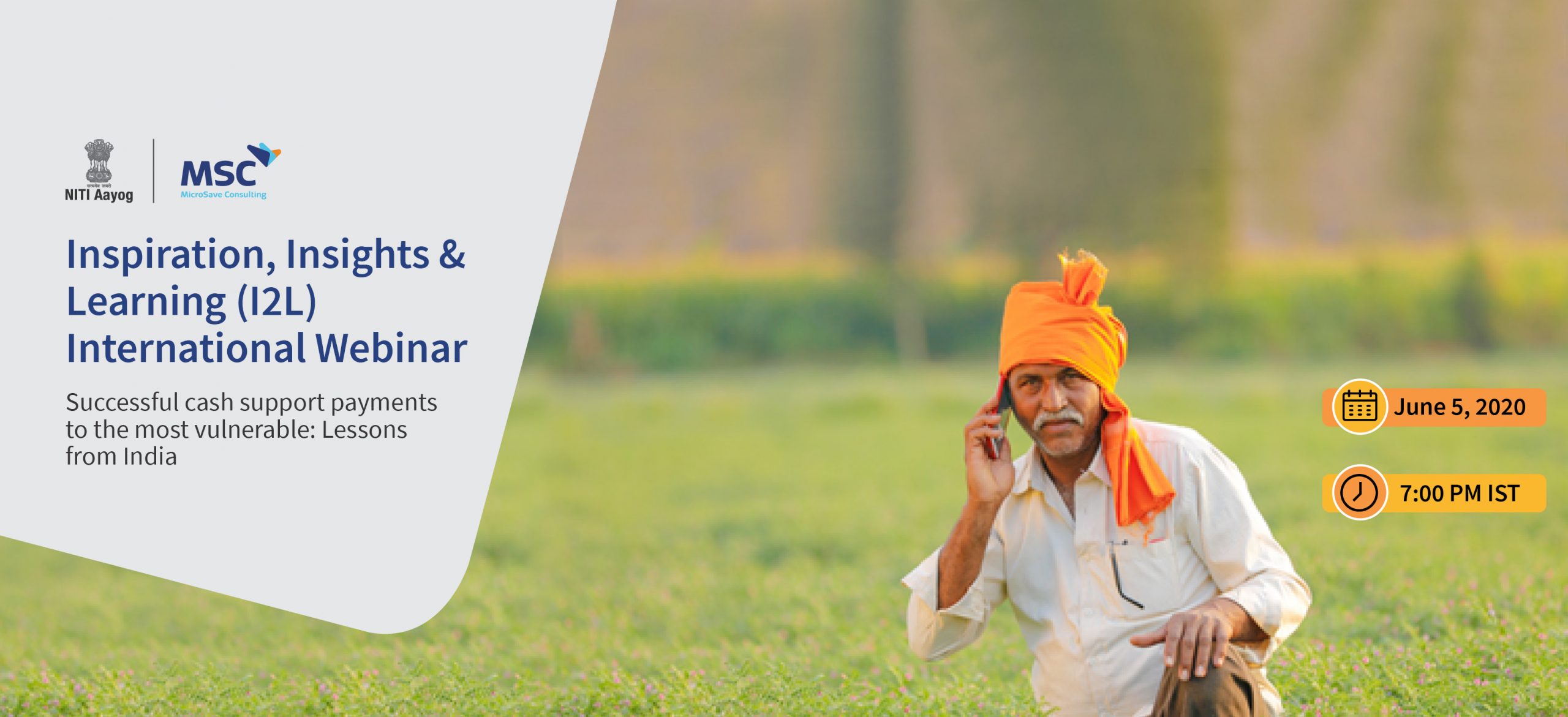
NITI Aayog and MSC will host a webinar on 5th June, 2020 at 7 p.m. IST/1:30 p.m. GMT to explore the lessons from India’s experience with digital G2P payments, especially in light of the latest pandemic.
In this webinar, the panelists will discuss India’s journey to enable this scale of financial inclusion, the challenges in designing and operationalizing the payment infrastructure, and the lessons from on-ground implementation in the aspirational districts.
The COVID-19 pandemic has brought upon us the responsibility to create awareness, influence precautionary behavior, and drive the safety of CICO agents and their customers. We have developed engaging training material for CICO agents in the form of conversational comics on COVID-19. These explain preventive measures through accessible, visual narratives and include aspects of workplace safety at the agent shop, cash handling, and ensuring customer protection. These booklets can be customized to country-specific guidelines, institutions, and customers. Feel free to share them and join us in fighting back. #staysafe
As we discussed in the first article in this two-part series, the COVID-19 pandemic has brought unprecedented challenges to the financial services industry – particularly in emerging markets. As the sector continues to grapple with health challenges, lockdowns and growing economic uncertainty, fintechs are redrawing their strategy to weather this storm and seize new opportunities.
Over starting from April 15, MSC interacted with a wide range of fintechs, investors, policymakers and industry associations across Bangladesh, Côte d’Ivoire, India, Indonesia, Senegal and Vietnam to understand how they are coping since the advent of the crisis. With no playbook to refer to or precedents to follow, fintechs are adapting to these difficult times on their own. Some have been building new tools and services, while others offer existing services with innovative tweaks. Based on MSC’s interactions and other analyses, fintechs are adopting several key measures to stay relevant, augment their recovery and build their resilience during the crisis. Below, we’ll look at seven approaches that fintechs have utilized to overcome the challenges brought forth by the pandemic.
Adaptability is the name of the game
Clearly, the need of the hour is to change and adapt to new situations. One fintech-and-logistics startup we encountered modified its business strategy and distribution infrastructure to keep up with the shift in the priorities and requirements of its rural customers from discretionary to essential goods. Today, though its margins on the delivery of essential goods are much lower, the startup has compensated with higher volumes coupled with faster turnaround times.
Improvisation is crucial to survival
Many fintechs rely on in-person verification of customers. But during the pandemic, some of them have switched to verification through video calls while maintaining their promised standards of quality assurance. This improvisation has helped them to keep their businesses running with substantial savings on logistics.
Ethical business practices never grow old
Containment measures, such as the lockdown, have resulted in panic buying and hoarding of essential and non-essential goods. A few opportunistic businesses have responded by raising their prices significantly. However, our respondent fintechs still believe in remaining ethical. One of them has kept its promise of helping farmers get a fair price for their produce. As licensees to deliver essential goods across lockdown areas in India, they continued to charge regular prices to their retail customers who were otherwise willing to pay more. This approach is paying off: In response, some of their big retailers are willing to give them the “first right of refusal” for large-quantity orders should they find it challenging to deliver.
Customer empathy is the secret sauce of success
The credit and lending fintechs that we spoke to have one thing in common: fear of borrowers defaulting on their repayments during the crisis. With imminent delinquencies due to loss of income, a few have taken an alternative approach. These fintechs now allow conversion of short-term loans (1-4 months) to longer-term loans (4-8 months) for a small processing fee. Not only are the delinquencies under control, but some customers are even willingly paying more than their installment amounts—which have now been reduced.
The outbreak of the pandemic has led to the hoarding of groceries, essentials and cash. Central banks in our focus markets have reported a sharp jump in cash-in-circulation and cash withdrawals over the last four weeks. Despite lockdowns, the demand for cash as a “safe asset” continues to rise, particularly among low- and moderate-income communities as they prepare to weather the difficult days ahead. This is affecting fintechs that deal in savings. Some of them are brainstorming innovative solutions to counter their dwindling customer base, such as adding complementary products (like nano-insurance) to their offerings.
Stay relevant and you will flourish
The magnitude of the pandemic and the ensuing health and economic hardships have overwhelmed the financial services sector, especially the insurers. Nevertheless, some insurtechs and established fintechs have come up with meaningful and affordable products to help low- and moderate-income communities stay safe and protected. One such fintech startup in India quickly assessed the situation and built “a la carofferings from its insurance policy suppliers, allowing customers to pick and choose the specific coverage they need. Another fintech offers nano-insurance products for term and life that includes hospitalization benefits against COVID-19, in partnership with a large insurance firm, at an annual premium of US $8-14.
The irony: the risk-takers are the most risk-averse
Venture capital (VC) and private equity (PE) firms are considered some of the most significant risk-takers, as they bet on the riskiest class of assets: startups. In the usual scenario of a market downturn, these investors seize the opportunity and stand ready to fund or acquire fintech startups. However, in the current situation of economic uncertainty, some of the VC and PE firms in our focus markets are contemplating which fintechs to continue funding and which to let loose as they seek safer investments. Anup Jain, a Managing Partner at Orios Venture Partners, aptly sums up the general investor sentiment today when he says, “Funds will now disproportionately preserve the dry powder to finance their own portfolio companies.”
With investors less willing to continue funding riskier fintechs, we may witness subdued investment activity in the second quarter of this year and beyond.
Looking toward the near future
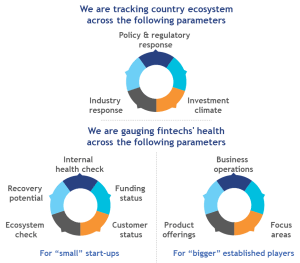
Clearly, these are uncertain times. An approach that is working today may not work tomorrow. However, newer and more innovative approaches are already emerging, as fintechs work to adapt to these rapidly changing circumstances. Through our multi-geography, holistic research on fintechs and their ecosystem partners, MSC will continue to track and assess policy, regulatory and industry responses, review the investment climate, and of fintechs.
Our objective is to design programmatic interventions to support fintechs, especially the ones focused on low- and moderate-income segments, to survive, rebuild, sustain and grow. We will continue to equip regulators, policymakers, ecosystem partners and investors with our findings, to empower fintechs to function effectively and play a positive role in the pandemic.
Leveraging the opportunities that technology offers, fintech has proven their potential to disrupt financial services to serve the mass market – including low- and middle-income customers. Increased adoption of smartphones, greater access to the internet, and growing comfort in using technology have given rise to many promising fintech innovations. However, even the most innovative approaches can fail to gain traction in an economy that’s been brought to a standstill by the COVID-19 pandemic. That’s why, as the financial services industry continues to grapple with growing economic uncertainty, fintechs are redrawing their strategy to weather this perfect storm.
In this article, the first of a two-part series, we’ll discuss the challenges and opportunities that the pandemic brings to fintechs—both small and established ones— in emerging markets, and what they can do to survive it. In the second article, we’ll look at seven approaches that stem from our initial studies, which these fintechs have utilized to overcome the challenges brought forth by the crisis.
Challenges are unprecedented, but opportunities exist
However, these unprecedented circumstances have led to some unexpected opportunities for fintechs. At a high level, as people minimize personal contact, we foresee a tremendous opportunity for growth around a variety of digital financial services. Some services that could gain traction during the pandemic include peer-to-peer payments, merchant payments, consumer and business lending, and health and life insurance. However, fear, anxiety, and quarantining will also hurt consumer sentiment, leading to overall weak demand. But these obstacles might also present fintechs with an opportunity to develop innovative solutions to help people, businesses, and the government to manage their finances and lives better.
Fintechs can help communities weather COVID-19
At MSC, we believe that every challenge is an opportunity. This view resonates especially with fintechs that have been at the forefront of the revolution of financial services for more than a decade. Our partnership and close, ongoing association with promising fintechs under the Financial Inclusion lab have provided valuable services to more than 1.5 million low- and middle-income (LMI) households in less than two years. This has strengthened our belief that fintechs can play a crucial role in addressing the imminent social and economic challenges that LMI communities face.
Given the extent of the pandemic and its likely impact on fintechs, the sector must be rebuilt once the crisis starts subsiding. To support this process, we must first take a deep dive into the financial, business and operations management of fintechs in emerging markets to understand the impact of the pandemic.
To assess the challenges and opportunities that face fintechs, MSC kick-started a thematic research exercise across six countries in Asia and Africa, covering both smaller startups as well as bigger and more established players. Our research is based on (sometimes referred to as longitudinal data), and will be carried out over three phases spanning nine months—“now,” “intermediate” and “recovery.” All three phases of research will focus on Bangladesh, Côte d’Ivoire, India, Indonesia, Senegal and Vietnam.
The pandemic has challenged the very existence of fintechs
we have interacted with a wide range of fintechs, investors, policymakers and industry associations across these six countries to understand the nature and extent of the early effects of the pandemic. The abruptness and spread of this extraordinary event have caught the fintech ecosystem off-guard. This has challenged the prevalent investment strategies, business models and distribution rails that have fueled the growth of these fintechs so far.
COVID-19 is causing five key challenges for fintechs:
Weak investment climate: Global funding to fintechs, which until the crisis was at record levels, has started to decline – both in terms of the number of deals and their dollar value – as investors are contemplating new risk mitigation measures. Some of the venture capital and private equity firms in our focus markets are considering which fintechs to continue funding and which to let loose, as they seek safety with a “,” moving capital away from riskier startup investments and towards larger, more established incumbents. Fintechs, which could earlier raise significant capital just on the promise of growth, now need to focus on profitability and positive cash flows to build the confidence of investors.
Subdued policy and industry response: As funding sources dry up, struggling fintechs may be forced to seek collaboration, investment or acquisition with deal terms expected to swing in favor of the acquirers. While policymakers and industry associations are working on short- to long-term policy responses to enable fintechs to cope with the crisis, they do not have a playbook to guide them. There are still no clear guidelines or stimulus packages from policymakers or industry associations to help fintechs cope with the crisis.
Falling transactions and dip in revenues: Our focus markets have begun to experience the onset of an economic slowdown due to restricted mobility, weak consumer sentiment and reduced business spending. Fintechs with transaction-and volume-based revenue models are witnessing a decline across all product categories. Minimizing fixed costs, while ensuring that most spend is variable, is the priority for all fintechs. Weak transaction volumes will not justify high customer acquisition costs based on large marketing expenditures and loyalty-based incentives. Fintechs need to revisit their strategies on how to retain existing customers while adding new ones to the pool.
Limited business operations: Restricted mobility due to lockdowns has halted the field operations for most of the fintechs in our focus markets. It has had an impact on vital business processes, such as in-person verification to acquire and onboard new customers for credit fintechs and insurtechs, cash-in/cash-out transactions and rebalancing liquidity at agent outlets for players that depend on agent networks, and delivery of non-essential goods for established fintechs. Transitioning these processes to the digital mode and retraining staff will require considerable efforts from some of these fintechs.
Employee retention and management: Many fintechs – especially the smaller, bootstrapped ones – are finding it difficult to retain employees. While some have started to implement softer measures, such as salary cuts, others are exploring stringent options, such as putting employees on furlough or lay-offs. Established fintechs are struggling to redesign internal operations to configure remote working, and to update policies to ensure the safety and health coverage of their staff.
Innovation can help fintechs unlock opportunities
Admirably, fintechs across these emerging markets are gearing up to respond to these challenging times. For instance, they have been adapting their business models and operations by eliminating variable expenses, such as hiring and marketing. They have also been preserving cash flow and runway by lowering fixed expenses, such as office space rentals. Some have been building new tools and services for remote customer acquisition and onboarding, while others are offering existing services with innovative tweaks.
One such example is PayAgri, an Indian agri-fintech that is part of the Financial Inclusion Lab, run jointly by CIIE.CO and MSC. Over the past few weeks, PayAgri’s team has been working around the clock to meet its mission — to offer market and financial linkages to farmers and farmer producer organizations. When most other startups are losing their customers with every passing day, PayAgri’s customer base of farmers needs them more than ever. Since the outbreak of the pandemic in India, the buyers’ payment cycle for agricultural produce has dropped from seven days to zero (cash and carry), and PayAgri has continued with its practice of making upfront payments to farmers at fair market prices upon collection of produce. This is the most critical value-add to the farmers it works with in these unprecedented times. Additionally, unlike many other fintechs that have laid-off their staff or put them on furloughs, PayAgri is planning to hire more people. It looks forward to serving more farmers, coming up with more innovative business ideas and expanding its business in the months and years ahead.
Along with PayAgri, an increasing number of fintechs, both big and small, are thinking and evolving to serve the low- and moderate-income community more meaningfully as the pandemic progresses. However, to stay relevant and build resilience, these fintechs need to dial down their costs, manage the squeeze in working capital, retain employees in a stricter environment, and continue to innovate.
In the second part of this series, we will look at seven specific approaches that fintechs are adopting to overcome the challenges of the COVID-19 crisis.
The blog was also published on Next Billion on 1st of June, 2020
According to the ILO, the decline in employment in the second quarter of 2020 is likely to be far worse than initial estimates had indicated. The first month of crisis points to a decline in earnings of informal workers of 60% globally. The anticipated impact in Africa is higher at 81%. The growth in African economies has been dropping sharply, especially in the West African Economic and Monetary Union (UEMOA), a dynamic area of the region. External demand has declined fast, supply chains are under strain, while domestic production continues to slow. The fight against unemployment promises to be long and difficult.
In West Africa, the impact will be even greater in those places where informal employment accounts for 92.4% of the overall employment across all sectors. This is due to confinement measures or because informal employees work in the sectors that the pandemic has hit the hardest, or due to a combination of both. As we know, crises have a more negative impact on the most vulnerable, and COVID-19 will not be an exception. Young people and especially women who already face the global challenge of underemployment count among the most at risk in this global health crisis. The financial, economic, and social repercussions of the pandemic are unprecedented.
At this point, we face several questions worth exploring. How are youth coping? How can we engage young people in the management of the crisis and recovery after the pandemic? While they will need short-term financial support, different levels of impact alongside a long-term strategy should be considered.
Moreover, young people who have opened their businesses will find it difficult to survive the crisis. They lack the financial resources and experience, particularly of crisis management, to tide them over. Policymakers will need to develop, test, and deploy programs designed specifically to create employment opportunities for youth.
Young people are already reacting to the virus through innovation for social impact
Despite the most damaging consequences of the current health and economic crisis, some positive developments have emerged. Indeed, if anything, the situation has revealed the resilient nature of youth. Many young workers and entrepreneurs have chosen to see the proverbial glass half full and to position themselves as agents of change. The confinement has not hindered their imagination.
Enterprising youth have already developed several applications, such as AntiCoro, created by the association of 10 Ivorian startups and SOS-COVID of the Cameroonian startup House Innovation. The features of these apps include the ability to self-diagnose in light of the symptoms presented, to follow the evolution of the disease around the world, and to learn about the precautions users can take to protect themselves. Some apps allow users to request geolocation assistance and provide mapping of infected areas. Others help users identify supply points for necessities, e-learning, or telecommuting solutions.
Several young tailors whose business has slowed to a crawl have repositioned to stitch the masks that are now mandated in public places in Senegal and Côte d’Ivoire. They were able to find buyers and broaden their distribution points to include a range of companies, pharmacies, bakeries, caterers, and even associations that redistribute them to the most vulnerable individuals.
For example, the startup Dakar Masks was born out of a collaboration between Senegalese entrepreneurs and craftsmen who decided to make fabric masks as per the standards defined by the CHU de Grenoble. The startup developed a test to ensure their effectiveness. “We spark a lighter flame in front of each mask, and then we blow. If the flame does not go out, it shows that the air does not pass through the fabric. The virus is therefore unlikely to get embedded in the tissue,” explains Demba Guèye, the founder of Dakar Masks. Customers can place their orders for masks through a WhatsApp number and the company delivers them home to address social distancing.
The Senegalese brand Lesly Mac Fashion designer has also taken this opportunity to pivot its business. “I anticipated the demand for the masks because I knew there would be a spike, just like what is happening now. Our mask creation business allows us to keep our staff and pay fixed expenses,” explains Charlene Lesley, founder of the brand.
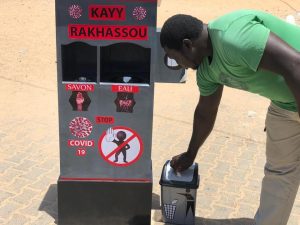
Two young Senegalese entrepreneurs Ibrahima Ndiaye and Ousmane Diop created and implemented automatic handwashing stations, named Kayy Rakhassou, which means, “come and wash your hands”. The device offers soap and water and works with solar energy, which makes its use completely autonomous and sustainable. It also has paper tissues and a bin. The two entrepreneurs hope that their next steps will be to increase their production volume through partnerships with companies, governments, and municipalities.
Oumar Basse is the co-founder of Yobante Express, a marketplace that connects delivery drivers to local businesses to optimize last-mile delivery in developing countries. He had to adapt to the new need quickly to deliver while strictly respecting the need for social distancing. “We have also implemented #yesfood (food delivery) and #region (delivery in all regions) in close collaboration with the Ministry of Trade and DER (General Delegation for Rapid Entrepreneurship of Youth and Women). We bring concrete solutions to the problem related to the distribution of bread with the “Diaym Mbourou” device”, Omar notes.
Such applications, masks, hand washing stations, and home delivery services are all innovations that came into being by adapting existing businesses or by creating new services. These can generate critical revenue streams and contribute to the survival of many businesses while enhancing the welfare of the population.
Solutions and recommendations
Many are pessimistic about Africa’s future, even though the region offers tremendous potential. Part of the solution lies in the youth. Young people need to be consulted and engaged in the development of health, economic, and social interventions that respond to COVID-19 and its recovery. Africa needs context-specific solutions and is already demonstrating its ability to reinvent itself in response to the crisis. Now is the time for the private sector to build strong partnerships with start-ups to maximize the impact of innovative emerging solutions.
“Africans must “occupy the ground” and become key players in the continent’s development. Stakeholders, such as the private sector and academia need to be more involved in sustainable development,” says Ahunna Eziakonwa, Deputy Under-Secretary-General of the UN. The President of MTN, Rob Shuter, agrees: “The private sector has a major role to play because we can very quickly put our assets and expertise into service.”
Conclusion
The recovery after the pandemic is going to be slow, very slow. The future looks difficult but the exit from the crisis will necessarily be through cooperation and partnerships. Many young workers and entrepreneurs have seized the opportunity to reposition their businesses or jobs and adapt. They are part of the solution. The private sector needs to see young people as potential partners, build their capacities, help them innovate, and bring solutions to the world in which they wish to live.
We have an opportunity to enhance the role of digital solutions. Many training courses, and tools of all kinds, are available online for free to support this. People can utilize the many opportunities of this challenging period to innovate, build capacity, and get ready to rebound after the pandemic is over. Many positive initiatives continue to emerge, making it more necessary than ever to collaborate and coordinate. The world will be a very different place—our collective work now, together, can help shape it for good.
We use cookies to ensure your experience on MSC Global is secure, reliable, and optimized. By continuing to browse www.microsave.net, you agree to our use of cookies as described in our Cookie Policy.
Strictly Necessary Cookies
Always active
Required for website security, authentication, and essential functionality to provide a secure and optimized experience on Microsave.
Preferences
The technical storage or access is necessary for the legitimate purpose of storing preferences that are not requested by the subscriber or user.
Performance and Analytics Cookies
Used to improve website usability and reliability through anonymous analytics and usage insights on Microsave.The technical storage or access that is used exclusively for anonymous statistical purposes. Without a subpoena, voluntary compliance on the part of your Internet Service Provider, or additional records from a third party, information stored or retrieved for this purpose alone cannot usually be used to identify you.
Functional Cookies
The technical storage or access is required to create user profiles to send advertising, or to track the user on a website or across several websites for similar marketing purposes.