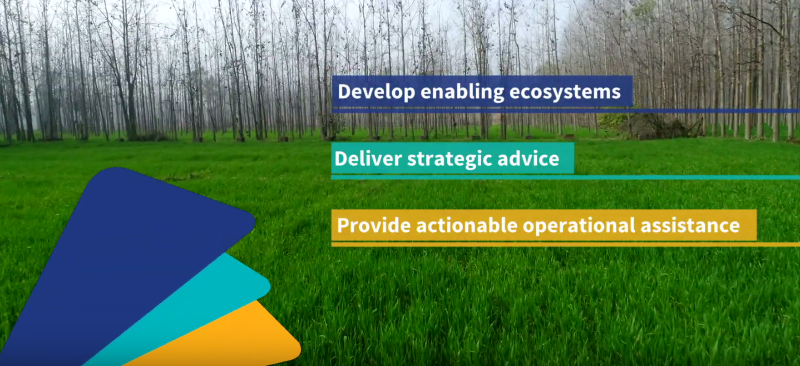
At MicroSave, we continue to solve problems related to social, financial, and economic exclusion around the world. The changing nature of the markets we work in and the opportunities provided by the digital age have encouraged us to reinvent ourselves. As MSC (MicroSave Consulting), we now feature a fresh new brand mark that reflects our commitment and expertise better. The brand mark—the “rays”—depicts our mission to develop enabling ecosystems, give strategic advice, and provide actionable operational assistance. See the full story in the video.
Blog
From MicroSave to MSC: A journey of 20 years
For over two decades, MSC has been at the forefront of financial inclusion advisory for a range of clients. We are experts in SMEs, digital identity, sustainable agriculture, WASH, youth, skills, gender, education, and refugees, among other areas. We work with microfinance institutions, banks, leading mobile network operations, policymakers, regulators across Asia and Africa, alongside donor agencies globally.
We helped transform Equity Building Society into a multinational digital bank. We sat at the steering committee for Safaricom in Kenya and worked on the initial pilot testing for the hugely popular M-Pesa service. In India, we continue to work with the Indian government to realize its government-to-people payments and financial inclusion strategy that touches the lives of 700 million-plus people. See the full story in the video.
Digital transformation of MFIs in Bangladesh
UNCDF’s Landscape Assessment of Retail Micro-Merchants in Bangladesh has shown that retail micro-merchants require access to financial services and credit in particular. Their need for financial services is high, and microfinance institutions are well placed to meet the growing credit needs of micro-merchants. These micro-merchants borrow predominately from microfinance institutions. With the introduction of digital technologies, microfinance institutions have a new opportunity to expand financial services further to micro-merchants by embracing digital and mobile technologies in their operations. In this context, UNCDF SHIFT commissioned MSC to conduct a study on the status of digitization in the microfinance sector in Bangladesh.
In the course of the research, we identified that while most MFIs use a loan management system, only a handful of MFIs have taken steps to digitize transactions. There are very few of these initiatives at pilot stages. Only three of the 16 surveyed MFIs have rolled out pilot tests to use the digital field application for loan origination. In conclusion, MFIs are on a digital journey but are yet to explore many more emerging technologies that would bring process efficiency and also increase the uptake of the products offered.
Keeping the micro-merchant market segment in mind, this report answers the questions of how and why microfinance institutions should make a switch to digital technologies to meet their customers’ needs better.
Digital transformation of MFIs in Bangladesh opportunities, challenges and way forward
UNCDF’s Landscape Assessment of Retail Micro-Merchants in Bangladesh has shown that retail micro-merchants require access to financial services and credit in particular. Their need for financial services is high, and microfinance institutions are well placed to meet the growing credit needs of micro-merchants. These micro-merchants borrow predominately from microfinance institutions. With the introduction of digital technologies, microfinance institutions have a new opportunity to expand financial services further to micro-merchants by embracing digital and mobile technologies in their operations. In this context, UNCDF SHIFT commissioned MSC to conduct a study on the status of digitization in the microfinance sector in Bangladesh.
In the course of the research, we identified that while most MFIs use a loan management system, only a handful of MFIs have taken steps to digitize transactions. There are very few of these initiatives at pilot stages. Only three of the 16 surveyed MFIs have rolled out pilot tests to use the digital field application for loan origination. In conclusion, MFIs are on a digital journey but are yet to explore many more emerging technologies that would bring process efficiency and also increase the uptake of the products offered.
Keeping the micro-merchant market segment in mind, this report answers the questions of how and why microfinance institutions should make a switch to digital technologies to meet their customers’ needs better.
Developing micro-insurance ecosystem in Mozambique
MicroSave (MSC) undertook extensive and widespread stakeholder consultations and has developed this report for enabling a micro-insurance ecosystem in Mozambique. It provides a pathway for a stronger foundation of micro-insurance in Mozambique and to guide all stakeholders towards establishing a mature and sustainable micro-insurance sector in the country. In this report, we discuss in great length about the four fundamental pillars necessary to develop an enabling ecosystem for micro-insurance in Mozambique.
Financial Inclusion of low income earners- A Fintech success story
Can you please introduce yourself?
I am Bernie Akporiaye, the co-founder & CEO of MaTontine. My speciality is financial software. My personal mission is to help reduce poverty in Africa through entrepreneurship and technology. I have has worked for over 20 years in Africa and elsewhere around the world.
Can you please introduce MaTontine?
MaTontine provides access to small loans and a range of financial services like microinsurance to the financially excluded in Francophone Africa via basic mobile phones. The problem for our customers is that they do not have access to small loans at reasonable costs. We solve the problem by utilizing mobile phones and our platform to digitize the benefits of traditional savings circles (ROSCAs), thereby reducing the cost of borrowing by 75% or more.
Why MaTontine? What client needs does it answer?
The big problem we are trying to solve though is how to lend small amounts like USD 100 profitably and at scale to the 1 billion people in Africa who are financially excluded. The banks and microfinance institutions cannot do it with their current cost structure. Consequently, the end user does not have access to financial services that are easily available, accessible, and affordable. The solution is a combination of technology, partnerships, and leveraging existing, traditional systems.
How long did it take you to commercialize MaTontine
Two years
What challenges did you have to face?
Our biggest challenge has been regulatory. We have found the regulators to be very inflexible. It seems to me that the financial services rules used to regulate today’s FinTech companies were designed decades ago for legacy financial institutions. We also found it difficult to form partnerships. The reality of the situation is that in Africa, one is dependent on the infrastructure of large companies like operators and insurers to deliver one’s services. These companies have very little motivation to work with small start-ups, so getting access to the decision-makers in these large companies to form partnerships is difficult.
What are the keys to success for a start-up like yours?
The keys to success for MaTontine and similar start-ups are a friendly regulatory environment, easier access to strategic partners, a simple and intuitive customer experience, and the ability to attract and retain senior management.
What are the key figures for MaTontine so far?
• We want to provide financial services to 1 million women over the next five years
• 90% of our members are women
• Till date, the default rate on loans provided has been 0%
• USD 100,000 lent to 1,000 in the past quarter
• The average contribution (savings) is USD 30 per month
• The average loan size is USD 170
• The current services are loans, life insurance, and health insurance
• 5,000 members by December, 2018
• USD 500,000 in loans by December, 2018
• USD 1 million in savings on the platform by December, 2018