Blog

Predictions for Regulators of Digital Financial Services

It is always dangerous to make predictions in an industry which is expanding and evolving rapidly, so it is with trepidation that I now do so. However, the predictions below are based on market insights and observations from working many years within the mass retail financial sectors and in Digital Financial Services (DFS).

1. DFS will drive financial inclusion strategies, new information requirements, and increase the importance of consumer protection: The power of DFS to provide basic payment services has been powerfully demonstrated in East Africa, and the first time created a realistic expectation of a world in which everyone has access to payment instruments – subject to the caveat of affordable pricing. This ubiquity is a powerful driver for national financial inclusion strategies. However, whilst the ‘pure access dynamic’ is being tackled, the ‘quality of service dynamic’ remains to be addressed. The ubiquity of DFS combined with the drive for financial inclusion will create new information requirements. However, the very fact that third parties are necessarily a part of complex agency arrangements, means that quality of service cannot be guaranteed and the potential for malpractice exists. These factors will drive focus on consumer protection across the DFS space.

2. Increased supervision of Mobile Money Operators: To date, many central banks have been collecting data on mobile money operations, but are yet to actively supervise all the players in the industry. There are many potential reasons for this; to suggest a few – the capacity of the regulator, the rapid evolution of the industry, the dual regulatory jurisdiction of mobile money operators between central banks, and Communications Commissions. However, there are increasingly powerful push factors which, in my view, make increased supervision of mobile money operators inevitable:

i. The publicity around frauds, some of which have been very significant, and have been related to the internal workings of mobile money operators

ii. The furore around KYC which led to a record fine for MTN Nigeria

iii. The spiralling volume and value of transactions through digital channels

iv. New emphasis on consumer protection

v. The need to develop risk management frameworks for mobile money (which can then be audited)

vi. The increased sophistication of mobile money information systems.

3. The registration and potential regulation of FinTech companies and updation of National Payments Acts: The payments world is now buzzing with FinTech, whether this is in terms of cryptocurrency, or products that ride over the top of mobile phone-based operating systems. As part of this, an increasing range of FinTech-based companies will be required to be registered and/or regulated. National Payments Acts will be updated much more quickly to accommodate different categories of payment actors and to provide a defined legal space in which they operate.

4. There will be a significant focus on risk management frameworks for digital financial servicesMicroSave, through its Agent Network Accelerator studies in Bangladesh, India, Indonesia, Kenya, Nigeria, Pakistan, Senegal, Tanzania, Uganda and Zambia have shown the growing significance of fraud, at all levels of the DFS ecosystem. This implies a much greater focus on the development of robust risk management frameworks within the digital financial services industry, and, as a corollary, the strengthening of the back offices of mobile money operators of all types.

5. Regulation of channel pricing verses product pricing: To encourage competition, interconnection or interchange fees will be monitored and in some markets controlled. So, for example, a telecommunications company will have a maximum fee that it can charge competing companies for use of its USSD gateway. However, there is the potential that increased use of Internet-based protocols and over-the-top transactions will make a current focus on channel pricing irrelevant over time.

6. Non-exclusivity will actually mean non-exclusivity: There is, in some DFS markets, a difference between the principle and the practice of non-exclusivity of agents. Exclusivity will continue to fade, and pressure will be applied by central banks for this to happen. However, the extent and time that this will take will be significantly influenced by the political economy, specifically the influence of large corporations in specific markets.

7. Interoperability will extend, but will imply standardising interconnectivity: Regulators generally profess a desire for interoperability. However, interoperability operates at different levels. Firstly, it operates at account to account level, from one wallet to another; secondly, it can operate at agent level – possibly through shared agents; thirdly, it can operate at the level of merchant acceptance – the ability of merchants to accept multiple payments, without having to deal with multiple acquirers or issuers; lastly, it can operate as full financial and payment system interoperability.  The work of the Better Than Cash Alliance (BTCA) shows that whilst interoperability is a trend which is widely desired, its actual practice and adoption will be market specific.  However, a factor which makes interoperability much more difficult is the ability of institutions to interconnect; interconnectivity implies the free flow of information in standard formats, either through the adoption of ISO8583 or through the use of Application Programmable Interfaces (APIs).

8. Central banks will rely increasingly on shared intelligence: The rapid evolution of the industry, and, increasingly, cross-border transactions, implies that central banks must seek to share ideas and intelligence and to evolve practices much more quickly than has been the case to date. Initiatives such as the Alliance for Financial Inclusion with working groups for central bankers across many areas related to digital financial inclusion, will be especially important.

9. Central banks need appropriate support: Many central banks clearly need support in adapting their responses to supervision, in risk management, and in understanding the rapidly-evolving digital finance marketplace. They have a limited core of staff members who understand mobile money and these staff are often over-stretched.

10. Government policy will start to significantly influence payment system architecture: This point is perhaps harder to see initially, but nevertheless is worthy of the status of a prediction as it is a fundamental driver of change. Government have their own objectives, which can be supported by the national payment system architecture. Typically, governments want to bring transactions into the tax net. They want to make payments efficiently and effectively to a large number of people. They need and want to enforce both KYC/AML. They want to avoid making payments to ‘ghost’ employees/beneficiaries. They want to expand access to national savings instruments, such as Treasury Bills and Treasury Bonds. The juggernaut of government policy will bring together joint initiatives between Ministries of Finance and central banks. We’re seeing the power of government policy influencing payment system architecture in India through the Aadhaar digital national identity and PMJDY financial inclusion programmes, as well as the National Payment Corporation of India’s Immediate Payment System and Unified Payment Interface. As demonstrated by the India case, government policy will be a significant driver of the introduction of National Identification Cards; in countries currently without these, biometrics will be used to create unique identifiers.

MicroSave’s extensive work with central banks, Ministries and payment services providers across Africa and Asia, clearly indicates that we are at an inflection point characterised by complexity, opportunity and risk. How we respond to these in the next five years will determine the access to, and impact of, digital financial services for the mass market.

Understanding Gender Dynamics in Agent Banking

MicroSave used its Market Insights for Innovations and Design (MI4ID) approach to conduct a series of studies in different parts of India. These studies sought to understand gender aspects of agent banking. The first part of this blog series highlights key findings aimed at understanding the differences in customer experience at an agent outlet based on customer gender. This research was conducted in the rural areas of Varanasi and Unnao, located in eastern part of Uttar Pradesh (UP).

Key insights

a. Male family members are key influencers of financial decisions by women 

In northern India’s rural areas, men have the key responsibility of earning a living for the household, while women are primarily expected to stay home and handle household responsibilities. Decision-making on larger expenditures in the household is collective, involving male and female adults; while smaller, household-related expenditure decisions are made by women.  Women are largely financially dependent on men and are far more inclined to save than men, often putting small amounts aside from the household budget. Males’ savings accrue from the receipt of lump sums of income – from the sale of animals or crops, or from monthly salary receipts.  Consequently, women will usually save small amounts frequently with the agents; whereas men tend to save less frequently, but in larger amounts.

Women customers will seek advice and approval from male and other family members prior to making any financial decision or availing a service at any agent outlet. This is not unique to the Indian market as S. Narain notes in the ‘Access to Finance’ World Bank report. In South Africa, a woman is required to obtain her husband’s signature in order to open and use a bank account. Similar biases were observed in Democratic Republic of Congo, Namibia, Rwanda, and Uganda. A number of banks in Pakistan require a husband or a male family member to co-sign a loan for a woman.

My husband said that I should open an account at the counter, so I did” – A female customer in rural Varanasi

b. Agent behaviour differs with respect to gender of customers

Female customers should be treated well to keep agency business sustainable: A key concern for agents is the sustainability and profitability of their business. This is largely dependent on frequency and regularity of transactions. As pointed out by Women’s World Banking, agents understand that women are more likely to save and hence serving them well can increase agent commissions. Agents interviewed indicated that, given the choice, they would rather serve female customers.

According to the “Digital Financial Solutions to Advance Women’s Economic Participation” report, women face cultural, social and systemic barriers that limit demand for, and use of, digital financial services. These include lack of identification documents, low literacy levels, lower technology adoption levels, and social and cultural sanctions that limit the free movement of women. Agents opine that social norms restrict females and they will treat female customers preferentially to encourage use of financial services. MicroSave observed, in some instances, that the agent would not only offer a seat to female customers ― as opposed to a male customer waiting to be served ― but also allow the waiting female customers to ‘jump’ the queue. Female customers interviewed confirmed having received this kind of preferential treatment.

Women visit my counter frequently to transact: this encourages me to serve them better.”  – An agent in rural Unnao

It is worthwhile to note that, in India, social norms differ across geographies and these findings are limited to two districts of the most populous state of India, Uttar Pradesh. It is possible that agent behaviour may differ in another region because of different social norms.

Agents perceive women customers as more manageable. Women’s lack of familiarity with financial products and services makes them less demanding, and more agreeable. Men are more inquisitive about different financial products and services, and more insistent to have their queries resolved by agents.

c. Male customers expect to get preferential treatment from agents

In the rural geographies of India, men generally enjoy a higher social status than women, due to a variety of complex social reasons. In this social system, males expect to get preferential treatment at the agent counter, including being served before any women in the queue. Sometimes, if men are denied preferential treatment, they are irritable and  dissatisfied with the agent.

At times, male customers are hard to deal with, as they try to override the queue and also argue over petty issues, such as delay due to over-crowding or systemic delays.” – An agent in rural Varanasi

Implications for agent banking

Agent networks need to be developed and managed to accommodate existing perceptions, beliefs, and social norms. As highlighted above, in different ways, both male and female customers offer a huge potential for growth in the development of digital financial services. The Government needs to adopt and promote a financial customer protection framework to ensure that new female customers are treated fairly and have sufficient financial skills to enhance understanding (and trust) in digital financial services with a view to large-scale adoption.

For a service provider, these insights will help design financial products and services that respond to gender aspects. Digital financial services can offer women greater privacy, confidentiality, and control over their finances. According to a report by UNCDF and GPFI, giving women more financial autonomy can have a positive impact on an entire household. Agent support can motivate female customers to use financial services despite the prohibitive social norms (as discussed in the next blog: “Agency Banking: Male vs. Female Agents”). Moreover, customer service is the key to surviving in a competitive market.

The social status of rural women often limits their ability to travel beyond the confines of the village. Men have more financial autonomy and higher levels of exposure to financial products and services, as they travel out of the village more often than women.  Thus, marketing and communication messages and delivery channels for products targeted at the rural female segment need to address this reality.

Now that we have looked into the gender aspects in agency banking, the next blog in this series will discuss how an agent’s gender impacts customer experience.

e-KYC and the India Stack – A Transformative Blueprint for Emerging Markets

A student newly admitted at Kenyatta University, Nairobi, wants a new mobile SIM, so she can talk to her parents back home in Eldoret. Her national identity card is used to establish her identity. A 32-year-old widow of a landless labourer in Bihar walks up to a Bank Mitragent to open an account, so she can receive her widow pension from the government. She is asked to bring documents establishing her proof of identity (POI) and proof of address (POA) in the village, before anything further can be done. A migrant vegetable hawker living in one of the night shelters in Delhi folds his daily savings into a small plastic container to keep it safe. He cannot deposit his surplus cash with banks or any reliable financial institution, as he has no regular address or document to establish his identity.

These personas represent billions of people around the world required to meet know your customer (KYC) norms to avail of services considerably important to their lives. Yet, widely prevalent archaic methods for KYC come in their way. e-KYC, a fully digital solution, leveraging resident Indians’ centrally stored demography details and biometrics (fingerprints and/or iris recognition) is changing how KYC has been done for ages. This note examines how e-KYC is an established and proven solution and (together with the India Stack presents a compelling and transformative blueprint for a majority of the emerging markets to consider.

Know your customer (KYC) is the first step that most financial and several non-financial institutions worldwide take to commence relationship with new customers. The common underlying objective is to unequivocally establish the identity of all customers of a service provider. Additional objectives, often prescribed for financial institutions, are to prevent identity theft, financial fraud, money laundering and terrorist financing. Reliance on paper-based documents as evidence to establish KYC has been most ubiquitous. This is not only hugely expensive and time consuming; it is also one of the most significant barriers to effective financial inclusion in the developing world.

A recent study on KYC benchmarking and harmonisation conducted by MicroSave[1], highlighted that Aadhaar-enabled e-KYC could result in an estimated direct saving of over US$ 1.5 billion[2] within the next five years.[3] Apart from substantial cost savings for banks and financial institutions, Aadhaar-enabled e-KYC is significantly more efficient compared to current paper-based KYC. Traditional customer enrolment processes followed by banks can take from two to four weeks before an account is activated, and all KYC details have been verified and stored for future retrieval. On the other hand, Aadhaar e-KYC enabled bank accounts can be activated and readied for transactions within a minute.

The existing practices prevailing in Indian banks are majorly paper-based, manual KYC processes. There is also a widespread tendency in banks towards over-compliance for static KYC, compared to dynamic risk profiling of customers, based on transaction data and analysis. This results in unnecessary costs for banks, and poor customer experience through delays and inconvenience.

In order to avoid repeated KYC verification for customers availing multiple services, there is a need and an opportunity for greater harmonisation of KYC processes across diverse financial institutions and indeed with players in the telecom sector. This will speed up the process and result in massive savings in time, effort and money.

The passage of the Aadhaar Bill in the Lok Sabha provides much needed legitimacy to the existence and the usage of Aadhaar. With Aadhaar enrolment covering nearly 97% of adults in the country, e-KYC could provide a number of benefits to service providers. Given that e-KYC provides digital information and near instant verification of applicants’ identity and addresses, substantial cost reduction and efficiencies can be achieved through elimination of paper based verification, movement, storage, archival and retrieval. Several regulators[4]have already approved the acceptance of Aadhaar e-KYC. These include RBI, IRDA, Department of Revenue, SEBI and PFRDA. Many more now accept Aadhaar letters.


Suvidhaa Leads The Way …

Suvidhaa Infoserve, a leading provider of financial services in India, has 35 million customers and an extensive network of over 32,000 BC agents (retail touchpoints) across India. Its outreach extends to 4,100 PIN code zones* in India. Suvidhaa, in association with Axis Bank, was the earliest adopter of e-KYC for its customers and has made it hugely successful.

Suvidhaa has already on-boarded over 125,000 customers through e-KYC. The process for opening a new bank account / issuing and activating a prepaid card at its BC agent touchpoints takes less than one minute, is seamless, and entirely paperless. Customers do not need to carry or sign any document. Customers can instantly transact using their account or prepaid card handed over by agents. The cards are fully interoperable and can be used at any ATM or Point-of-Sale terminal, besides Suvidhaa’s agent touchpoints across India. The one-time investment from agents for fingerprint reader is below US$ 50.

e-KYC is a beginning of relationships with customers. Suvidhaa leverages data analytics and consumer insights to offer innovative products in collaboration with Axis Bank including Nano Credit, a first of its kind, credit programme for migrants and the under-banked in India.

* With a vast majority of villages in India having no numbering system for households, PIN (ZIP) codes tend to be the de facto mechanism to reach residents.

Despite its massive potential and enabling environment (regulatory, technology integration and stability offered by UIDAI, high levels of consumer enrolment for Aadhaar, and so on) the adoption of e-KYC by financial and non-financial institutions has been limited. We believe that the Government of India (GOI) and the key regulators can nudge service provides towards adoption. e-KYC will be vital for the success of PMJDY, DBT, Digital India, to name a few of the important government initiatives. We recommend that the Department of Financial Services, Ministry of Finance, and RBI issue guidelines highlighting advantages and recommending transition to e-KYC by banks, gradually, but within a specified timeframe. This can be accelerated by GOI, RBI and/or UIDAI through suitable incentives and subsidies of the costs required to create e-KYC infrastructure (primarily integration to UIDAI and biometric recognition devices) at Bank Mitr agent locations, and at bank branches. Concurrently, GOI and UIDAI should aim to provide Aadhaar identity to the remaining residents in India. The day is not far when (as Bill Gates mentioned) “India will become the forerunner of the financial inclusion space in the world”.

[1] The benchmarking study covered a range of institutions including banks, mobile operators, mobile money providers, and semi-closed and open wallet providers.

[2] The savings potential can be viewed in light of the US$ 3.7 billion capital infusion into public sector banks (to tide over the high NPA situation and twin-balance sheet challenge) that the Government of India has announced in the budget for FY16-17.

[3] The estimate is conservative, considering over 212 million new accounts have been opened under PMJDY since August 2015. As a result, the rate of opening new accounts will be lower in the foreseeable future.

[4] Refer http://uidai.gov.in/fi-e-kyc.html

Payment Systems in India and Current Status: A Perspective

The payment system in any country needs to pass the litmus test of safety, security, soundness, efficiency, and accessibility. In order to address all these, payment systems have evolved from barter to currency, to digital systems. We are witnessing enormous change in the payment systems, disrupting the monopoly of physical/paper-based system by electronic ones.

There are basically two types of payment systems:

1. Paper-based, like cheques and drafts; and

2. Electronic payments, like ECS, NEFT, and RTGS; and payment systems extensively used by people at large, such as PPI, mobile banking, and ATM/POS.

Paper Based System

Electronic Payments – Retail Electronic Clearing

It started with ECS (Credit) in 1990s and has evolved over a period of time as captured in the diagram below.

NECS leverages the Core Banking Solutions (CBS) of member banks, facilitating all CBS bank branches to participate in the system, irrespective of their location across the country. Around 31 million ECS (Credit) transactions leading to Rs. 828 billion (US$13 billion) were processed in the first three quarters of FY 2015/16.

The popular Electronic Fund Transfer (EFT) system, introduced in the late 1990s to enable account-to-account transfers, was replaced by one-to-one NEFT system in November 2005. Available on all banking days from 8 AM to 7 PM, the NEFT system provides 12 batch settlements at hourly intervals, thus enabling near real-time transfer of funds. Other unique features, including acceptance of cash for originating transactions; initiating transfer requests without any minimum or maximum amount; facilitating one-way transfers to Nepal; providing confirmation of the date/time of credit to the account of the beneficiaries, etc., were also made available with the NEFT system. The NEFT accounts for a lion’s share (91%) of transactions in terms of value, with close to Rs. 58 trillion (US$892 billion) from 886 million transactions, by the end of the first three quarters of 2015/16.

The establishment of the National Payments Corporation of India (NPCI) to act as an umbrella organisation, in early 2009, is considered to be a landmark for retail payments in India. The NPCI has taken over National Financial Switch (NFS) from the Institute for Development and Research in Banking Technology (IDRBT). The NPCI launched the Immediate Payment Service (IMPS) in November 2010, which allowed instant 24/7 inter-bank fund transfer through the Internet, mobile, and ATM at a very low cost (Rs. 1.50 per successful transaction, or about two US cent) using the NFS switch. Though IMPS accounts for only Rs.1.08 trillion (US$16.6 billion) from 148 million transactions as of December 2015 (FY16), it has come as a boon for small value transactions.

Overall, the volume of transactions handled by India’s retail electronic clearing system has been growing by leaps and bounds, and touched Rs. 64 trillion (US$1 trillion) in 2.2 billion transactions by Q3 2015/16. The IMPS has seen a meteoric rise in the 5 years of its existence. In the month of December 2015 alone, IMPS processed over 20 million transactions handling Rs. 142 billion (US$2.2 billion). This has taken IMPS way ahead of money remittance services of Department of Post, which have been in existence since the late 18th century. The last published data of 2013/14 indicates that Rs.122 billion (US$1.9 billion) were remitted by DoP through Inland Money Orders – compared to Rs.96 billion (US$1.5 billion) transacted through IMPS for the same period and there was then a fivefold increase in value transacted through IMPS the following year.

Electronic Payments – RTGS

Real Time Gross Settlement (RTGS), introduced in 2004, is a funds transfer systems where transfer of money takes place from one bank to another on a “real time” and on “gross” basis. RTGS is primarily meant for large value transactions. It processes customer transactions above Rs.200,000 (US$3,076) and is available between 9 AM and 4.30 AM on all the banking days. The RTGS is the largest payment system in India in terms of value and had handled Rs.729 trillion (US$11.2 trillion) in 72 million transactions by Q3, FY 2016.

The table below has captured the data of last FY and till Q3 of the current FY for various payment systems

Other Payments System

Of late, we have seen other innovative payment systems (like closed wallets, PPI, eCom, etc.) propelled by the environment and changes in the regulations. Pre-paid instruments (PPI) facilitate purchase of goods and services against the value stored on these instruments. The PPIs can be issued in the form of smart cards, magnetic strip cards, Internet accounts, Internet wallets, mobile accounts (issued by banks), mobile wallets, paper vouchers, etc. With 68.67 million transactions in December 2015, this has generated a throughput of Rs.44 billion (US$682 million) – an average ticket size of Rs. 646 (US$10).

With the ever increasing penetration of mobile phones, RBI brought out a set of operating guidelines on mobile banking for banks in October 2008, under which only banks were permitted to offer mobile banking. With almost all banks promoting mobile banking, the latest data as of Q3,FY16 shows that a significantly lower number (39 million) of mobile banking transactions resulted in throughput of more than 11 times (Rs. 490 billion – US$7.5 billion), of PPI.

Debit cards in India have overtaken credit cards. As of December 2015, there are more than 630 million debit cards as against 22.75 million credit cards. With about 193,000 ATMs and 1.25 million POS, debit cards are generating 816 million transactions per month comprising Rs.2.3 trillion (US$35 billion) in retail payments.

The last 3 years’ trends clearly show the direction of the market ― less and less paper, and more and more electronic payments ― with all electronic categories growing both in volume and value terms. The electronic clearing comprising of ECS, NEFT and IMPS are growing at the highest rate. With this and the new Payment Banks, there will be ever-increasing focus on electronic payments. These will be accessible to a large section of society at remarkably low cost. Since June 2015, electronic transactions of EFT/NEFT has surpassed paper-based, in volume terms. Even in value terms, this has overtaken beginning September 2015, highlighting a clear trend towards adoption of electronic payments over paper-based payments.

The Future of India’s Payments System

Looking at the trends, we can be sure that electronic payments is the future and that digital will redefine the payment systems of years to come. This will be significantly more pronounced with the entry of 11, resource-rich, technology-focused payment banks in 2016/17. Based on our experience, these are some of the broad trends that will redefine payment systems in India:

a. Inter-operability: With a myriad of payment service providers servicing millions of customer accounts, the time is ripe to unleash network effects through inter-operability between various digital channels.

b. Proliferation of acceptance networks: As of now, India has about 1.2 million POS terminals. This needs to increase rapidly (some estimates suggest it should expand to around 20 million), given India’s population, geography, number of merchants, etc.

c. Government initiatives: The Government of India has been at the forefront in the drive to encourage digital payments. Furthermore, it is working to use direct benefit transfers for its various schemes and thus deliver entitlements directly into beneficiaries’ accounts, identified and authenticated by the Aadhaar system. Buoyed by the success of DBT for LPG, the Union Budget 2016 announced trial of DBT for fertilisers.

d. Customer convenience and affordability: With a critical mass of 50 million transactions per month happening over mobile wallets – increasingly in rural areas of country, the continued focus on convenience (without losing sight of security and risk mitigation) will be essential. There are very real concerns about client service and protection that should be addressed urgently. With this, and a low-cost 24X7 backbone offered by IMPS, the time is ripe to reduce the transaction cost for the customer. This would be something that will be hastened with the entry of new players.

Given various experiments and initiatives in the market, they need to ensure safety and security of transactions, in addition to adding convenience for the customer and affordability for the service provider.

Customer Protection in Indian Digital Financial Services: Part 2: Transparency and Privacy
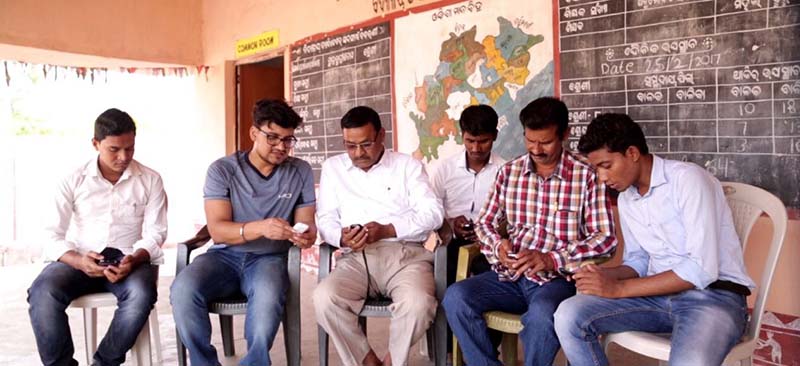
MicroSave’s study for the Omidyar Network on customer protection, risk and financial capability in India sought to understand the extent to which customer protection practices were embedded into DFS offerings in India. The research examined the effectiveness of these customer protection practices and the ease with which customers and agents could access them. In the first blog of this series, we examined Customer Recourse. This blog looks at Transparency and Privacy

2. Transparency

Communication with customers is typically verbal in nature

Our research showed that in most deployments, a well-developed customer support system in the form of regular interactions (SMS/voice) and monitoring visits by supervisors/managers to agents for optimising customer service is missing.

Furthermore, most customer communication is verbal. A small proportion of customers are not even provided information, either at the beginning or during the course of operation of their account.  Some of the reasons for this were: agent did not have time; agent did not take interest; customers did not ask; and the agent explained initially, but they could not understand.

High dependence on agents both for terms and conditions of service, as well as for recourse options, makes customers highly vulnerable to agent-perpetrated fraud. Since most of the communication is verbal, the customers would not even know whether they are being defrauded or not.

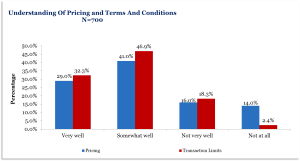
Around 2/3rd of the customers do not fully understand the terms and conditions of DFS service that they are using. Lack of awareness of service among customers is the largest stated barrier for DFS growth, according to MicroSave’s recent ANA India Survey.
Communication Between Agents, Agent Network Managers, and Banks Needs to Improve

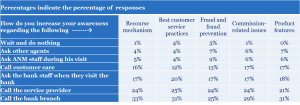
After the initial agency agreements, there is no active communication between the agent network managers (ANMs), banks and agents. The table below suggests that some agents try to reach out to the most responsive option, but a few just do not make any effort to reach out. This suggests that an active dialogue between agents and service providers is missing, and details are communicated only on the basis of a specific request from the agent.
Agents point out that lack of support for them in running the agency is one of the reasons why they do not recommend DFS/bank agency as a business to others.

The current system of providing fraud and risk-related information to the agents is ad hoc, and only 63% of agents are provided information on frauds. In most cases, the information about risks is verbal and, thus, informal.
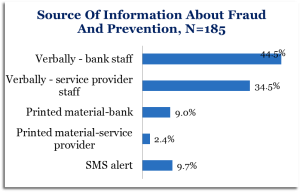
Proper formal communication about the terms and conditions of service is also not complete. Only 68% of all active agents reported having received documents with terms and conditions of service. Poor communication both at the customer as well as at the agent level means that the situation will facilitate external frauds as DFS grows and matures in India.

Moreover, coupled with low awareness levels about recourse among customers and high dependency on the agent for information and recourse, most customers, ANMs, and banks will not even know about risks/frauds until they have become big.

3. Privacy: Customers
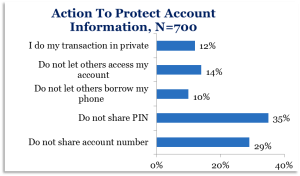
Experienced customers (who have had an account for more than one year) are more aware of the means to protect their account information. More than one-third of all customers interviewed highlighted that they do not share their PIN. But, once again, agents are the most important source of information about methods to protect accounts.

As highlighted earlier, one of the major risks is transaction data security. However, MicroSave’s qualitative study shows that most transactions are assisted by the agent who thus has access to account details.

CGAP notes that assisted transactions are common particularly with elderly customers and in rural areas where literacy levels are low.

3. Privacy: Agents

Agents are very proactive in protecting their personal and account information and do not share personal account-related information with others.

Though these are good practices, there are a number of ways in which fraud can happen, about which they are not aware and thus do not know about its prevention. (See Survival of the Fittest: The Evolution of Frauds in Uganda’s Mobile Money Market (Parts 1 and 2)).
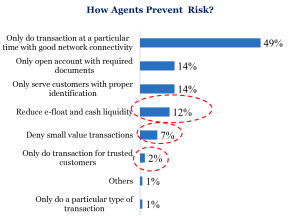
In the same way that operational issues often lead to service denial (“Real and Perceived Risk in Indian Digital Financial Services”), the precautionary measures adopted by agents also often result in service denial to customers in different forms. As highlighted before in a variety of MicroSave and CGAP publications, this service denial undermines trust in digital financial services.

There is a clear need for significant improvements in the communication of both DFS products and how to use them in India. Not all agents will be able to do this, as it involves fundamentally different skills than conducting transactions, but many will be able to do so, given their existing (remarkably – almost alarmingly ― trusting) relationships with customers.  Agents who really can only perform basic transactions to service existing products, should be supplemented with sales agents charged with clearly explaining products and how to use them.