
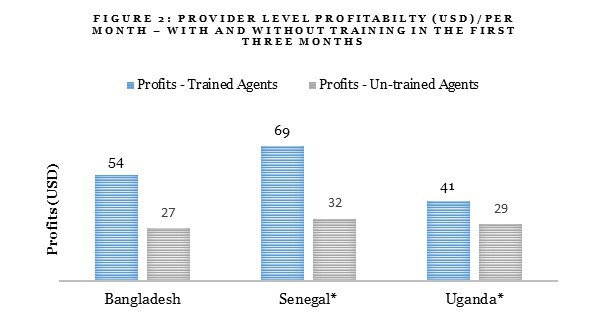
The Helix Institute of Digital Finance recently concluded the second wave of the Agent Network Accelerator (ANA) study in Bangladesh, which, along with a number of other key findings, highlights the importance of agent training in the first three months of inception (‘starting the agency business’).The ANA 2016 Bangladesh Report highlights that agents who receive training in the first three months of starting the agency business conduct, on average, 20% more transactions per day compared to those who do not. These agents also earn USD 27 per month more than their untrained peers. We witnessed similar trends in Senegal (2015) and Uganda (2015), where trained agents conducted 33% and 10% more transactions per day, respectively. Agents in Senegal and Uganda also reported higher profits*. (See Figure 1 and 2 below)
Figure 1
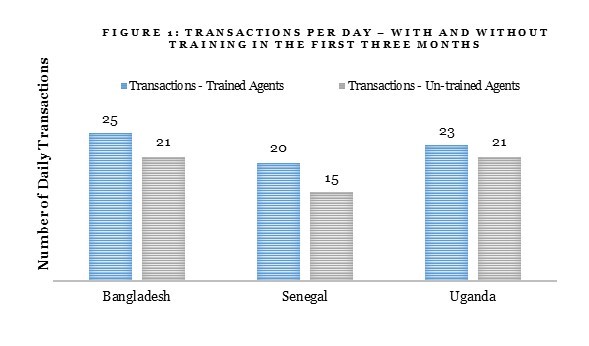
Figure 2
It is not the first time we are learning about the importance of agent training. The Helix Institute, in partnership with the Harvard Business School, conducted econometric analysis and found that well-informed agents perform better in the face of competition and also experience higher demand for services. Well-informed agents, it argued, are a product of inception and refresher training.
While it is evident that training makes agents more knowledgable and, thus, the preferred choice of customers, we wonder whether training only influences agent knowledge. Is it also that a trained agent is more motivated to expand and improve his business? Does training change anything else for agents?
Recent data from Bangladesh (2016), Senegal (2015) and Uganda (2015) demonstrate a rather interesting story of what else training might be doing to the agents.
Compliance,** too, is affected by training
We find that agents who are trained in the first three months of starting their agency business are more likely to be compliant – they display tariff rates, grievance redressal cell numbers, call centre numbers, and unique ID or certificate from the provider (Figure 3). Interestingly, these, more compliant, agents also perform better than the non-compliant ones.
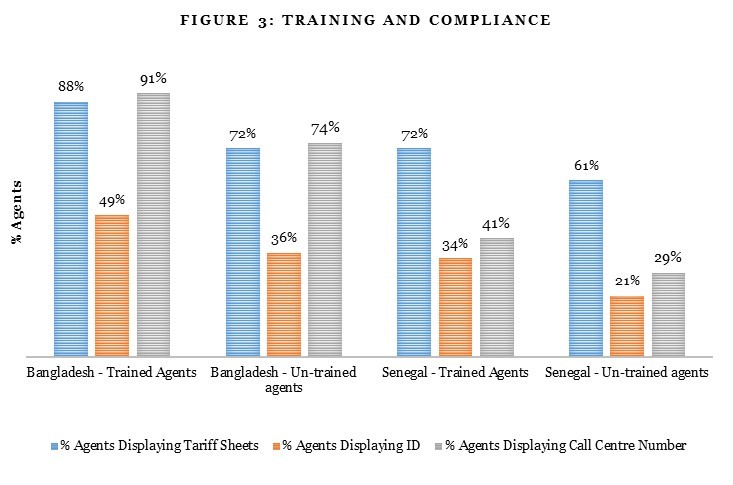
Since the number of transactions at an agent point is primarily a function of customer’s trust in service and in the agent, in the light of findings above, we hypothesise that training in first three months is a significant factor in helping make agents more compliant, and hence, more trustworthy, from the customer’s perspective.

Agent compliance enhances the “appearance and impression”/ “look and feel” of an outlet, and contributes to a sense of legitimacy that makes both the agent and customer more confident. It can be argued that this helps improve customer services by making agents more client-centric, which can help build agent/customer trust and improve the customer’s experience.
A trained agent who is more likely to show tariff sheet is also more likely to gain customers’ trust because of the transparency of pricing – a major driver of performance. Similarly,a trained agent who displays an agent’s certificate is more likely to gain customers’ confidence because of the transparency he/she promotes. The confidence that an agent gains ultimately helps in building customers’ trust, which is otherwise in danger of being lost if customers get inadequate information – a key risk in digital financial services.
A logical extension of agent compliance to outlet set-up is their modus operandi of running the outlet. A compliant agent will be more likely to follow providers’ instructions/suggestions on liquidity management and customer engagement. A compliant agent will, therefore, be more hands-on in managing liquidity (critical to DFS) to ensure minimal denial of transactions due to lack of liquidity; and will be more pro-active in supporting customers when the latter face challenges.
Where does this hypothesis lead us?
The current data provides preliminary empirical evidence to the hypothesis – “agent-training->more compliance->higher trust->more transaction”. Nevertheless, it does open up the probability of more nuanced inter-linkages, perhaps on what changes training can bring along and/or other parameters that affect compliance, customer trust, and number of transactions.*** While more data will help us understand and explore these nuances and inter-linkages, for now, we see a clear theory that identifies changes that an agent witnesses due to agent training – thereby answering the question we started with. We will be closely watching evidence from further ANA research to evaluate how this hypothesis may be supported further.
* For Senegal and Uganda, the profit numbers aren’t statistically significant.
** Compliance is measured by the display of tariff sheets, agent’s ID, grievance redressal number, call centre number, provider sign, provider colours, etc., and performance is measured by transactions and profitability of agents
*** We know training might not be the only cause for better compliance. Monitoring visits by the provider, for example, is also likely to impact agent compliance. Compliance is likely not the only factor that builds customers’ trust in DFS. Service reliability, for example, influences a customer’s trust too. Similarly, external factors, such as ATL and BTL marketing by the provider, also contribute to a customer’s trust in DFS.





 When it comes to fraud in digital financial services (DFS), stories from Uganda will surely arise: be it the infamous case of

 Fraud is one of the major threats to the emergence and sustainability of the DFS ecosystem. Uganda’s DFS market has long been
 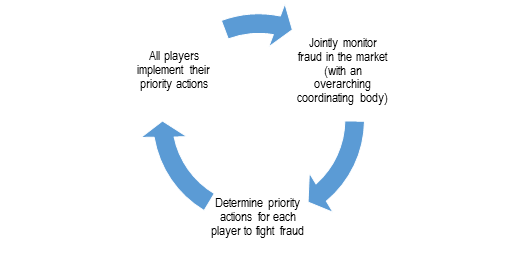 Who should be involved?