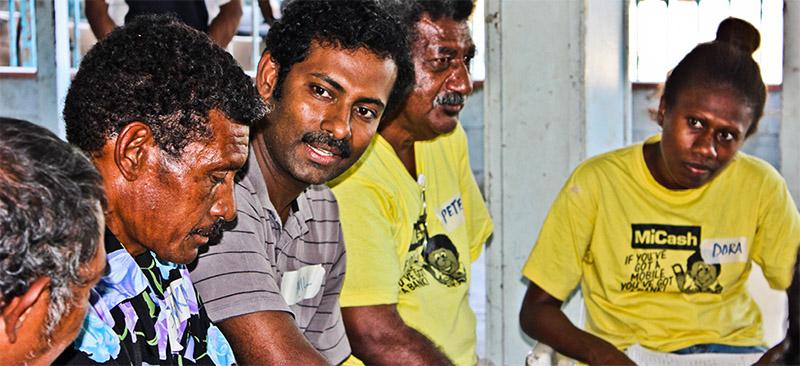
MicroSave’s experience and reviews of successful new products reveal that market research is the starting point in most successful product development. This note illustrates importance of market research in the entire product development process, which is often neglected by most of the institutions. It draws on experiences from seven countries—Kenya, Tanzania, Uganda, Bosnia, Herzegovina, India and the Dominican Republic. The study reveals that MFIs participated in the study enjoyed the cost benefit, better understanding of market, client perception and internal capacity, and enhancing image or reputation, among the several other benefits.
Blog
BRAC Approach To Microfinance
In this video Dr Fazle Abed, the founder and chairman of BRAC talks about the BRAC approach to microfinance and their recent expansion to Africa. He elaborates the BRAC’s role in tackling the various aspects of poverty in terms of finance, health, education and family planning. On Africa expansion, he stresses on the modifications required in the BRAC model to make it adaptive to the needs of Africa. He also stressed that microfinance should be looked not as a means of making money but as a means of alleviating poverty.
ShoreCap Exchange: Leveraging Human Capital For Performance And Growth
The ShoreCap Exchange forum addresses strategies and tools for attracting and retaining talent, enhancing the alignment of human resource practices with primary business goals and using human capital to build institutional strengths. ShoreCap Exchange is a ShoreBank capacity building company that helps banks working to serve small business and microfinance markets overcome the substantial operational challenges they face in dealing with clients not reached by traditional financial markets.
M-banking for Sustainable Financial Inclusion
In this video Graham A.N.Wright, Prgogramme Director MSC discusses the challenges with the existing banking infrastructure in India and the usefulness of mobile-banking for MFI clients. He outlines the role of MSC in identifying the needs of stakeholders of m-banking in India. Further, this episode takes up the case of EKO and interviews Abhishek Sinha, CEO EKO Financial Services Pvt. Ltd. who discusses the challenges faced in building an m-banking network and the key success factors. He highlighted the role of market research in determining value proposition of Eko. Later Graham also discusses the importance of m-banking for financial inclusion in India.
Mobile Banking
In this video, Ignacio Mas, Senior Advisor, CGAP, discusses the challenges of fixing remuneration for agents in mobile banking. Ignacio notices that mobile operators and banks enjoy certain benefits and opportunities but agents face problems in handling cash. In addition, Ignacio discusses the way ahead for mobile banking and how volumes can be increased by grabbing more transactions to make it lucrative for the agents.
Safety Net for the Poor: BRAC Bangladesh
In this video, Syed Hashemi, a senior microfinance specialist of CGAP, talks about the effectiveness of microfinance in Bangladesh not only in terms of economic development but also social change. Elaborating this point Hashemi says that it has brought women to the economic foreground and provided better schooling facilities and legal rights to the bottom of the society. He studies BRAC, Bangladesh, which has introduced a new pathway for the poorest to graduate out of poverty by linking two aspects of development, like, food aid with the world of microfinance.