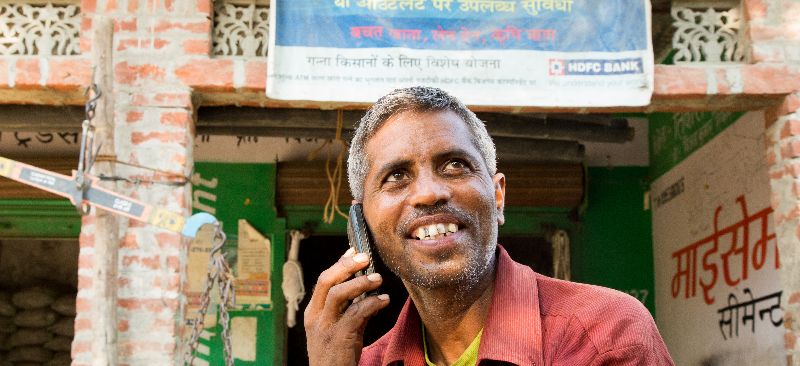
Mobile money is receiving increasingly global attention as some observers hope that it will largely replace cash – in the long run at least. MFIs stand to gain immensely from the advent of mobile money as (inter alia) they deal with large amounts of cash. Our experience is that there are obvious benefits from partnerships between an MFI and an MNO to provide mobile money facilities to the MFI’s clients. Mobile money agents will also benefit beneficiaries of social benefit transfer schemes such as “Mahatma Gandhi National Rural Employment Guarantee Scheme (MNREGS)” and “National Social Assistance Programme (NSAP)”. This, in turn, will lead to better remuneration for agents. However to realise these benefits, the business case for agents, that must form the backbone of this offer, has to be carefully analysed.
Ghiyazuddin A. Mohammad, Manager – Digital Financial Services at MSC, talks about the changing regulatory environment for digital financial services (DFS) / branchless banking in Indonesia.
Financial inclusion has evolved significantly since the days of microfinance. Today, instead of building small financial institutions to offer services to marginalized populations, partnerships are being built with huge banks and telecom providers that leverage their infrastructure, human resources, and financial capital to offer financial services across entire countries. However, despite the global fanfare surrounding the innovation of using mobile phone networks to deliver financial services, we have seen very little subsequent innovation at scale. Product uptake has been largely dominated by a small sub-set of payments, mainly airtime top-ups, bill payments, and person-to-person transfers, which cumulatively account for 97% or transactions by volume or 89% by value globally (State of the Industry 2013). Even in the pioneering Kenyan market, at least 98% of transactions are still done in cash. So what is inhibiting the next wave of disruptive innovation in this space?
Photo Credit: Anjali Banthia
Crippling Costs and Regulatory Roadblocks
The business model of digital finance is based on earning small margins on very large volumes of transactions, meaning scale is the key to business viability and success. To reach this scale, providers must invest tens of millions of dollars upfront, the most expensive and complicated piece of which is building a large network of agents across a broad geography. This has proved to be the greatest barrier to entry for even medium-sized companies, many of whom have tried to launch without the necessary capital, and thus have fallen victim to the sub-scale trap, where providers fail to reach a critical mass of customers. The unfortunate result is an industry controlled by corporate giants who do not want to take big risks to disrupt the markets they already dominate. Most big companies are just not designed to innovate.
Ignacio Mas points out that beyond the business case needing corporate giants to advance innovation, regulatory policy in most countries also stipulates that the service providers must be responsible for the agents offering the services. What is needed is a big corporate channel that offers distribution at scale to agile, risk-taking entrepreneurs who can, in turn, afford to experiment and innovate without being hindered by corporate decision-making bureaucracies, perennial quarterly revenue targets, and a huge national distribution network to manage.
A Breakthrough for Small Banks in Bangladesh?
However, there are now some big markets in the world where these more innovative market dynamics might be possible. In both Bangladesh and Nigeria, regulation prohibits telecoms from offering digital financial services, but it does not prohibit them from building channels that licensed banks can use for digital financial services. In Bangladesh the Central Bank has issued 28 licenses to offer digital finance; however, the last Helix Institute Agent Network Accelerator report in Bangladesh showed there are really only four providers that have had even minimal success in building an agent network. The other 24 are in serious need of a national channel over which they can offer their services, and this high number of smaller players might be just the market dynamic the country needs to push it into product innovation.
The need for a channel creates market demand, for the telecoms that are fundamentally channel builders with huge marketing budgets, large network of retailers selling pre-paid phone credit, and enormous customer bases. In Bangladesh, GrameenPhone a leading telecom provider with over 50 million subscribers, stated in its 2013 annual report (p. 53)that its goal was to build an agent network of 20,000 agents in Bangladesh under the MobiCash brand to provide a completely managed solution to banks. It now has almost 30,000 agents and partnerships with six banks to offer banking services through its MobiCash agents. We will have to see if GrameenPhone will be able to actually scale and successfully manage tens of thousands of agents, and also if banks, even smaller ones, will advance the innovation we have been seeking.
Glo-ing Developments from Nigeria
In Nigeria, regulations have created an operating environment similar to that of Bangladesh. However, the big difference is that a wide variety of organizations (telecoms excluded) can be licensed to provide digital finance. The Central Bank of Nigeria reports 14 non-banks with mobile money licenses beyond the seven licensed banks. The Helix Institute research in Nigeria showed that most of these entities were struggling to build agent networks, creating the same demand dynamic present in Bangladesh where there are a lot of potential providers that would love to have a network they could plug into. The advantage in Nigeria is that innovation does not rest in the hands of generally risk-averse banks.
Globacom (Glo), the second-largest telecom company in Nigeria with over 27 million subscribers, recently launched Glo Xchange, a network of digital finance agents. It has an extensive retail network of over 35,000 airtime dealers and 150 Glo shops, and it has already signed on three mobile money operators: FirstMonie, Ecobank, and Stanbic IBTC. On 2 December, the Central Bank of Nigeria released an exposure draft of a Licensing Framework for Super Agents, which, if formalized, will allow almost any business, including telecoms such as Glo, to develop its own agent network and advertise its services as long as it fulfils some minimal capital requirements and registrations.
Conclusion
Having these industry giants develop and own distribution channels can provide the scale needed for providers currently struggling to drive revenues from small margins. If these corporate giants are not able to also offer their own products over these channels, then the door is open to smaller, more innovative companies, hungry to disrupt markets and garner more market share.
However, these developments are new and could still yield a number of outcomes, and some big questions remain. First, these telecoms have all the right tools; however, flawless execution in building a large network of agents has been a stumbling block even for many industry leaders. Further, while hungry, agile, disruptors could theoretically ride these networks, for now, we are seeing partnerships with banks only, which most people consider risk-averse and not particularly good candidates for disruption. Finally, with such powerful companies controlling the channels, it is not clear that they will develop a business case that is enticing to providers. Will they charge prohibitive fees for partnerships (something the Nigerian framework is trying to address with their price controls)? Will they push an over-the-counter model to capture more revenue at the agent level? Or will they hesitate to place themselves in this position at all, where they risk being either reduced to a channel, totally taken out by banks setting up mobile network virtual operators (MNVOs), or in the long-term disintermediated by smartphones and internet access?
We have some of the key ingredients for disruptive innovation in the market that could remove the greatest barrier to entry this industry has been struggling with—building an agent network. However, there is still a long road ahead, and many questions to be answered before we have an industry that is mature enough to allow a small, enterprising innovator to go viral over an established channel.
This blog was originally posted on the CGAP (the Consultative Group to Assist the Poor) blog as part of their ”Disruptive Innovation” series.
MicroSave implemented an Alternative Financial Education programme (AFE) at one of the biggest MFIs in north India. The tool based was based on the principle of product-led financial education, the programme delivery was embedded in the existing operational structure of the MFI, and the tools were designed using SWITCH behavior change framework.
The report is based on a study conducted under the guidance and support from College of Agricultural Banking (CAB), Reserve Bank of India, Pune. The report brings forth perspectives on the impact of regulatory and policy regime on microfinance institutions and its customers.
The first blog in this series Over The Counter Transactions – Liberation Or A Trap? (Part I) highlighted that over the counter (OTC) transactions alone cannot deliver the digitally enabled financial inclusion many of us are working towards. The second Over The Counter Transactions – Liberation Or A Trap? (Part II) noted that despite this OTC transactions have been growing rapidly and offer benefits for providers, customers and especially agents. This blog looks at the not inconsiderable drawbacks of OTC-based operations for providers and customers … concluding that value proposition for agents means that they are unlikely to promote wallet-based alternatives, thus blocking perhaps the most important sales channel for these offerings.
So what’s not to like about OTC?
Providers: While it is a short-term expedient (see Beware the OTC Trap), OTC causes significant problems for providers. As highlighted in the customers’ and agents’ perspectives in Over The Counter Transactions – Liberation Or A Trap? (Part II), the freedom afforded by OTC-based systems means that there is no customer (or often times agent) loyalty. Indeed, in Pakistan, providers are now facing a situation where, in order to promote the use of their system over those of their competitors, they are paying agents as much as 110% of the commission received from the customers making the transaction. Yes, you read that right, and I did not make one of my usual typos, “110% of the commission received from the customers making the transaction” … other providers find themselves having to offer incentive awards such as fridges, air conditioners and even trips to perform Haj to their high performing agents.
The lack of a wallet also limits options for providers to offer additional products and services. Absent wallets, providers are largely unable to develop the digital ecosystem, thus stranding them in a cash intense environment with the inevitable attendant liquidity management problems. Furthermore, OTC transactions reduce providers’ income – MicroSave estimates that OTC transactions are cost the Ugandan providers around $220 million in lost revenue in 2013 (assuming that all transactions made OTC would have been made on a wallet-based P2P basis). And this amount is rising with the number of mobile money users. OTC transactions are also illegal under most central banks’ regulations, and so providing the services remains a significant regulatory risk. And as providers in Pakistan and elsewhere have found out, once customers are used to OTC, it is very difficult to get them (or indeed agents) to register and use wallets.
“An OTC business can breakeven and yield modest margins, but it is vulnerable to getting stuck in a high-growth remittance phase, where it is difficult to improve overall profitability. In some cases, profitability may actually decrease with agent commission wars between different providers.
Agents: As highlighted above, agents benefit enormously from OTC transactions, which crown agents as the kings of “agent money” systems. There is little not to love about OTC for agents, with one important exception – they are more likely to fall victim to fraud when using their own phones to conduct transactions. See Survival of the Fittest: The Evolution of Frauds in Uganda’s Mobile Money Market (Part-I) for a discussion of this.
Customers: OTC transactions are very often linked with agents charging customers additional fees above the “on the board” price. Furthermore, OTC transactions raise more customer protection issues as they are more prone to fraud, and can be used to avoid KYC/AML requirements in environments where identification is not required. But, in many ways, the most dangerous aspect of the OTC trap is that it leaves customers only able to send remittances and to make basic payments. Trapped in a low equilibrium “financial inclusion” without access to the savings, credit or insurance services that you and I depend on, and take for granted.
So what to do?
We should examine this in the context of two broad market segments – those that are functionally literate and those that are not. For those that are functionally literate, providers should apply Safaricom’s approach and insist that all users register and use the wallets that will eventually allow them to access a much broader range of services (thus yielding higher revenues for the providers).
Regulators need to introduce tiered KYC requirements that allow poor people to register (and start to use) wallets easily and Governments need to route all G2P payments through digital channels – whether cards or mobile wallets.
For those that are illiterate, I suspect that we need to look much more carefully at two options immediately, and another in the long run. Right now we need to look again at whether USSD strings (of numbers of course) are in fact relatively easy (or at least feasible) for illiterate people to use. When MicroSave looked at this briefly in India in 2010, we concluded that this indeed the case with Eko’s carefully simplified system. We also need to see if advances in voice recognition technology will allow the use of interactive voice recognition to allow illiterate people to navigate transaction menus. When this was tried in India 2-3 years ago it was not tremendously successful – the ambient noises in crowded housing or markets made it very frustrating and error-prone. In the future, as smartphones are rolled out and allow better graphic user interfaces, we need to look at using these to guide illiterate people to make transactions.
And, in the interim, of course, we should not forget that in many cases trusted agents (or trusted relatives) can (and indeed do) help illiterate customers use their wallets to make transactions. The agent navigates the menu until the transaction is to be confirmed and the PIN is to be entered … whereupon he hands the customer’s phone back to allow the customer to confirm and complete the transaction.
Of course, all of this also requires providers to develop and rollout products that add real value to the end customers, thus pulling them to register and set up their own wallets. Without real customer value proposition, the lure of the OTC trap will continue.
Manage Consent
We use cookies to ensure your experience on MSC Global is secure, reliable, and optimized. By continuing to browse www.microsave.net, you agree to our use of cookies as described in our Cookie Policy.
Strictly Necessary Cookies
Always active
Required for website security, authentication, and essential functionality to provide a secure and optimized experience on Microsave.
Preferences
The technical storage or access is necessary for the legitimate purpose of storing preferences that are not requested by the subscriber or user.
Performance and Analytics Cookies
Used to improve website usability and reliability through anonymous analytics and usage insights on Microsave.The technical storage or access that is used exclusively for anonymous statistical purposes. Without a subpoena, voluntary compliance on the part of your Internet Service Provider, or additional records from a third party, information stored or retrieved for this purpose alone cannot usually be used to identify you.
Functional Cookies
The technical storage or access is required to create user profiles to send advertising, or to track the user on a website or across several websites for similar marketing purposes.