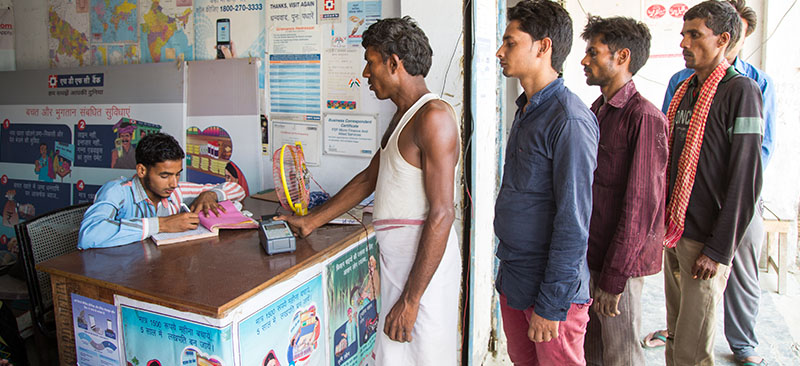
Building and managing an agent network independently is not an easy task for banks. The task is challenging since banks have to develop competencies and support systems required to build and manage the network, address standardisation and scalability issues, reduce dependency and workload of branch staff, balance roles and responsibilities, reduce turn around time, and train agents and staff. This paper discusses the challenges banks are likely to face in building and managing their own agent networks. These include: The speed that banks are able to scale an agent network Achieving standardisation across the network The challenges of coordination The problems of relying on busy branch staff Establishing support and monitoring systems for the agent network Building management information systems for the agent network
M-Shwari: Market Reactions and Potential Improvements

M-Shwari, launched in November 2012, it is already receiving much attention for its mobile phone based credit scoring system, and robust growth rate. MicroSave, with inputs from Grameen App Labs, conducted market research to assess customers’ perceptions of and reactions to M-Shwari. From the research, it seems that the savings feature is used by a more upmarket demographic to circumvent the limits on saving on M-PESA; while the small loan facility is accessed by lower income customers. Of all the clients interviewed, only one had been approved for a loan larger than KES 2,500 (US$ 28.74), while all wanted larger amounts, and Safaricom reports the average loan size at around KES 1,000 (US$ 11.49). There is also widespread confusion about the basis on which credit limits are decided by the system. As a result, a great deal of the much-vaunted KES 2.8 billion (US$ 32.2 million) deposited in the first three months may have been as a result of customer depositing and withdrawing to test the system and credit appraisal algorithm. Customers also have a series of specific recommendations to improve the M-Shwari product and these are also outlined in the Note.
Role of Central Bank and regulatory environment in India
Graham A.N. Wright, Group Managing Director at MicroSave talks about the changing regulatory environment for mobile money in India. He further discusses the approach banks and regulators need to take to achieve financial inclusion in its real sense — offer a range of financial services through the accounts rather than using them as mere pass through accounts for disbursement for government benefits.”
The Case for a Bank Managed Agent Network in the Business Correspondent Model
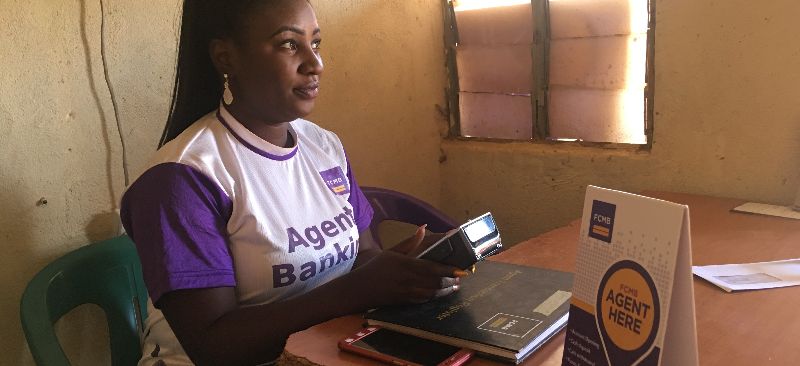
In 2011, MicroSave examined the two modes of managing agent networks-through outsourced institutional ANMs, and directly through the banks-in the India Focus Notes 76 and 77.1 We arrived at a conclusion that institutional business correspondents were perhaps better suited both from the client as well as from the bankers’ perspective. Most banks in India have also chosen to adopt the institutional business correspondent model. However, some banks have started experimenting with agent networks they directly manage and supervise. In this Note we outline the core incentives to adopt a directly managed agent network. Bank-managed models appear to:
• Help to establish trust amongst clients
• Allow better remuneration of, and thus business cases for, agents
• Meet agents’ expectations of being associated with powerful bank brands
• Have a symbiotic impact on branch business
• Diversify the risk of agent dormancy and churn (which is concentrated with 3rd party institutional network managers)
• Improve the quality of customer service at the agent outlet where they are exclusive agents.
Mobile money – Influencers of success

In this study, we attempt to examine some notable mobile money deployments across the globe.
Aadhaar Enabled Direct Benefits Transfer in Aurangabad
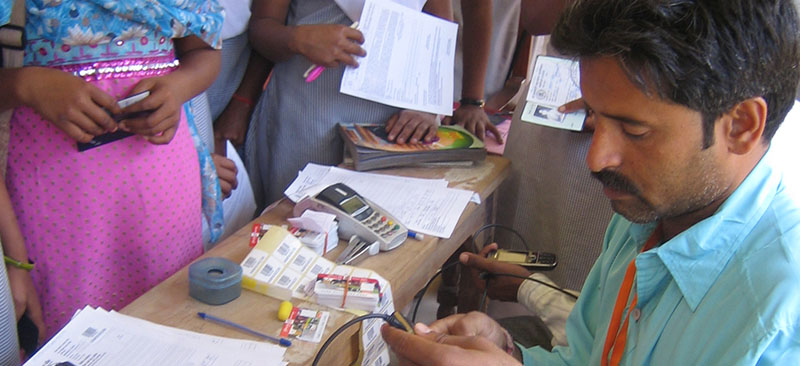
The hugely ambitious, policy initiative of transferring the vast majority of central and state government benefits, entitlements and subsidies, as e-money, directly into the UIDAI Aadhaar linked accounts of the eligible beneficiaries was announced by the Prime Minister of India on the 26th of November 2012 at the first meeting of the National Committee on Direct Transfers.
Given the scope and scale of work involved and the rudimentary state of the agent network, and indeed the technology infrastructure needed, to make G2P happen in India, the work being contemplated is truly massive. MicroSave case studies on barriers and best practices in some of the UIDAI demonstration districts show that front-end processes are usually manual (even where technology could be effectively employed). They involve multiple hand-offs (often between unconnected departments, such as block officials to bank managers in the district, who have virtually have no reporting responsibilities to the district administration); lack clarity on ownership, roles and responsibilities; and have limited opportunities to learn from more optimal solutions that might have emerged elsewhere. The problem is further compounded by significant variations across districts in: (a) the level of maturity and automation (IT or technology enablement) within the state or the district, and within the specific beneficiary programmes; and (b) the motivation and ownership of the officials driving the programmes.
But there are important and laudable successes emerging, which we document in Aurangabad and in East Godavari; although East Godavari is also the site of experiences that highlight some of the many challenges that lie ahead.