
Term deposits are one of the most common means of investment across the world – this also holds true in the rural sub-districts of Java. A majority of rural clients prefer term deposits in commercial and rural banks because of the perceived guaranteed safety and assured return. This Note highlights the experiences of rural banks in mobilising term deposits, the issues and challenges they face, and the strategies adopted by them to revive their portfolio and growth. This therefore also offers an inadequately realised growth potential for rural banks. Rural banks can develop an edge over commercial banks to capture term deposits. BPRs offer higher interest rates, lower minimum deposits, usually do not charge penalties on early withdrawals, and have convenient local offices. However, to develop and maintain a competitive edge BPRs need to understand their target segments and fine tune their products, services, and marketing efforts. This calls for better market intelligence as well as committed and capable institutional resources.
BPR Arta Kencana – Loan Product Development for Onion Cultivators

Agricultural loans are amongst the most difficult to design and deliver. As part of its expanding operations in Indonesia, MicroSave worked with BPR Arta Kencana to design a loan tailored for the needs of onion cultivators Java. Based on the field research outcomes, a loan product prototype was designed to respond to clients’ preferred attributes such as competitive interest rate, easy collateral requirements, flexible repayment terms, simplicity in documentation, swift processing of loan applications etc. and to build in a savings component with an option for life insurance cover. The prototype also addressed situations of financial distress/crop failure. The design and testing process, as well as the final product itself, holds important lessons for all those involved in agricultural financing – across the globe.
Learnings on customer behaviour, product uptake and agent management
Deepak Chandnani, CEO of Obopay Inc., talks about their partnership with Nokia and their m-banking launch in India with Nokia Money three years ago. Nokia Money started out as a pilot in two cities and has now been rolled out to the National Capital Region.
Agent network for remittances and mobile wallets
David Hunter is the CEO of Ukash, a three-party payment scheme which allows people to buy products and services on the internet through e-commerce facilitated by Ukash merchants. Ukash has 3500 thousand merchants who are directly connected to their payment scheme and 420,000 locations where customers can buy Ukash vouchers across 51 countries.
David talks about the opportunity to leverage their agent network to offer wider financial services such as remittances and mobile wallets. He also discusses about competition in this space and shares experience of managing large and geographically widespread agent networks.
Customer adoption for mobile banking solutions
“Customer adoption has been one of the key challenges with most of the mobile banking implementations across the globe. Balachandran Unni, Director – Business Development for Nokia Money shares his learnings and experience on how to ensure customer adoption for a mobile banking solution. According to him, customer adoption has to a function of the following:
1. Product, which should be compelling and easy to use
2. Delivery, which channel and handset (mobile) agnostic
3. Customer service and education, through agents and call centre
Balachandran also discusses about how these functions have been incorporated in Nokia Money to ensure customer adoption.”
Is the Business Correspondent Model in Policy Paralysis?
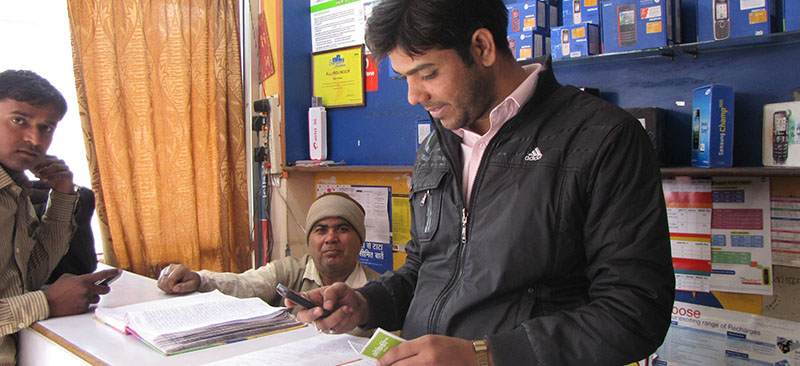
Banking regulations and government policies have been, and will continue to be, vital determinants of the progress of e/m-banking and the impact it can deliver, particularly for bank-led models. At times, however, there has been a blurred dividing line, and even tension, between the roles of the regulator, (as guardian of the interests of consumers and banking institutions), and activist governments (providing policy direction as the largest shareholder in public sector banks). This can lead to some undesirable consequences. This Policy Brief examines the recent shift in policy direction for the business correspondent model in India and the associated challenges and potential consequences from a consumer standpoint.
The new Business Correspondent Network Manager selection process using a reverse auction approach takes no notice of consumer needs and aspirations for a wider range of products, differentiated services, assured quality, and service continuity. Pricing is still fixed, and does not recognise consumer willingness to pay market driven prices for quality products and services. The prescriptive nature of the reverse tender documents blocks off all avenues for innovation, as well as remuneration according to real cost of delivery. This Policy Brief investigates the merits, demerits and challenges of this approach and potential consequences from a consumer standpoint. It highlights detailed scenario analyses of different BCAs’ current and prospective earnings in a range of situations – rural and urban for both individual and BCNM-managed agents. In all situations BCAs are likely to see (often significant) reductions in their already limited and precarious incomes – suggesting that agent churn (already in the range of 30-40%) is likely to further increase.