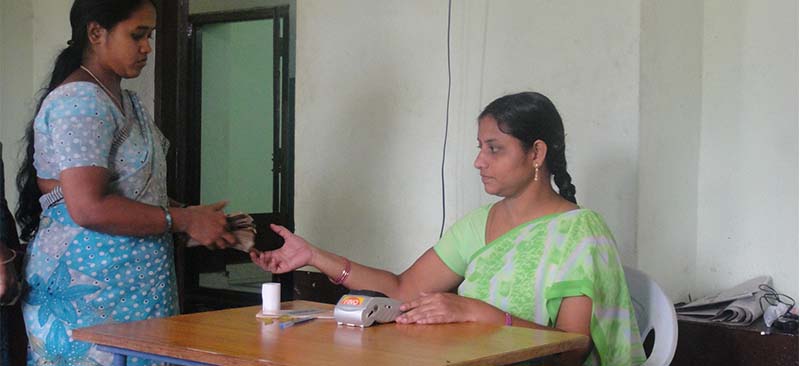
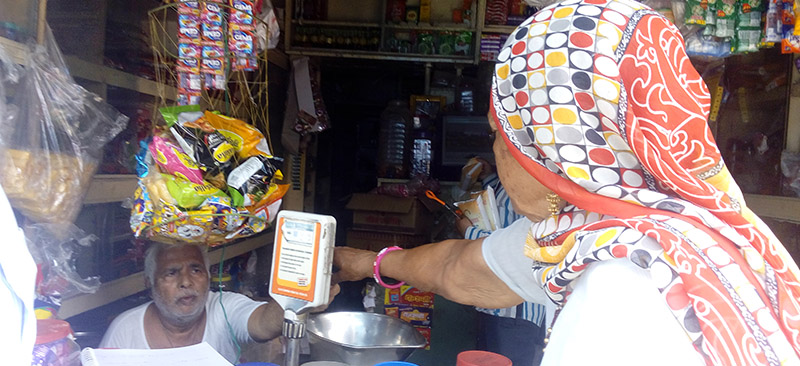
Agent dormancy is a cause of concern for financial inclusion. MicroSave recently conducted research to understand rural customers’ perception of dormancy, the challenges faced by them after an agent goes dormant and their coping mechanisms. The research was carried out in 12 districts across four states of India. This Note analyses the impact of agent dormancy on the financial behaviour of customers. Agent dormancy results in many negative impacts on the customers such as: customer account dormancy, inaccessibility of savings, challenges associated in reaching the bank branch and, as a result, a behavioural shift towards cash.
The next IFN – Agent Dormancy: Reasons and Remedial Measures- addresses the reasons for agent dormancy and the ways to address this issue.
Sheetal, a 41 year-old widow, is a vegetable hawker and lives by herself in Mumbai. She wanted to expand her business by adding more stock and buying a new wheel-cart. She has a bank account, opened under the Prime Minister’s Jan Dhan Yojana. She could not avail credit from her bank for lack of any collateral or transaction history. Indeed, she is not aware of the importance of transacting regularly through her account. She has, however, been remitting money through a Suvidhaa agent (a small grocery store owner) to her mother for the education of her daughters, studying in her native village. The agent recently informed her of the possibility of availing loan from Suvidhaa (and Axis Bank) and she decided to avail it. The agent checked her eligibility and agreed to her request within an hour. She walked out of the store with the loan disbursed on her pre-paid card account. The next day, she withdrew about a half of the amount at a nearby ATM, to buy more vegetables to sell. She plans to buy a new cart soon, by withdrawing additional cash from the same account. Sadly, very few of the poor like Sheetal have an opportunity or the benefit of getting credit from banks to meet their personal or business needs.
By providing relatively easy access to micro credit to over 28 million women clients, microfinance institutions play a vital role in partially democratising credit. Nevertheless, there is significant unfulfilled demand that is often met by informal sector moneylenders at exorbitant rates.
Meanwhile, Aadhaar has been enabling a silent revolution. To quote Nandan, “India has a unique opportunity to create a new and alternative credit infrastructure that can provide easy access to credit for millions of businesses and individuals, arising from the convergence of Aadhaar’s recent legislative legitimacy with regulatory innovation, technology and digitisation.”
(Source: iSpirt)
In addition to Aadhaar, the India Stack is likely to transform payments, financial services and consumer protection in India. The India Stack has four layers. The foundation presence-less layer is Aadhaar and its extension in the form of JAM trinity (Jan Dhan will 213 million accounts, Aadhaar that reaches 97% of the adults; and mobile with over 1 billion registered users and over 300 million smartphones). The paperless layer will leverage digital identity (e.g. eKYC, eSignatures) and a repository for digital documents (DigiLocker) for storage, sharing and other purposes.
The cashless layer is a range of systems and platforms that can enable seamless and low cost digital transactions for all segments of population. Aadhaar-Enabled Payments System (AEPS), Aadhaar Payments Bridge (APB) System and Immediate Payment Service (IMPS) are already handling over a 100 million transactions a month, with value exceeding INR 200 billion (as of February 2016). The recently introduced Unified Payments Interface (UPI) aims at democratising payments and enabling interoperability across a wide range of payment instruments, not just bank accounts. Bharat Bill Payments Service (BBPS) will enable utility bill payments for the mass market. The consent layer is on the lines of the OpenPDS (open personal data store) developed by Massachusetts Institute of Technology. The consent layer will give people access to a store for all their personal data; and to which they can allow selective access to others. This will ensure data privacy, reduce consumer fraud, enhance consumer protection and allow users to build a repository of their digital footprints to enable financial service providers to make informed decisions on products for them.
Innovators and early adopter service providers are leveraging the building blocks of the India Stack that are already available, to deliver innovative financial products and services. Suvidhaa, a financial service provider for the mass market, in collaboration with Axis Bank, was amongst the first to adopt e-KYC and roll it out across its retail points. Building on this, Suvidhaa introduced another innovative product ‘Nano Credit’ for mass-market consumers and small businesses that regularly transact at Suvidhaa’s retail outlets[1]. It is a term loan for a period of 18 months and with a ticket size of US$ 225. The interest rate charged is 22% per annum, with plans to lower it further. Nearly two-thirds of the borrowers so far have taken the loan for business purposes. The table below compares the typical ticket size, interest/fee rates charged and the common purpose for the loans.
Suvidhaa and Axis Bank are able to offer loan ticket sizes comparable to the microfinance sector, but at lower rates and with much quicker disbursement. Moreover, in the main, the loans are being availed of by customers who do not have access to credit from other sources, including from microfinance institutions. When benchmarked against global MFIs and the much lauded M-Shwari, the rates, ticket size, and processing time are (in the main) significantly better.
The factors that drive Suvidhaa’s superior offering are sophisticated, rapid credit scoring of applicants using a combination of a scoring algorithm with over 85 parameters (such as nature, frequency and ticket size of transactions; account balances; sending and receiving locations; sending agent coordinates) analysed from a financial transaction history of at least a year; e-KYC for customers; rapid appraisal by the bank team; credit bureau checks and digital disbursement through fully interoperable prepaid cards.
Going forward, Suvidhaa plans to leverage e-sign for customer consent and eliminate the process of authorisation with wet signatures. This will reduce the processing time by 15 minutes and enhance the convenience for clients even further. Efforts are underway to link directly with credit bureaus in India, which would allow Suvidhaa to then offer instant processing of loans for its customers.
In the three months of pilot to date, Suvidhaa has processed over a 1,000 loans and not one has arrears. All borrowers are called within two days of taking the loan to remind them of their obligations, that their loan is registered with credit bureaus and the implications of any default. Seven days before the monthly instalment is due, the system sends details of the amount due to the agent who originated the loan (and therefore receives commission on the basis of the borrower’s monthly repayment). This report encourages and helps agents remind customers that instalments will be automatically swept from their savings account, and thus it is important to ensure funds are available.
Suvidhaa and Axis bank are so pleased with the results of the pilot-test that they are already planning to scale-up the lending operations to 100,000 borrowers within a year, with a significantly larger roll-out, including into smaller towns and rural areas to follow thereafter. The overdraft variant, too, is all set to be launched and larger, business loans for the top 15% of Suvidhaa customers, who typically already have an e-KYC-enabled account. With 35 million customers, the majority of which have no other “digital footprint” beyond their transaction history with Suvidhaa, the organisation is well poised to leverage technology to democratise credit on a huge scale.
[1] People like Sheetal often do not have any digital footprints for lenders to be able to assess and evaluate the credit worthiness.
Let’s face it: we’ve all had problems with our bank or financial service provider; there have been times when we’ve sat across from a Customer Service Officer (CSO) and been unhappy about the answers we’ve been given. A few years ago, this very challenge led my colleagues and myself to think that there was a fundamental problem with how financial institutions respond to service issues – whilst staff are trained to respond with an appropriate attitude to customers, they are often incapable of addressing the underlying problem. Naturally, this leads to the problem reoccurring time after time. The fundamental challenge is not to respond nicely to customers – but to fix the underlying issue.
A decade has passed, and we’ve worked with as many as 20 financial institutions examining how they provide services to their customers, through an intensive workshop focused on management and staff perceptions of service delivery at the customer level. Our approach examines all aspects of service delivery, organised by the 8 Ps which are mnemonic for financial marketing: namely, People, Process, Price, Product, Promotion, Positioning, Place, and Physical Evidence. The workshop records the majority of service issues that workshop participants know occur frequently or that have significant impact. The difference is that with the issues appropriately collated, a strategy can be developed to resolve multiple service failings through a range of tailored actions.
Results can be significant! In one institution, the findings assisted with strategy improvements, which turned a significant loss to a significant profit in a single year. In a second bank, the findings contributed to changes in products and product strategies that significantly increased product usage and institutional profitability. In a third bank, the findings are informing and prioritising an ongoing process of change designed to deliver sustained improvements in service delivery.
The irony is how fast this process of discovery can be – the workshop and analysis takes a little more than a week, from start to finish.
So what are some of the highlights from our experience?
i. People: Most service issues are not created by the CSOs, and, as such, they do not have the ability to resolve many issues unassisted. To be effective, therefore, branch staff need to be able to categorise the issue and refer it to the most relevant person as efficiently and effectively as possible. Identified issues need to be addressed individually and. more importantly. Systemically, to ensure as far as possible that the identified issue does not recur.
Internal customer service: If external customer service is poor, the same can be said for the internal customer with slow service between departments – between operations and credit, between credit and legal, between operations and alternative business channels. Service Level Agreements are usually in place but they are simply not monitored and enforced.
Head office as an island: In institutions which truly seek to serve customers, they have advanced metrics for monitoring service, which they then match with the expectation that the senior management team actually visits branches. Mystery shopping is used to assess levels of performance. This level of interaction creates and reinforces a customer service culture. However, the reverse is often the case, with a gulf between head office and the branches.
Induction and training: Many financial institutions in Africa have a firm belief in the value of on-the-job training. No doubt this can be very cost effective, but it is unlikely to be effective unless the existing staff know what they are doing! For effective staff induction, training often needs to be increased, and institutions need to look more carefully at how they spend their scarce training budgets.
ii. Processes: Staff members usually follow a well-defined process, but what if the process itself is flawed, or on other occasions, new staff members do not know the processes they are supposed to follow? If a financial institution fails to regularly update and publicise its new procedures effectively – and then enforce process compliance, then many service issues will result. When Equity Bank worked on its procedures as long ago as 2003, and enforced process compliance – the income raised from ensuring process compliance on charging fees more than paid for the compliance function!
iii. Products: Products are an area of frequent confusion. It is hardly a surprise that members of staff who are not familiar with a new product or service are unable to sell effectively, or a product which has simply been copied from a competitor into a new context, fails to be taken up. Often, a poor product development approach is at fault, and the financial institution needs fewer products that respond well to market needs, than numerous individual products and services that can respond to every conceivable need.
iv. Pricing: Product pricing generally confuses customers. Our work clearly shows that there are pricing principles that should be adhered to; namely, transparency, fairness, and consistency. Pricing which comes up for criticism tends to break one of these principles. Every institution has examples of these: seemingly arbitrary lawyers’ fees, fees charged differently between branches in the same bank, and manually raised fees. Transaction-based pricing is often perceived to be fairer than ledger fees. Banking systems come in for criticism, too, for incorrect interest calculations or even for continuing to charge fees once loans have been completely discharged!
v. Promotion: If staff members are confused about products and services, then promotion and strategies around promotion are destined to under-deliver. Particular care needs to be taken not to over-promise and under-deliver. Of concern in mass retail financial services, particularly in developing countries, is the nexus between the head office marketing function (where marketing is envisioned) and the branches where customer-based marketing occurs. Branch-based marketing, developed locally, but supported by head office marketing departments, alongside centralised promotion initiatives, can significantly reinforce marketing effectiveness. The branch manager’s role is hugely important, both in conducting marketing to high net worth customers, and in conducting one-to-many marketing as well as in coordinating the marketing efforts of branch staff. However, our experience is that branch managers in our clients are rarely appointed for their business development or marketing skills, so they need help in the transition to a broader branch management role.
vi. Positioning: Many institutions are misaligned ― where the market positions the institution in a certain way, and the institution is driving it in another! A real-life example of this would arguably be K-Rep Bank in Kenya, which a few years ago was positioned by the market as a microfinance bank, and yet was spending significantly trying to move into corporate banking with limited success. Typically, positions evolve gradually and require coordinated brand building from the institution. Misalignment, whilst common, has a hugely detrimental impact on a financial institution, as it builds in non-delivery to customer expectations by design!
vii. Place: To be effective at serving customers, all channels should work! Systems should be stable, downtime should be minimised. Branches should be effectively used to communicate to customers and be well organised. Care should be given to optimise branches for peak customer loads. However, the reality is often different, with under-investment ― particularly in rural branches; limited, if any, communication material; systems which fail frequently; and branches which are poorly organised or inappropriately staffed.
viii. Physical Evidence: A financial institution sells intangible products ― we can’t touch financial services! Therefore, the physical collaterals which accompany the financial service need to provide customers with the assurance that they will be receiving quality service. Standards are important, yet frequently not set, or not kept – standards in clothing, in brochures, in use of language, in application of the brand, in infrastructure.
Once an institution has a more complete understanding of how it appears to its customers, that’s when the real fun begins. Driving forward the volume of customer-focused changes required to drive service excellence is an institution-wide, never-ending task. However, there is a huge and significant advantage of customer-focused change. It’s highly visible. It drives goodwill and builds the brand. It is, of itself, a cost-effective marketing approach.
This blog is titled, “Delivering Quality in Financial Services – Redefining Customer Service”. Financial institutions must take control of the quality of their financial services; to resolve issues permanently and not to rely upon explaining issues away!
There is a worldwide movement towards the use of Big Data[1] across many industries, including financial services. Many financial institutions in the South now have economists reporting to the Board, and a select few, including Equity Bank and Kenya Commercial Bank, have Chief Information Officers. Data warehousing is a common terminology, even if evident in few institutions; Fintech and technology-enabled services are current buzz phrases.
But, and this is a big BUT …
Despite this, it is remarkable how little use is being made of ‘small data’ ― the high level information that is directly available on a financial institution’s customer base, from the banking system itself. Let me give some examples.
A few years ago, a financial institution in East Africa had installed ATMs and was puzzled at why the machines were not being widely used. MicroSave asked the institution to compile basic data on usage and customer base. The data showed that of the institution’s customers, the vast majority were using the institution to repay loans, and, in fact, less than 10 per cent of the customer base was transacting regularly on their current or savings accounts or, indeed, maintained a balance to enable them to withdraw regularly. At the time, the institution wanted to move towards a large-scale advertising campaign, and our advice was simply to give cards to customers who maintained funds and/or transacted on their accounts, initially; and to follow up with targeted marketing campaigns at a later stage.
Whilst, in this case, it took some time to gather the data, it took just a few minutes to detect and then validate the patterns being shown in the data.
Shortly thereafter, another financial institution was preparing a strategy to significantly expand its services and was considering its delivery channel strategy, using a combination of branch and alternative channels. However, MicroSave’s data analysis showed that the institution had significant levels of dormancy across its network, but that it had a small, but very important, customer segment, which transacted regularly and maintained value in the bank. The initial strategy was focused on a mass market approach; however, data quickly showed that refining the value proposition for the small, minority of customers would probably provide quicker returns.
In a third example, a commercial bank was considering the case for major changes in its product strategy. It called in MicroSave for advice. Again we asked for data from the banking system. Data was prepared on product usage, dormancy levels, channel usage, and customer balances. The data showed that, whilst the institution was large and valued, it had growing dormancy, and some of its products and services were struggling to gain acceptance. The data revealed a need for more in-depth understanding: this led directly to targeted customer based research, which further demonstrated the need for product refinement. Core deposit liability products were refined and re-launched. Partly as a result of these strategic changes, within two years, the commercial bank was reporting record profitability and growth.
There are a number of key lessons in the examples above:
1. Simple data and trend analysis across a small range of indicators is sufficient to identify where to look, but analysing ‘small data’ is of itself, often, not enough. In the last case decisions were taken as a result of ‘small data’ to launch a more in-depth study, and it was this more in-depth study which led to the subsequent decisions on products and product delivery, which were to double profitability. However, it was the small data that helped to focus the research and take key decisions.
2. Many financial institutions are not using their own data to inform their strategic decisions. This remarkable observation means that even some large commercial banks are planning in a relative vacuum. With insufficient data, senior management teams in these institutions typically plan on the basis of their own perceptions about the institution and its client base, rather than an objective reality. This approach can result in confusion, misdirection and frequent changes of course – as perceptions change.
3. Significant expenditure can often be avoided; or better targeted, simply by trying to understand an institution and its market before taking key strategic decisions. Periodic system-based segmentation analysis should be conducted by every financial institution.
In India, over 100 agent network managers (ANMs) are delivering digital financial services (DFS). Till March 2015, more than 600,000 agents were associated with ANMs in India, covering 92% of the country’s villages. There is, however, wide gender disparity amongst agents in India. For instance, according to a CGAP report, in 2012, only 15% of DFS agents were women. This had further declined to 13% by 2013, and to a low of 9% by 2015, according to the ANA India Country Report of MicroSave’s The Helix Institute of Digital Finance.
In our previous blog, we mentioned that female agents create a reassuring environment for transactions – for both men and women. Thus, DFS providers might want to focus on female agents for acquiring more women customers and provide better customer experience to them. The blog presents key insights from the gender analysis conducted using MicroSave’s Market Insights for Innovations and Design (MI4ID) approach to understand variables influencing the achievement of a more balanced representation of female agents.
1. A female’s decision to become a banking agent is largely dependent on approval of her family, particularly her husband
For most women, their key decision maker is their father before marriage, and husband after marriage. As a result of this dependence on male family members, men are the major decision-makers of whether women become DFS agents or not. Most women become aware of the potential remuneration from acting as an agent as a result of interaction with the bank or provider’s staff responsible for agent recruitment and on-boarding. This income, together with the likely impact of the agency business on their familial responsibilities, is then discussed with family members.
2. The social acceptance of a female working as a banking agent is a key factor in determining her success in the agency business
To a large extent, the acceptance (as well as success) of female agents is dependent on social perceptions, which play a much more influential role for them, compared to their male counterparts. For instance, our research shows that most customers generally perceive male agents to be faster, more knowledgeable, updated (about product features), and less prone to commit errors in DFS business. Discussions with providers’ field staff show that they hold similar opinions. However, these may vary according to regional socio-cultural perceptions. A study conducted in the states of Rajasthan and Uttar Pradesh concluded that some other factors may be more pertinent.
On the basis of their (or others’) past experiences with aanganwadi, panchayat and self-help groups, extrinsic motivating factors, such as higher visibility, relationships and trust within society, play a larger role in motivating women to become agents. Also, it was usually observed that these female agents actually leveraged their past relationship with the bank and/or panchayat not only to become an agent, but also to get required support. However, in cases where women agents have no past association with the bank and/or panchayat, male agents continue to get better support from providers.
3. Familial responsibilities and societal norms limit the operational capabilities of women agents
Female agents with less/limited support from family members are expected to fulfil their household responsibilities before managing their DFS business. As a result, their operating hours are often shorter than those of their male counterparts. Female agents are also often limited by social norms in servicing customers in their own village, and requiring a male chaperone to visit the bank. In a few cases, family members also prohibit women agents from providing doorstep services to their customers, due to security concerns.
Due to these restricted operating hours and confined mobility, female agents often have a limited customer base. In addition, lack of/limited marketing support from providers(particularly for women) results in lower awareness amongst potential customers, thereby impacting the remuneration and motivation of women agents. Male agents, in contrast, are involved in extensive promotional activity, such as door-to-door campaigns, leveraging relationship with bank staff by using them to attract customers, etc. The restricted mobility also impacts frequency of liquidity rebalancing by women agents, who prefer to carry “more” cash and rebalance “only” during need.
4. Women agents have lower levels of engagement with banks compared to their male counterparts
Most male agents are also at an advantage in terms of their relationship with bank officials. This is primarily due to their ability to manage additional responsibilities (such as business facilitator, loan recovery agent, etc.) for the linked branch manager. As a result of this relationship, male agents not only get differentiated and enhanced bank support for DFS business, but are also (as a result) likely to earn more than their female counterparts.
Implications for DFS providers
DFS providers can use these insights and address the issue of lower representation of women agents in DFS business at two critical stages of their journey. First, at the entry phase, when a female enters DFS business; and second, as agents continue in DFS business. For this, providers would be required to:
1. Identify and provide reliable and tailored information for female agents as part of the recruitment and on-boarding process. This will provide potential agents and their families with sufficient information to take an informed decision on whether to become an agent or not.
2. Influence male family members to support female agents Males are the key decision takers for females intending to become agents. As a result, providers should engage with them directly, providing them with reliable information, and encouraging them to motivate female household members to become agents. Similarly, providers should work to ensure that males understand the importance of supporting female agents in their work, and how this can enhance their household income – thus securing the necessary family support for women agents.
3. Help female agents to enrol more customers As noted above, familial responsibilities and social norms act as major limitations to the operations of women agents. Due to these impediments, such women agents have reduced operational hours and limited mobility, and also lower customer base. In addition to encouraging male family members to support women in their agency business, providers will need to support them in acquiring more customers by enhancing ground level awareness, educating customers about various product and service offerings, and organising mass enrolment drives near agent’s locality.
As part of the Government of India’s pilots of Direct Benefit Transfer (DBT) for Targeted Public Distribution System (TPDS), MSC conducted three progress assessments. The assessments were conducted as follows: 1. Baseline: August 2015; 2. Mid-line assessment October 2015; and 3. Final in January 2016.
It was clear that the progress was chequered and a number of areas need to be streamlined before the pilot could be scaled up and implemented elsewhere. Our final assessment once again shows mixed results across the key indicators; 1) beneficiary awareness; 2) access to banking; 3) use of subsidy amount; 4) access to markets; 5) subsidy sufficiency; 6) grievance redressal.
As and when DBT in TPDS is to be scaled up, the following should be looked into: 1) DBT amount to be market linked; 2) access to markets and banking is ensured; 3) intimation to beneficiaries of subsidy transfer; 4) DBT to female account holders to avoid diversions.
This site uses cookies, by continuing your navigation, you agree with our Cookie Policy.