In this video, Donna Nails, former Deputy Director, Risk Management Department, ShoreBank Corporation, talks about the key components of credit risk management. Donna describes the reasons for credit risk management for financial institutions, the importance of monitoring of credit risk and setting up of credit risk tools and department before disbursing loans. She also discusses the three important tools of mitigation of credit risk namely, PAR Reports, Loan Reviews and Risk Rating of portfolio.
Blog
MIS in MFIs
In this video, Gautam Ivatury, Microfinance Specialist, Manager – Technology Program, CGAP, talks about the importance and implementation of Management Information System (MIS) in MFIs. Gautam also stresses upon the importance of involving people in the development process of MIS. He further talks about making the MIS adaptive to the future needs of the MFIs.
Capacity Building – Needs and Challenges in India
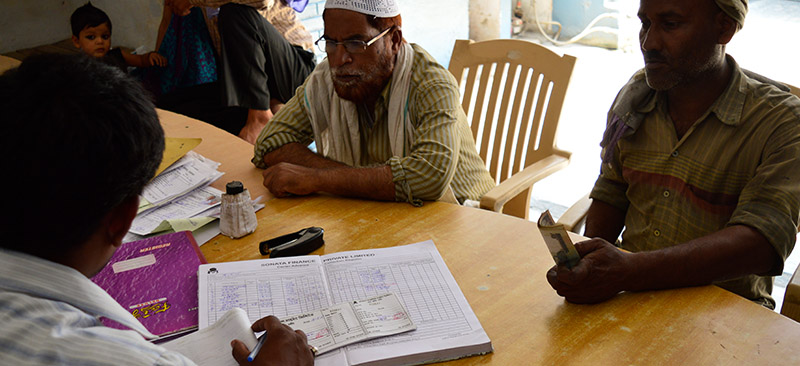
This IFN discusses some of the current trends and challenges faced by Indian microfinance institutions. The exponential growth coupled with efficient operating costs has attracted attention of venture capital funds and nationalised institutions to invest in Indian MFIs. However, this is also leading to a number of challenges, like limited access to finance, weak governance and lack of second line of leadership, inadequate integration of IT and E-banking solutions, competition and lack of social protection.
The IFN focuses on the single biggest challenge – capacity building, imperative to address the above mentioned challenges. It stresses on the need to invest in human capital and systems through capacity development encompassing both training and technical assistance. There is need for involving established service providers rather than relying on ad hoc in-house training competencies. Customised solutions to nascent/growing and expanding/mature MFIs are the need of the hour. Rural academic institutions need to focus on theory and real life case studies integration.
Discussing the demand side, the IFN highlights on less attention paid to training for senior management who are most often not considered for training. It is time that capacity building starts getting treated as an investment rather than expense. The IFN concludes by emphasising the need to focus on good governance, client focus and networking with other development institutions.
POS vs. Mobile Phone as a Channel for M-Banking

Given the functional capabilities and the multiple formats in which POS and mobile phones are used by financial service providers, this note focuses on the relative merits of the POS and the mobile phone in a branchless banking environment. This compares the benefits and drawbacks of these two key delivery channels, their strengths and weaknesses as well as the opportunities and threats inherent in the technologies.
Staff incentive schemes
In this video Martin Holtmann, Head of the Microfinance Unit in the IFC’s Global Financial Markets Department, talks about the staff incentive schemes typically followed by Microfinance Institutes (MFIs). Explaining the benefits of staff incentive schemes, Martin discusses various types of staff incentive schemes such as short-term monetary incentives and non-monetary incentives. Martin further explains that a mix of incentive schemes is suitable for today’s MFIs.
Costs and Benefits of Pilot Testing for Product Development

This briefing note emphasises on pilot testing as an important component of a new product development process which in turn helps institutions to become more viable and profitable. It explores lessons on the costs incurred, the benefits received and also draws experience from the MFIs that implemented the pilot testing process. It explains various costs—financial, non financial, psychological and reputation costs—associated with pilot tests. It also highlights the costs of failure and concludes with suggestions on lowering the costs of pilot testing.